 MineArchive
Midgeholme Colliery
| Also known as | Naworth Colliery, King Pit |
|---|---|
| Location | Midgeholme, east of Brampton, Cumbria — 54.9222, -2.5593 (approximate) |
| Commodity | Coal |
| Type | Coal |
| Worked | 1628 (first record)–1954 |
| Maximum depth | About 457 feet (Engine Pit, 1831, to the Midgeholme seam) |
| Operators | Naworth Collieries Co. Ltd (?–1947), National Coal Board (1947–1954), M. Thompson and Sons |
Overview
The collieries of the small Midgeholme coalfield on the Cumberland-Northumberland border, recorded from 1628, whose coal went out on the Brampton Railway, hauled in the 1830s by Stephenson's Rocket. Worked by the Thompsons and later as Naworth Colliery, they closed in 1953-54.
History
Coal was being mined at Midgeholme by 1628, in the largest of the small coalfields along the south side of the Tyne valley, a faulted outlier of the Coal Measures on the edge of the North Pennines. Large-scale working began in the 1820s; the Engine Pit was sunk from 16 May 1831 to the Midgeholme seam at about 457 feet. In the 1830s coal trains from Midgeholme Colliery were hauled along the Brampton Railway by Stephenson's Rocket. Mrs Maria Thompson held the colliery in the 1850s and M. Thompson and Sons in the 1860s, and there were coke ovens at Midgeholme in the later nineteenth century. On 6 June 1870 an explosion of gas killed two hewers, George and Robert Jackson. Plans for the King Pit's Cragnook and Wellsyke date from 1823; the Midgeholme and Lambley pits' seams were abandoned in 1888, and in 1893 the Wellsyke, Three Quarters, Low Main and Yard were given up as exhausted.
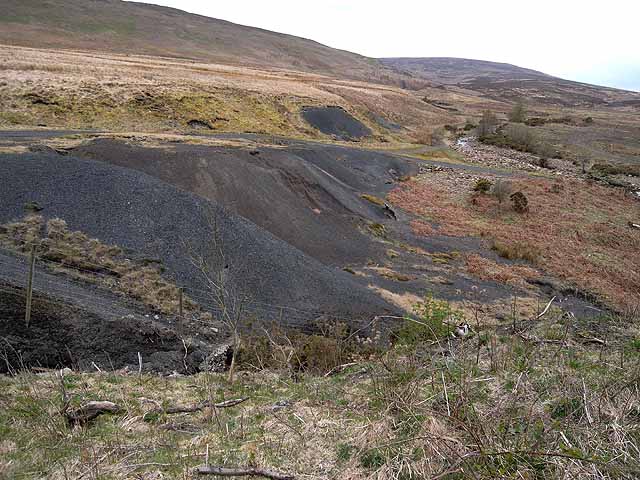
Several pits were reopened from the 1920s as Naworth Colliery, with the King Pit and the East, West, North and Wellsyke drifts working the Craignook, Little Limestone, Three Quarter, Low Main, Wellsyke and Cannel. The colliery employed 160 in 1940 and, as Naworth Collieries Ltd and then the National Coal Board's, 285 in 1952. The drifts closed between 1948 and March 1953, and the King Pit on 20 July 1954. Spoil heaps, bell pits, shafts and adits remain.
Geology
The Midgeholme Coalfield, Pennine Lower Coal Measures on the Stublick-Ninety Fathom Fault System: the Craignook, Little Threequarters, Wellsyke, High Main, Slag or Low Main, Yard, Cannel and Little Limestone, with ganister clay.
Workings
The Engine Pit (1831), the King Pit, and the East, West, North and Wellsyke drifts of the 1930s-50s; coke ovens; a washery; the Brampton Railway (Lord Carlisle's Railway).
Closure
The drifts closed in 1948-53 and the King Pit on 20 July 1954.
What remains
Spoil heaps, bell pits, shafts and adits remain; the old railway is a cycle track.
Spoil heaps by the Black Burn at the site of the colliery washery, bell pits, shafts and adits.
Redevelopment
Unknown.
Related mines
- Blenkinsopp Colliery — Both held by the Thompson family (M. Thompson & Sons) in the 1860s.
Nearby mines
- Roachburn Colliery — 1.7 miles (2.8 km) W
- Blenkinsopp Colliery — 4.0 miles (6.4 km) N, Northumberland
- South Tyne Colliery — 5.5 miles (8.9 km) NE, Northumberland
- Plenmeller Colliery — 6.2 miles (10.0 km) E, Northumberland
- Church Burn Mine — 6.9 miles (11.0 km) E, Northumberland
Straight-line distance, within 9 miles (15 km). Show on the map.
Recorded claims
Individual factual claims, each attached to the source(s) that support it below. Where sources disagree, both are kept.
- Coal was being mined at Midgeholme by 1628. 1,2,3
- In the 1830s coal trains from Midgeholme Colliery were hauled along the Brampton Railway by Stephenson's Rocket. 2
- The Engine Pit was sunk from 16 May 1831 to the Midgeholme seam. 4,5
- Several pits at Midgeholme were reopened from the 1920s and worked until 1953. 1,3
- The King Pit of Naworth Colliery closed on 20 July 1954. 4,6
Photographs & further reading
The Midgeholme collieries and drifts with their dates.
View sourcePits, owners, employment and those killed at the colliery.
View sourceSources
- (secondary) South Tyne Valley Coalfields - Northern Mine Research Society — Northern Mine Research Society
- (secondary) Midgeholme Coalfield — Wikipedia
- (secondary) Midgeholme — Cumbria County History Trust
- (primary) Midgeholme Colliery — Durham Mining Museum
- (primary) Midgeholme Colliery: Engine Pit shaft details — Durham Mining Museum
- (primary) Naworth Colliery — Durham Mining Museum
Record created: 4 October 2026 · Last researched: 4 October 2026