 MineArchive
Rumney Quarry
| Location | Rumney, Cardiff — 51.5028, -3.1327 (exact) |
|---|---|
| Commodities | Limestone, Sandstone |
| Type | Quarry |
| Worked | 19th century–1920s |
| Maximum depth | Unknown. |
Overview
Rumney Quarry worked one of the two inliers of Silurian rock that break through the younger cover in the eastern suburbs of Cardiff, the other being at Pen-y-lan. It was opened in the nineteenth century and its stone went for roads, feeding the city's Victorian expansion, before it closed in the 1920s. It is now a Site of Special Scientific Interest, and the workings serve as a public park.
History
The quarry was opened in the nineteenth century and the stone was used for roads. That is nearly the whole of its recorded industrial history: it closed in the 1920s, and nothing on record names who worked it, how many were employed, or how much stone came out. What survived the working is the exposure. The quarry cuts an inlier — a window of older rock surrounded by younger — of the Wenlock Group, and the faces it left behind are now a Site of Special Scientific Interest, valued for the Silurian strata they reveal and the fossils in them. The site doubles as a public park, and the former workings are laid out as open ground for the surrounding streets.
Geology
In south-east Wales, Wenlock strata crop out in an inlier in the suburbs of Rumney and Pen-y-lan in Cardiff, and again in the core of the anticline of the Usk inlier. At Cardiff the lowest strata are typically grey-green mudstones, calcareous and silty in places, with thin sandstone bands — the Pen-y-lan Mudstones. The sandstones are fine grained with planar bases and diffuse, wave-rippled tops, and the sequence holds a rich shelly fauna of late Wenlock (Homerian) age laid down in a shallow marine, mid-shelf environment; the sandstone and bioclastic limestone beds within it were probably storm induced.
Those mudstones are sharply overlain by a pebbly, cross-bedded, fine- to coarse-grained sandstone, the Rhymney Grit, which sits at the base of a further sequence of sandstone, siltstone and mudstone. It is the grit rather than any limestone that made the quarry commercially useful: a hard, gritty rock is what a road wants.
Geological setting: Sedimentary Beds and Seams (surviving physical example)
Workings
A surface quarry cut into the Silurian inlier on the eastern side of Cardiff. Nothing on record describes its plan, depth, plant or workforce; what is documented is the section it exposed, which is why the site is protected.
Closure
The quarry closed in the 1920s. No source gives a reason. A small hard-rock quarry inside a growing city has the usual difficulties — the city grows over it, and larger operations elsewhere supply the same stone more cheaply by rail — but that is not stated of Rumney anywhere consulted and is not asserted here.
What remains
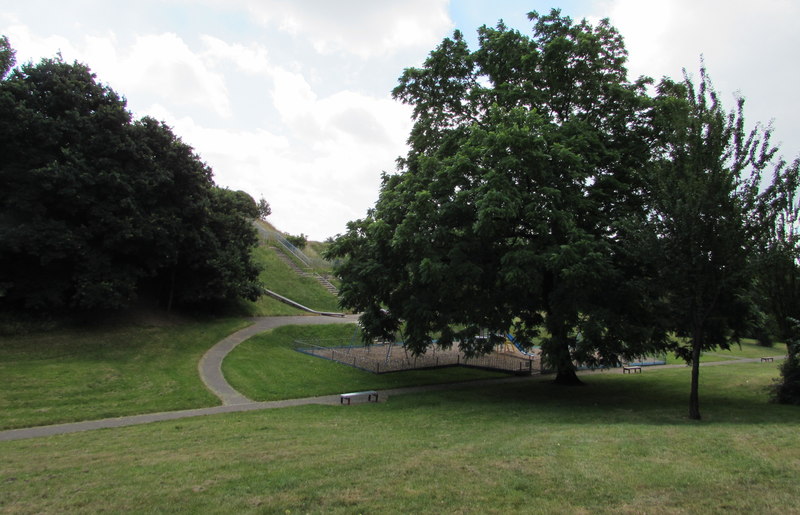
Protected and public. The disused quarry is a Site of Special Scientific Interest for the Wenlock Group facies it exposes, and the ground is laid out as a park, photographed as such in recent years.
The quarry faces themselves, which are the reason for the designation, within ground now used as a park. Nothing on record describes a surviving quarry building or structure.
Related mines
- Penylan Quarry — The two Cardiff quarries cut the same thing: a single inlier of Silurian rock breaking through the younger cover in the eastern suburbs, which the Geological Survey describes as cropping out at Rumney and Pen-y-lan together. Both were worked for stone in the nineteenth century and both are now Sites of Special Scientific Interest for what they exposed.
Nearby mines
- Penylan Quarry — 1.0 miles (1.6 km) W
- Rudry Colliery — 5.5 miles (8.8 km) N, Caerphilly
- Wenvoe Iron Mine — 5.7 miles (9.2 km) SW, Vale of Glamorgan
- Wenvoe Quarry — 5.8 miles (9.4 km) SW, Vale of Glamorgan
- Machen Colliery — 6.3 miles (10.1 km) N, Caerphilly
Straight-line distance, within 9 miles (15 km). Show on the map.
Recorded claims
Individual factual claims, each attached to the source(s) that support it below. Where sources disagree, both are kept.
- Rumney Quarry is a Site of Special Scientific Interest in Rumney, Cardiff; the area is a disused quarry which shows facies of the Wenlock Group, was opened in the 19th century with the stone used for roads, and closed in the 1920s. 1
- In south-east Wales, Wenlock strata crop out in an inlier in the suburbs of Rumney and Pen y Lan in Cardiff; the lowest strata are typically grey-green mudstones, calcareous and silty in places, with thin sandstone bands (the Pen y Lan Mudstones), holding a rich shelly fauna of late Wenlock (Homerian) age deposited in a shallow marine, mid-shelf environment. 2
- The Pen y Lan Mudstones are sharply overlain by a pebbly, cross-bedded, fine- to coarse-grained sandstone, the Rhymney Grit, at the base of a sequence of sandstone, siltstone and mudstone. 2
- The former quarry is now laid out as a park. 3
Photographs & further reading
The Survey's account of the Wenlock rocks of Wales, including the Cardiff inlier at Rumney and Pen-y-lan, the Pen-y-lan Mudstones and the Rhymney Grit that this quarry worked.
View sourceSources
- (secondary) Rumney Quarry — Wikipedia
- (primary) Wenlock Series, Silurian, Wales — British Geological Survey (Earthwise)
- (observational) Park in a former quarry, Rumney, Cardiff (photograph) — Geograph Britain and Ireland
Record created: 4 September 2026 · Last researched: 5 September 2026