 MineArchive
William Gill Colliery
| Location | Stonesdale Moor, near Tan Hill, North Yorkshire — 54.4429, -2.1317 (approximate) |
|---|---|
| Commodity | Coal |
| Type | Coal |
| Worked | By 1804–No reliable closure date has yet been located. |
| Maximum depth | No recorded depth has been found; a 2010 visitor judged the covered shaft to be at least 100 feet deep. |
Overview
William Gill Colliery is a small 19th-century coal pit high on Stonesdale Moor, at the eastern edge of the Tan Hill coalfield, where the Tan Hill Coal outcrops beside William Gill. Worked from shafts and a level, it is now a scheduled monument whose horse-gin circle, coal stores, coke oven and spoil tips survive around a still-open shaft.
History
Coal from the Tan Hill area was reaching Richmond as early as 1384, and coking was under way in the district by 1682, but it was in the 18th and 19th centuries, Historic England notes, that production peaked, with coke from numerous primitive beehive ovens feeding the growing lead industry. William Gill was one of the outlying pits of that trade. The Northern Mine Research Society records that in 1804 its coal, then 15 inches thick, was selling at 3.5d a corf, or tub. The coal here burned with a white, intense heat but would not coke, yet cinder ovens are shown at the site on the 1856 Ordnance Survey map. The pit was worked from shafts and a level, and the level was eventually stopped by water. No owner or lessee is named in the sources read, and no closing date has been found. The remains were scheduled on 29 April 1998.
Geology
The pit worked the Tan Hill Coal where it outcrops on the northern side of William Gill, on the eastern edge of the Tan Hill coalfield. The seam was 15 inches thick here in 1804. Unlike the strongly coking coal around Tan Hill itself, the William Gill coal burned hotter but would not coke.
Geological setting: Sedimentary Beds and Seams (surviving physical example)
Workings
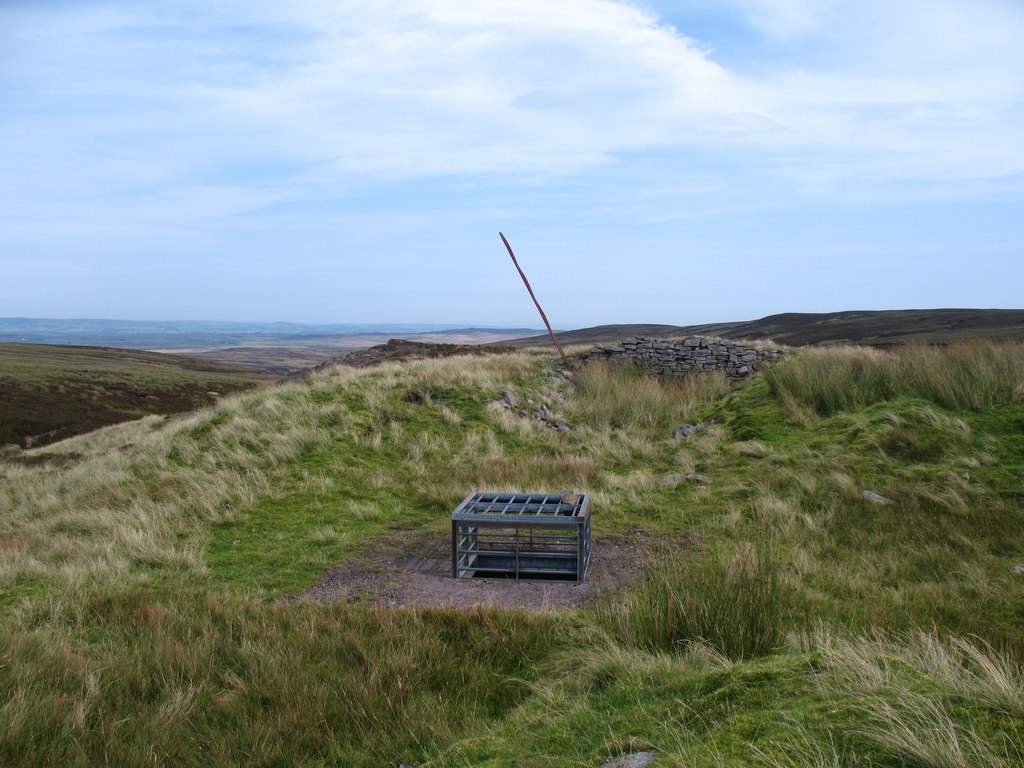
Shafts and a level; the level was eventually stopped by water. The main shaft, stone-lined in its upper part, was worked by a horse gin for both winding and pumping: its circular horse track, 8 m across, survives with two stone supports 3 m high on opposite sides that carried the gin superstructure. Two coal stores stood north-east and south-west of the shaft, and a coke oven on a lower terrace to the north, with long tips of mining and coking waste to the north-east and north-west.
Closure
No closure date or reason has been found in the sources read.
What remains
A scheduled monument (list entry 1018368). Geograph photographs from about 2010 and 2012 show the shaft capped with a metal grille, a free-standing drystone pier of the gin, and ruined walling on open moorland.
The shaft, the gin circle and its two stone supports, the remains of two coal stores and a coke oven, and long spoil tips of mining and coking waste.
Related mines
- Tan Hill Colliery — Both worked the Tan Hill Coal: William Gill on the coalfield's eastern outcrop.
Nearby mines
- Tan Hill Colliery — 2.0 km NW
- West Stonesdale Mine — 3.1 km SW
- Cleasby Mines — 4.5 km NE
- Sun Hush Mine — 4.5 km SE
- Swinnergill Mine — 5.2 km S
Straight-line distance, within 15 km. Show on the map.
Recorded claims
Individual factual claims, each attached to the source(s) that support it below. Where sources disagree, both are kept.
- In 1804 the William Gill coal was 15 inches thick and sold at 3.5d per corf or tub. 1
- The coal burned with a white, intense heat but would not coke, though cinder ovens appear on the 1856 Ordnance Survey map. 1
- The colliery was worked from shafts and a level, which was eventually stopped by water. 1
- The scheduled remains comprise the open, partly stone-lined shaft, an 8 m gin circle with two 3 m stone supports, two coal stores, a coke oven and spoil tips. 2
- Tan Hill area coal supplied Richmond by 1384 and coking was in operation by 1682. 2
- A visitor in about 2010 judged the covered shaft to be at least 100 feet deep. (uncertain) 3
- A photograph from about 2012 shows the covered shaft and other ruins at the site. 4
Photographs & further reading
Scheduling description of the shaft, gin circle, coal stores, coke oven and spoil tips.
View sourceShort account of the seam, the 1804 coal price and the cinder ovens.
View sourceSources
- (secondary) William Gill Colliery — Northern Mine Research Society (after M. C. Gill, British Mining No. 86, 2008)
- (primary) William Gill 19th century colliery on Stonesdale Moor (List entry 1018368) — Historic England
- (observational) William Gill Colliery (Geograph 2013242, Michael Graham) — Geograph Britain and Ireland
- (observational) William Gill Colliery (Geograph 3123182, Gordon Hatton) — Geograph Britain and Ireland
Record created: 13 September 2026 · Last researched: 13 September 2026