 MineArchive
Heol Senni Quarry
| Also known as | Gwar Heol Senni |
|---|---|
| Location | Afon Senni valley, near Heol Senni, Powys — 51.8871, -3.5783 (exact) |
| Commodity | Sandstone |
| Type | Quarry |
| Worked | from 19th century |
| Maximum depth | Unknown. |
Overview
Heol Senni Quarry stands on the hillside south-west of the hamlet of that name, in the valley of the Afon Senni just north of Fforest Fawr in the Brecon Beacons. It was quarried extensively in the nineteenth century for the Old Red Sandstone brownstones, and is now a Site of Special Scientific Interest for two reasons at once: the section it exposes through an ancient braided river system, and the fossil fish found in it. It is the only locality in the world at which the pteraspid Althaspis senniensis has been found.
History
Heol Senni is a hamlet in the valley of the Afon Senni just north of the Fforest Fawr section of the Brecon Beacons National Park; the Welsh name means the road by the river Senni, and reflects its position near the point where a minor road running between the A4067 and the A4215 crosses the water. The quarry is on the hillside to the south-west of the village, and was quarried for stone extensively in the nineteenth century. Nothing on record names who worked it, what the stone was used for, how many were employed or when it stopped. What is documented is what the quarrying exposed, and the site is now protected as a Site of Special Scientific Interest, which means fossils, stones and geological objects may not be collected or removed from it.
Its afterlife has been recreational as well as scientific. The quarry is used for paragliding, and is said to be excellent for thermalling and cross-country flying. Peregrine falcons nest on the higher ledges and foxes are sometimes seen; in 2001 two hounds from the local hunt, chasing a fox on a high ledge, fell to their deaths.
Geology
The quarry is of interest to geologists because of the non-marine Devonian rocks it exposes. The rock is brownstone, from the upper part of the Welsh Lower Old Red Sandstone, and consists of pebbly, cross-bedded sands laid down in a large braided river system. The exposure is good enough to allow the reconstruction of bar morphologies and river size, and to show the way channels were stacked vertically to build the sequence up — in other words, a section in which the shape of a Devonian river can still be read off the rock. Of the eastern brownstone outcrops in South Wales, Heol Senni is a fine example, showing how these loose, unconsolidated sediments were eroded, reshaped and redeposited over time.
The quarry is also of interest to palaeontologists, and for a stronger reason: it is the only locality at which the pteraspid Althaspis senniensis, an extinct jawless fish, has been found. A closely related pteraspid, Rhinopteraspis dunensis, has been found in a neighbouring quarry. Such finds are very rare in the Senni Beds.
Geological setting: Sedimentary Beds and Seams (surviving physical example)
Workings
A hillside quarry cut into the brownstone outcrop south-west of the village, worked extensively through the nineteenth century. Nothing on record describes the method of working, the plant, or how the stone was taken away.
Closure
The closure date is not known. The quarry was worked extensively in the nineteenth century and is disused now; nothing on record narrows it further.
What remains
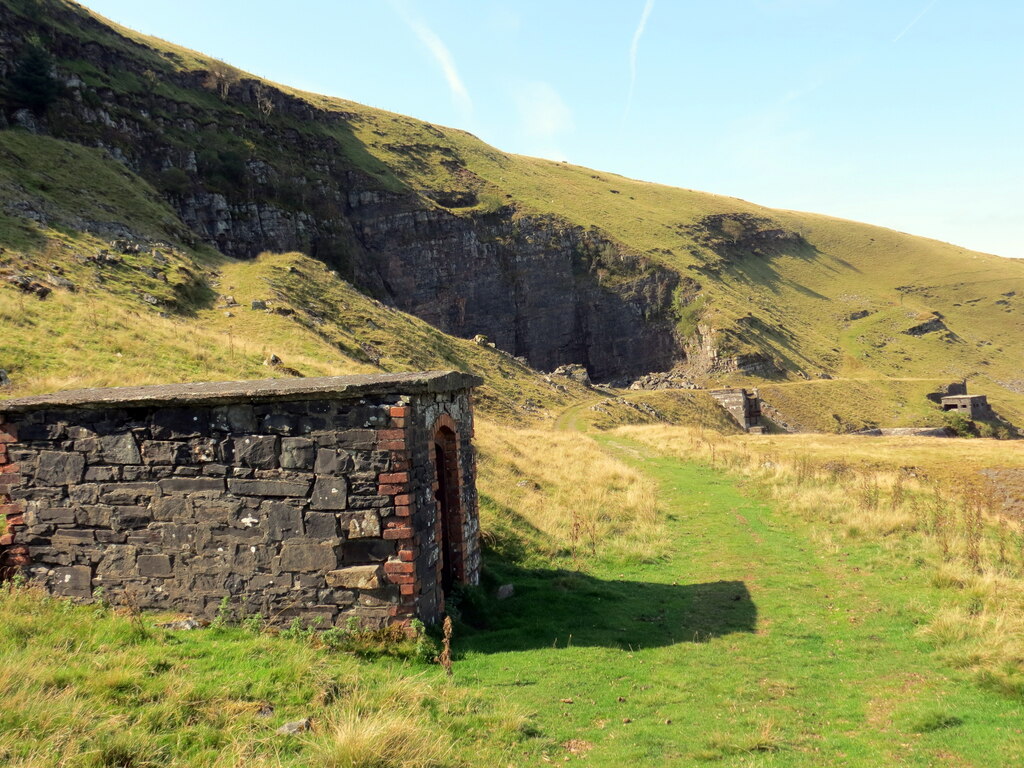
Disused and protected. The quarry is a Site of Special Scientific Interest, so no fossils, stones or geological objects may be collected or removed. Some of the quarry buildings survive. The faces are used by paragliders, who rate the site highly for thermalling and cross-country flying, and peregrine falcons nest on the higher ledges.
The quarry faces themselves, which are the reason for the designation, and the disused quarry buildings, which have been photographed.
Nearby mines
- Penwyllt Quarry — 5.8 miles (9.3 km) SW
- Abercrave Colliery — 8.3 miles (13.3 km) SW
- Glyn Neath Colliery — 8.4 miles (13.5 km) S, Neath Port Talbot
- Onllwyn Colliery — 8.4 miles (13.5 km) SW, Neath Port Talbot
- Maes Marchog Colliery — 8.5 miles (13.6 km) SW, Neath Port Talbot
Straight-line distance, within 9 miles (15 km). Show on the map.
Recorded claims
Individual factual claims, each attached to the source(s) that support it below. Where sources disagree, both are kept.
- Heol Senni Quarry is a disused quarry in Brecknockshire, Powys, and a Site of Special Scientific Interest because of the geological strata it reveals and the fossil remains found there; it is also used recreationally for paragliding. 1
- The quarry is on the hillside to the south-west of the village and was quarried for stone extensively in the nineteenth century. 1
- The exposed rocks are brownstones from the upper part of the Welsh Lower Old Red Sandstone, consisting of pebbly, cross-bedded sands formed in a large braided river system, and allow reconstruction of bar morphologies and river size and show how channels were stacked vertically to build up the sequence. 1
- Heol Senni Quarry is the only locality at which the pteraspid Althaspis senniensis, an extinct jawless fish, has been found; a closely related pteraspid, Rhinopteraspis dunensis, has been found in a neighbouring quarry, and such finds are very rare in the Senni Beds. 1
- Peregrine falcons nest on the higher ledges of the quarry and foxes are sometimes seen; in 2001 two hounds from the local hunt chasing a fox on a high ledge fell to their deaths. 1
- Disused quarry buildings survive at the site. 2
Photographs & further reading
The fullest available account of the site, covering the brownstone section, the pteraspid fossils found nowhere else, and the quarry's later use for paragliding.
View sourceSources
- (secondary) Heol Senni Quarry — Wikipedia
- (observational) Hen gwar Heol Senni / Disused Heol Senni Quarry (photograph) — Geograph Britain and Ireland
Record created: 4 September 2026 · Last researched: 5 September 2026