 MineArchive
Llanhilleth Colliery
| Also known as | Llanhilleth Steam Colliery, Llanhilleth Red Ash, Llanhilleth House Coal Colliery |
|---|---|
| Location | Cwmnantddu, Llanhilleth, Blaenau Gwent — 51.6951, -3.1285 (exact) |
| Commodity | Coal |
| Type | Coal |
| Worked | 1850s–1969 |
| Maximum depth | 375 yards. The No. 1 and No. 2 shafts, both deepened or sunk to the Black Vein by Partridge, Jones and Co., were 375 and 368 yards respectively. The original house coal shafts were far shallower: the old pit reached the Tillery seam at 200 feet and the new pit was 240 feet. |
| Operators | Powell Bros. (?–1889), Partridge Jones and John Paton (1889–1946), National Coal Board (1947–1969) |
Overview
A large Ebbw Fach valley colliery whose first shaft was sunk in the 1850s by W. Crook to the Tillery, or Red Ash, seam at only 200 feet. What made it substantial came later: Partridge, Jones and Co. took control in 1889, deepened the new pit to the Black Vein and sank a second shaft to the same seam, reaching 375 and 368 yards, and from 1892 the colliery produced fine quality steam coal. It ran two operations side by side, a small house coal pit and much larger steam pits, employing 1,809 people between them by 1908. The house coal pit was abandoned in 1946 and the colliery closed in 1969.
History
Llanhilleth's beginnings were modest. The first shaft, the old pit, was sunk in the 1850s by W. Crook on the eastern side of the railway line, reaching the Tillery seam, known locally as the Red Ash, at a depth of 200 feet. A second shaft, the new pit, followed in 1865 on the western side of the line, 240 feet deep, sunk to improve ventilation rather than to win new coal. Ownership passed to Powell Bros., and from 1879 to Henry Powell alone.
The transformation came in 1889, when Partridge, Jones and Co. Ltd took control. The company deepened one of the house coal shafts, the new pit, to the Black Vein, and added a third shaft, the No. 2, to the same seam on the eastern side of the railway. Nos. 1 and 2 finished at 375 and 368 yards. Coal production from the steam seams began in 1892. By the Inspector of Mines list for 1896 there were 813 men producing fine quality steam coal from the Black Vein.
The two halves of the colliery ran on different rhythms. House coal production stopped temporarily in 1896 when the company shifted it to the Hafod Van colliery, and was back by 1908, when 1,809 people were employed across the house coal and steam collieries together. In 1918 the Red Ash house coal pit had 77 men against 1,305 in the steam pits. A 1923 report gives 92 at the Red Ash working the Tillery seam and 1,212 at Llanhilleth Steam, producing from the Black Vein, Meadow Vein and Lower Black Vein. By 1945 the figures were 83 and 653.
Partridge, Jones and John Paton Ltd was formed in 1920 to amalgamate Partridge, Jones and Co. with seven other companies, and the collieries passed to the National Coal Board in 1947. Llanhilleth Red Ash was abandoned in 1946 and the colliery closed in 1969.
The record of death here is relentless rather than concentrated, which is why the colliery has no single disaster attached to its name. Welsh Coal Mines calls it a constant drip of death and lists, from a single decade, a boy of thirteen killed by a roof fall in 1899, a haulier run over by drams in 1904, a nineteen-year-old collier killed by a sprag in 1905, a thirteen-year- old dragged by the endless rope at the pit mouth after three weeks at work in 1906, the traffic manager killed at the shaft bottom by a falling piece of coal in 1907, and a fifteen-year-old killed by a fall of coal in 1910. The youngest to die at the colliery was not a worker at all: Elias Lewis, aged three, was struck by the endless haulage rope on the surface on 27 April 1895 and drawn into the framework of the pulley.
Geology
Llanhilleth worked the eastern side of the South Wales coalfield in the Ebbw Fach valley, where the house coals lie close to the surface and the steam coals far below them. The first shafts took the Tillery or Red Ash seam at 200 feet; the seams that made the colliery's reputation, the Black Vein at the Nine-Feet horizon, the Meadow Vein and the Lower Black Vein, lie in the steam coal measures of the Lower and Middle Coal Measures nearly 400 yards down. Working both from one site is why the colliery is returned in the Lists of Mines as two collieries, a house coal pit and a steam pit, for most of its life.
Geological setting: Sedimentary Beds and Seams (well documented example)
Workings
Three shafts in the end. The old pit of the 1850s stood east of the railway and the new pit of 1865 west of it, both shallow house coal shafts; Partridge, Jones deepened the new pit to the Black Vein and sank the No. 2 east of the railway to the same seam. Haulage on the surface and underground used an endless rope, which appears repeatedly in the fatality record, including the death of a three-year-old child drawn into the pulley framework at the surface in 1895 and of a thirteen-year-old boy at the pit mouth in 1906. Pithead baths were built and their derelict shell is the most visible thing left of the colliery.
Closure
The Red Ash house coal pit was abandoned in 1946 and the colliery as a whole closed in 1969, after nationalisation had brought it into the National Coal Board in 1947. Employment in the steam pits had already halved between 1923 and 1945, from 1,212 to 653. No account of the specific decision to close in 1969 is recorded.
What remains
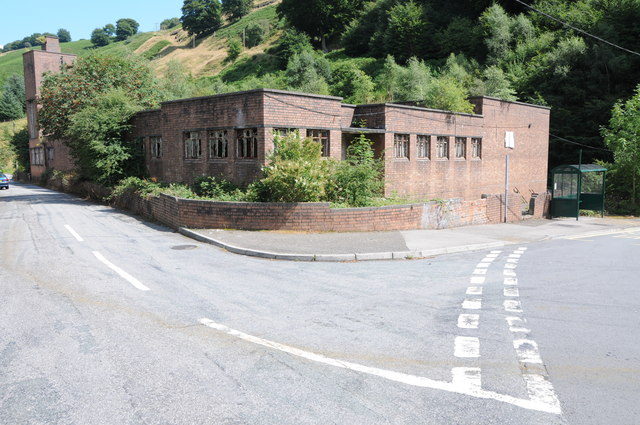
The colliery site between the High Street and the railway has largely reverted to open ground. The pit head baths survive as a substantial derelict building, photographed on Geograph and repeatedly visited and written up by urban explorers, most recently in reports from 2021. A memorial to the colliery stands nearby, reached by steps beside the baths and screened by bushes on the banking opposite; explorers' accounts describe it as easy to miss from the road.
The pit head baths are the principal survival, standing derelict. The colliery memorial stands close to them. Colliery Way, the road across the site, and its parking area take the name of the pit, and a further memorial stands in Granny's Wood above the site.
Related mines
- Hafod Van Colliery — In 1896 Llanhilleth's owners switched its house coal production to Hafod Van while Llanhilleth stopped for a time; both belonged to Partridge, Jones & Co.
Nearby mines
- Erskine Colliery — 0.6 miles (0.9 km) NE
- Aberbeeg South Colliery — 0.9 miles (1.4 km) SW, Caerphilly
- Navigation Colliery — 1.1 miles (1.7 km) SW, Caerphilly
- Blaencuffin Level — 1.1 miles (1.8 km) NE
- Pen-y-fan Colliery — 1.2 miles (1.9 km) NW
Straight-line distance, within 9 miles (15 km). Show on the map.
Disasters & major incidents
-
Llanhilleth Colliery Air Blast
10 March 1905 · Collapse / Roof Fall · 1 fatality
A rush of wind from a large fall of stone into a cavity at Llanhilleth Colliery injured seven men on 10 March 1905; the haulier Dennis Carroll died of his injuries a week later. First taken for a gas explosion, investigation found no trace of one. -
Llanhilleth Colliery fall of coal, 1907
8 March 1907 · Collapse / Roof Fall · 2 fatalities
At about one in the morning of 8 March 1907 a lump of coal seven feet across fell from the face in the Black Vein at Llanhilleth Colliery and killed two brothers, William and Walter Morgan, as they filled a dram. Welsh Coal Mines records that a 'bumper' shook the place; the Inspector found the overhanging coal had been held by a single sprag, totally insufficient, and noted that such falls had become more common at the colliery since the strike.
Culture
- Llanhilleth Miners' Institute (Learning)
The institute was built for the workmen of this colliery, out of a levy on their wages matched by its owners, and became a social club shortly before the pit closed.
Recorded claims
Individual factual claims, each attached to the source(s) that support it below. Where sources disagree, both are kept.
- The first shaft, the old pit, was sunk in the 1850s by W. Crook to the Tillery or Red Ash seam at 200 feet, east of the railway; a second shaft, the new pit, was sunk in 1865 west of the railway at 240 feet to improve ventilation. 1
- Partridge, Jones and Co. Ltd took control in 1889, deepened the new pit to the Black Vein and added a No. 2 shaft to the same seam east of the railway; the Nos. 1 and 2 shafts were 375 and 368 yards deep. By the Inspector of Mines list of 1896 there were 813 men producing fine quality steam coal from the Black Vein. 1
- House coal production ceased temporarily in 1896 when the company moved it to Hafod Van, and was back by 1908, when 1,809 men were employed across the house coal and steam collieries. In 1918 the Red Ash pit had 77 men against 1,305 in the steam pits; in 1923, 92 and 1,212; in 1945, 83 and 653. 1
- Llanhilleth Red Ash was abandoned in 1946 and the colliery closed in 1969. 1
- On 10 March 1905 Dennis Carroll, a collier of about 31, was fatally injured by an air blast, a rush of wind caused by a fall of stone into a large cavity that blocked the engine plane then being repaired. It was at first thought to be an explosion of gas but investigation proved conclusively that it was not. Six or seven other men were injured or trapped, one with both legs broken, and it took a day to bring them out. 1,2
- The BGS mine-plans catalogue holds a Mining Remediation Authority abandonment plan titled 'Llanhilleth' (catalogue SWA988, Lower Five Feet And Gellideg (Old Coal)., dated 1968). 3
Photographs & further reading
The fullest account located: the 1850s and 1865 sinkings and their depths, the Powell and Partridge Jones ownerships, the deepening to the Black Vein, employment figures for the house coal and steam pits from 1896 to 1945, the abandonment of the Red Ash in 1946 and closure in 1969, together with a long roll of individual deaths from 1895 to 1910.
View sourceOwners, output and employment by List of Mines year, and fifty-one named fatalities with the Inspector of Mines' account of the circumstances, including the 1905 air blast and the deaths of the Morgan brothers in 1907.
View sourceA photograph of the colliery's pit head baths standing derelict, the largest surviving structure on the site and the subject of repeated urban exploration reports.
View sourceSources
- (secondary) Llanhilleth Colliery — Welsh Coal Mines
- (primary) Llanhilleth Colliery — Durham Mining Museum
- (primary) BGS / Mining Remediation Authority mine plans: LLANHILLETH — British Geological Survey / Mining Remediation Authority
Record created: 10 September 2026 · Last researched: 10 September 2026