 MineArchive
Gedling Colliery
| Location | Gedling, Nottingham, Nottinghamshire — 52.9889, -1.0898 (exact) |
|---|---|
| Commodity | Coal |
| Type | Coal |
| Worked | 1899–1902–8 November 1991 |
| Maximum depth | 419–428 m (see shaft depth note) |
| Operators | Digby Colliery Company (1899–1947), National Coal Board (1947–1991) |
Overview
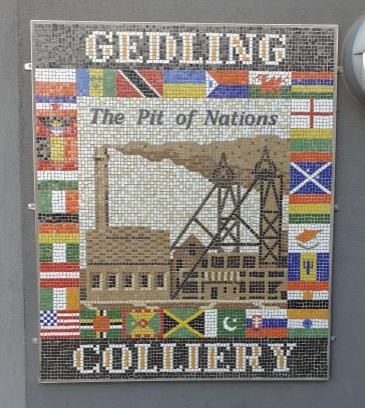
A Nottinghamshire colliery sunk by the Digby Colliery Company from 1899, worked for 89 years until 1991 and known from the 1950s as the 'Pit of Nations' for its unusually diverse workforce. The former site is now Gedling Country Park.
History
Gedling Colliery was sunk by the Digby Colliery Company between 1899 and 1902 at a site three miles east of Nottingham, where twin shafts 5.5 m (18 ft) in diameter were driven to work the Top Hard seam alongside the shallower High Hazels and Main Bright seams. Peak employment reached 3,746 in 1923, and from 1952 to 1969 the colliery exceeded a million tons of saleable coal a year in all but one season, reaching a maximum output of 1,156,995 tons in 1963; over its working life it raised more than 70,000,000 tons of coal. Nationalised into the NCB's East Midlands Region on 1 January 1947, the colliery was modernised through the postwar decades, replacing its steam winding engines with electric ones in 1970 using equipment from the closed Wellesley Colliery in Scotland, and in the late 1970s building an underground roadway — dubbed a 'motorway' — served by high-speed electric trolley locomotives to reach new working areas. From the 1950s to the 1980s Gedling became known as the 'Pit of Nations' for the diversity of its workforce, which over that period drew around thirty nationalities, including migrants from Eastern Europe and the West Indies; the colliery's NUM branch banner carried the words 'Brothers Beneath the Surface'. Designated a 'long life colliery' in the early 1980s, Gedling nonetheless saw its workforce reduced after 1988 as renewed working of the Main Bright seam ran into geological problems, and the colliery's final shift was worked on 8 November 1991, after 89 years of production that cost 135 miners' lives.
Geology
Coal of the Nottinghamshire field: the Top Hard and Main Bright seams early on, with the High Hazels the mainstay for most of the twentieth century.
Workings
Early working concentrated on the Top Hard and Main Bright seams, with the High Hazels seam becoming the mainstay for most of the twentieth century. A late-1970s underground roadway equipped with high-speed electric trolley locomotives, known at the pit as an underground 'motorway', was built to reach new mining areas as the colliery modernised.
Closure
Despite being classed a long-life colliery in the early 1980s, Gedling's workforce was cut back from 1988 as renewed working of the Main Bright seam ran into geological problems, and production ended with the final shift on 8 November 1991.
What remains
No colliery structures survive above ground; the former pit and its spoil heaps became Gedling Country Park, a 240-acre public park between Mapperley, Lambley and Gedling, which opened to the public in March 2015 after Gedling Borough Council took a 25-year lease and invested over £1 million in infrastructure, buying the land outright later that year.
Redevelopment
Park facilities added since opening include a children's play area with a mining-themed tower slide (2016), the Café 1899 visitor centre (2017), a Memorial Garden built partly from roof-support rings recovered from the workings and commemorating miners who died at the colliery, a 'Pit of Nations' mural (2019) depicting the colliery's multinational workforce surrounded by the flags of thirty nations, and the Holocaust Gardens (2023).
Related mines
- Digby Colliery — Both sunk and owned by the Digby Colliery Company: Digby (1866) was the company's original Giltbrook pit, and its profits went into sinking Gedling from 1899; the 1923 Colliery Year Book lists them together with New London.
- New London Colliery — Same owner: the Digby Colliery Company's profits from its Erewash pits went into sinking Gedling from 1899, after which Gedling dwarfed both.
- Wellesley Colliery — Gedling replaced its steam winding engines in 1970 using equipment taken from the closed Wellesley Colliery.
Nearby mines
- Calverton Colliery — 3.9 miles (6.3 km) N
- Bestwood Colliery — 4.1 miles (6.6 km) NW
- Newcastle Colliery, Basford — 4.3 miles (6.9 km) W
- Babbington Colliery — 4.8 miles (7.8 km) W
- Bulwell Colliery — 5.2 miles (8.4 km) W
Straight-line distance, within 9 miles (15 km). Show on the map.
Culture
- Gedling Miners Welfare F.C. (Sports)
Founded in 1919 as Gedling Colliery's works team and revived by the colliery in 1941 to raise wartime output; it plays on as Gedling Miners Welfare (Wikipedia; club history; Mapperley People).
What's uncertain
Points where sources disagree or the record could not be settled; both accounts are kept. All open questions in the archive.
- Sources give slightly different depths for the main seams: Gedling Borough Council's own history states 428 m (1,404 ft) to the Top Hard seam, while a separate account gives the High Hazels seam at 368 yards (337 m) and the Top Hard seam at 458 yards (419 m). (disputed) 1,3
Recorded claims
Individual factual claims, each attached to the source(s) that support it below. Where sources disagree, both are kept.
- Gedling Colliery was sunk by the Digby Colliery Company between 1899 and 1902, with twin shafts 5.5 m (18 ft) in diameter. 1,2
- Sources give slightly different depths for the main seams: Gedling Borough Council's own history states 428 m (1,404 ft) to the Top Hard seam, while a separate account gives the High Hazels seam at 368 yards (337 m) and the Top Hard seam at 458 yards (419 m). (disputed) 1,3
- Gedling raised more than 70,000,000 tons of coal over its working life, with peak annual output of 1,156,995 tons in 1963 and peak employment of 3,746 workers in 1923. 1,3
- From the 1950s to the 1980s Gedling was known as the 'Pit of Nations' for a workforce that, over that period, drew around thirty different nationalities, including migrants from Eastern Europe and the West Indies. 3
- Gedling Colliery's final production shift was worked on 8 November 1991, after 89 years of production that cost 135 miners' lives. 1,3
- The former colliery and its spoil heaps became Gedling Country Park, a 240-acre public park that opened in March 2015 after Gedling Borough Council leased and later purchased the land. 4
Sources
- (secondary) Gedling Colliery (1901 - 1991) — Gedling Borough Council
- (primary) BGS/Coal Authority mine plans catalogue: Gedling — British Geological Survey / Mining Remediation Authority
- (secondary) Gedling Colliery – The Pit of Nations — Mining Heritage
- (observational) Park History — Friends of Gedling Country Park
Record created: 26 August 2026 · Last researched: 26 August 2026