 MineArchive
Bestwood Colliery
| Location | Bestwood Village, on the Duke of St Albans’ Bestwood Park estate, Nottinghamshire — 53.0219, -1.1726 (exact) |
|---|---|
| Commodity | Coal |
| Type | Coal |
| Worked | 1870s–June 1967 |
| Maximum depth | Unknown. |
| Operators | Bestwood Coal and Iron Company |
Overview
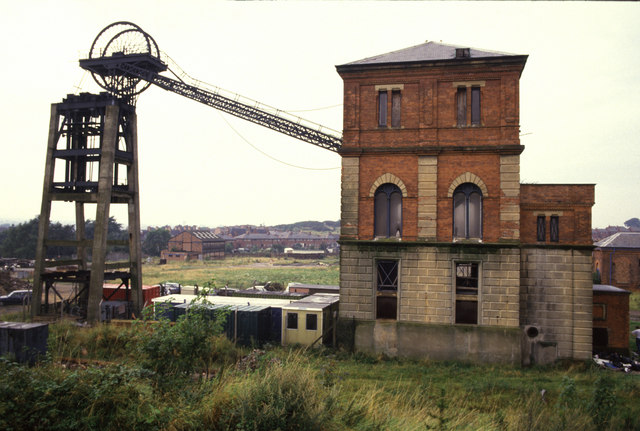
One of the largest collieries in the Nottinghamshire coalfield, developed by the Lancaster family on land at Bestwood Park belonging to the tenth Duke of St Albans. Production finished at the end of June 1967, but the winding engine was kept operable until 1971 and the colliery’s 1873 winding house and headstocks survive — listed Grade II*, built in an Italian Gothic style unusually ornate for a pithead, notable as an early use of structural concrete, and containing two single-cylinder vertical winding engines said to be the only in-situ example in Great Britain.
History
Bestwood Colliery was developed by the Lancaster family on land at Bestwood Park owned by the tenth Duke of St Albans, lord of the manor. Sources differ on the sinking: one dates the first shaft to 1875, while the archival record for the colliery period begins in 1872, and the listed winding house is dated 1873. It grew into one of the largest collieries in the Nottinghamshire coalfield, with a model village built alongside it. The winding house that survives was built in 1873 with late nineteenth-century additions: concrete and brick with stucco quoins and moulded brick and ashlar dressings, in an Italian Gothic style, with rusticated basement and pilasters, keystoned recesses and multi-keystoned double lancets. Inside are cast-iron stages with classical ornament, an ashlar winder stair with a square newel, latticed iron minor stairs and a matchboarded queen-post truss roof on corbels with ornate iron reinforcement, and in situ two single-cylinder vertical winding engines with overhead drum and brake gear. Outside stand trabeated concrete-clad headstocks with iron lattice stays, with their pulleys and cage guides still in place. Production finished at the end of June 1967. The winding engine was kept operable until 1971, and the winding engine house and Dynamo House survived to become part of Bestwood Country Park, developed from the mid-1980s; the winding engine house was restored and opened as an attraction in 1995.
Geology
The exposed Nottinghamshire coalfield on the western side of the county, where the Coal Measures come to the surface before dipping east beneath younger rocks — the older, shallower half of the field that was worked long before the great concealed-coalfield sinkings further east. Nothing is recorded of the individual seams worked at Bestwood.
Workings
The surviving winding house of 1873 is square on plan, two storeys over a basement, and holds two single-cylinder vertical winding engines with overhead drum and brake gear — an arrangement unusual in Great Britain, and said to be the sole surviving in-situ example. The headstocks outside are trabeated and concrete-clad with iron lattice stays, their pulleys and cage guides still in place. The building is notable for its early use of structural concrete.
Closure
Production finished at the end of June 1967. The winding engine was nevertheless kept operable until 1971, which is why it survives; the winding house and Dynamo House were taken into Bestwood Country Park from the mid-1980s and the winding house was restored and opened to visitors in 1995.
What remains
The winding engine house and headstocks stand in Bestwood Country Park, listed Grade II* since 1985, restored and opened as an attraction in 1995, with the winding engine preserved in situ and able to be turned slowly by an electrohydraulic winch. The Dynamo House survives with it.
The 1873 winding engine house and its concrete-clad headstocks, with the vertical winding engines, pulleys and cage guides in situ; the Dynamo House.
Redevelopment
Bestwood Country Park, developed from the mid-1980s over the colliery ground, with the winding house restored as a visitor attraction from 1995.
Related mines
- Calverton Colliery — Calverton's first shaft, sunk 1937-39, was an intake and man-riding shaft for Bestwood's Top Hard workings, reached by the Calverton Head driven from Bestwood.
Nearby mines
- Hucknall Colliery — 1.7 miles (2.8 km) NW
- Bulwell Colliery — 1.9 miles (3.0 km) SW
- Linby Colliery — 2.3 miles (3.7 km) NW
- Babbington Colliery — 2.8 miles (4.5 km) SW
- Watnall Colliery — 3.0 miles (4.9 km) W
Straight-line distance, within 9 miles (15 km). Show on the map.
Recorded claims
Individual factual claims, each attached to the source(s) that support it below. Where sources disagree, both are kept.
- The winding house and headstocks are listed Grade II*, dated 1873 with late nineteenth-century additions: concrete and brick with stucco quoins and moulded brick and ashlar dressings, in an Italian Gothic style, square on plan and of two storeys over a rusticated basement. 1
- Two single-cylinder vertical winding engines with overhead drum and brake gear survive in situ, with trabeated concrete-clad headstocks outside carrying their pulleys and cage guides; vertical winding engines are unusual in Great Britain and these are said to be the sole in-situ example. 1
- The building is notable for the early use of structural concrete. 1
- The colliery was developed by the Lancaster family on land at Bestwood Park owned by the tenth Duke of St Albans, and became one of the largest in the Nottinghamshire coalfield; production finished at the end of June 1967, though the winding engine was kept operable until 1971. 2
- The BGS mine-plans catalogue holds a Mining Remediation Authority abandonment plan titled 'Bestwood' (catalogue EM866, High Hazel, dated 1967). 3
Photographs & further reading
The statutory description of the 1873 winding house, inside and out, down to the queen-post roof and the two vertical winding engines still standing in it.
View sourceA local history of Bestwood and its colliery village, and what became of the pit and its engine after 1967.
View sourceSources
- (primary) Winding house and headstocks at Bestwood Colliery — list entry 1235186 — Historic England, via British Listed Buildings
- (secondary) Notts villages: Bestwood — Nottinghamshire History
- (primary) BGS / Mining Remediation Authority mine plans: BESTWOOD — British Geological Survey / Mining Remediation Authority
Record created: 7 September 2026 · Last researched: 7 September 2026