 MineArchive
Wolfcleugh Mine
| Location | Rookhope valley, between Redburn and Groverake, County Durham — 54.7700, -2.1400 (approximate) |
|---|---|
| Commodities | Lead, Fluorspar |
| Type | Metal |
| Worked | From 1818–1912 |
| Maximum depth | Unknown. |
| Operators | W. B. Lead Company (1818–1846), Weardale Lead Company (1901–1946) |
Overview
Wolfcleugh was a lead and fluorspar mine in the Rookhope valley in Weardale, lying between the Redburn and Groverake mines. Its reputation and its record do not match: the old accounts name it among the richest mines of the dale, but across the documented Beaumont period from 1818 to 1846 there is evidence of only 325 tons of galena. Its measurable output came later and in a different mineral, under the Weardale Lead Company between 1901 and 1912.
History
The Weardale mines belonged to the Bishopric of Durham, and the ground has a long tenurial history: in 1696 the mines were leased to the Blackett family and the ore was smelted by the London Lead Company. At the beginning of the nineteenth century that company leased a number of the mines while others went to Colonel Beaumont, and by 1809 they were producing enough ore to keep three smelters going. In 1821 there were thirty-six mines working in Weardale with a total production of 6,800 tons, and in 1836 the Ecclesiastical Commissioners took over the ownership from the Bishopric.
Wolfcleugh appears in those accounts as one of the rich ones. Records name Breckonsike and Wolfcleugh among the richest mines in the area — Breckonsike having produced 4,000 tons of ore in a single year — but there is little evidence supporting the alleged prosperity of Wolfcleugh. In the recorded period of Beaumont operations, between 1818 and 1846, there is evidence of only 325 tons of galena. Whatever wealthy past the mine may have had is not in the returns.
Its documented production is later. The Weardale Lead Company reopened the mine in 1901 and, up to 1912 when it was abandoned, produced 3,400 tons of fluorspar and 1,639 tons of galena — five times as much lead in eleven years as the Beaumonts are recorded as raising in twenty-eight, and more fluorspar than lead by weight. The 1914 List of Mines still enters Wolfcleugh in Weardale under the Weardale Lead Co. Ltd., two years after that abandonment. The company made a further attempt at the mine in 1946.
Geology
The Weardale orefield carries its ore in near-vertical veins cutting a Carboniferous sequence of limestones, sandstones and shales, richest where a vein crosses a competent bed. Wolfcleugh's production figures show the district's great reversal in miniature: galena was the object in the Beaumont years and fluorite the gangue thrown out with the deads, and by the Weardale Lead Company's reopening in 1901 the fluorspar was the larger product by weight. Nothing on record names the vein the mine was following.
Geological setting: Veins and Lodes (historical documentary reference)
Workings
Unknown. The mine lies in the Rookhope valley between Redburn and Groverake, and a reservoir at Wolfcleugh survives above the valley. Nothing on record describes the shafts, the levels or the dressing arrangements.
Closure
The mine was abandoned in 1912, after eleven years of working by the Weardale Lead Company. That company made a further attempt in 1946. The 1914 return still lists the mine under the company two years after the abandonment, which is a reminder that appearing in a statutory list is not by itself evidence of production.
What remains
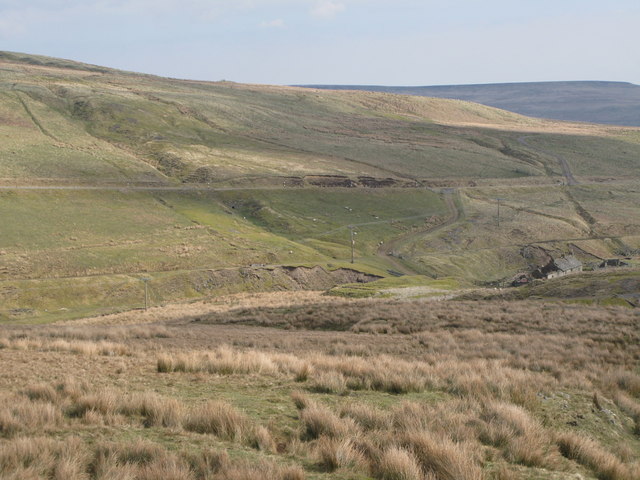
Long disused. The valley of Rookhope Burn near the former mine has been photographed, and Wolfcleugh Reservoir and the sheepfolds known as Wolfcleugh Folds survive on the ground above. Nothing on record describes surviving mine structures.
Unknown. Wolfcleugh Reservoir survives in the valley above the mine site, but nothing on record identifies it as mine infrastructure rather than a later water supply, and no source describes surviving mine buildings.
Related mines
- Groverake Mine — Neighbours in the Rookhope valley — Wolfcleugh lies between Redburn and Groverake — and both were held by the Weardale Lead Company and both were carried by it from lead into fluorspar — it reopened Wolfcleugh in 1901 for exactly the mineral that kept Groverake working long afterwards.
- Rookhope (Boltsburn Mine) — Both were Weardale Lead Company mines in the North Pennine orefield.
Nearby mines
- Brandon Walls Mine — 0.9 miles (1.4 km) SE
- Lintzgarth Mine — 1.2 miles (1.9 km) NE
- Redburn Mine — 1.4 miles (2.2 km) NE
- Stotsfield Burn Mine — 1.5 miles (2.4 km) E
- Slitt Mine — 1.6 miles (2.6 km) S
Straight-line distance, within 9 miles (15 km). Show on the map.
What's uncertain
Points where sources disagree or the record could not be settled; both accounts are kept. All open questions in the archive.
- The BGS mine-plans catalogue holds a Mining Remediation Authority abandonment plan titled 'Wolfcleugh' (catalogue OM15150, Fluorspar Lead Ore, dated 1955); the catalogue gives no location and the plan's details do not clearly tie it to this working, so it may belong to another of the same name. (uncertain) 4
Recorded claims
Individual factual claims, each attached to the source(s) that support it below. Where sources disagree, both are kept.
- Records name Breckonsike and Wolfcleugh as among the richest mines in the area, the former having produced 4,000 tons of ore in one year, but there is little evidence supporting the alleged prosperity of Wolfcleugh; in the recorded period of Beaumont operations between 1818 and 1846 there is only evidence of 325 tons of galena. 1
- The Weardale Lead Company reopened the mine in 1901 and, up to 1912 when it was abandoned, succeeded in producing 3,400 tons of fluorspar and 1,639 tons of galena; the company made a further attempt in 1946. 1
- The 1914 List of Mines records Wolfcleugh in Weardale under the Weardale Lead Co. Ltd. 2
- In 1696 the Weardale mines were leased to the Blackett family and the ore was smelted by the London Lead Company; at the beginning of the 19th century that company leased a number of the mines while others were leased by Colonel Beaumont, and by 1809 the mines were producing sufficient ore to keep three smelters going. In 1821 there were 36 mines working in Weardale with a total production of 6,800 tons, and the Ecclesiastical Commissioners took over the ownership from the Bishopric in 1836. 1
- The valley of Rookhope Burn near the former Wolfcleugh Mine has been photographed, with Wolfcleugh Reservoir above it. 3
- The BGS mine-plans catalogue holds a Mining Remediation Authority abandonment plan titled 'Wolfcleugh' (catalogue OM15150, Fluorspar Lead Ore, dated 1955); the catalogue gives no location and the plan's details do not clearly tie it to this working, so it may belong to another of the same name. (uncertain) 4
Photographs & further reading
A transcription of two technical articles working through the Weardale mines one by one, with the tenurial history of the dale and the production figures that undercut Wolfcleugh's reputation.
View sourceSources
- (secondary) Lateral Science: A Couple of North Pennines Lead Mine Articles from Mine & Quarry Engineering — Lateral Science
- (primary) 1914 List of Mines under the Metalliferous Mines Act: Durham — Durham Mining Museum
- (observational) The valley of Rookhope Burn near the former Wolfcleugh Mine (photograph) — Geograph Britain and Ireland
- (primary) BGS / Mining Remediation Authority mine plans: WOLFCLEUGH — British Geological Survey / Mining Remediation Authority
Record created: 5 September 2026 · Last researched: 5 September 2026