 MineArchive
Roman Gravels Mine
| Location | Worthen with Shelve, Stiperstones, Shropshire — 52.5928, -2.9861 (exact) |
|---|---|
| Commodity | Lead |
| Type | Metal |
| Worked | possibly Roman (c. AD 120)–1895 |
| Maximum depth | 80 fathoms below adit (New South Engine Shaft) |
| Operators | John Lawrence and Co. (1784–?), Lewis & Phillips (1825–1848), Roman Gravels Company Ltd (1870–1895), Grit and Gravel Company |
Overview
Roman Gravels, in the Shelve mining field of the Stiperstones hills, takes its name from Roman-period finds reported on the site — but its real claim to fame is the 1780s, when its operator became one of the first anywhere to install Boulton & Watt steam engines.
History
Known before about 1850 as Gravels or Shelvefield Gravels, the mine took the name Roman Gravels after 19th-century miners found earlier shafts containing pottery and wooden shovels, together with Roman coins and a lead ingot in the spoil, and Roman-style opencuts on the surface — evidence that the site was possibly first worked around AD 120. That evidence has been doubted: the Victoria County History (1908) thought the tools could as well be medieval, and Newman (2016) judged the lead pig unlikely to be genuine, reported as it was at about the time 'Roman' was added to the name and bearing the hallmark of a story to interest investors in the shares. Mining was certainly under way in the medieval period: the King's lead mine at Shelve was being worked in 1179, sheriff's records of the 12th century mention 'the King's miners at Shelve', and the mine supplied lead for Glastonbury Abbey in the 13th century. The mine's most notable period began in 1784 under John Lawrence and Co., who ran Roman Gravels alongside other mines in the Shelve field and were among the first operators anywhere to apply Boulton & Watt steam engines to mine drainage and winding: of nine such engines installed across the Shropshire orefield by 1800, three stood at Roman Gravels alone by 1790. Lawrence, who leased the sett from the More family, ordered a 24-inch Boulton & Watt pumping engine for Old Shaft in 1788; of the three engines, the last was an experimental suspended-beam design and another a 'blowing engine', presumably to supply a draught for smelting. Despite the investment, Lawrence abandoned the mine as unprofitable around 1820. Lewis and Phillips took the lease in 1825 together with the nearby Grit sett, and the mine was very productive in the mid-1830s before it declined and was abandoned in 1848; an attempt to reopen it in the 1850s by the partnership working the Pennerley and Ovenpipe (later Tankerville) mines was beaten by pumping costs, and it was an effort led by Richard Palin that succeeded. In the 1860s the new owners deepened the mine and found rich lead 65 fathoms below adit, installing a 40-inch Cornish pumping engine and a 15-inch winding engine at Old Shaft. In 1870 the public Roman Gravels Company Ltd was formed to raise funds, with Arthur Waters as its agent, and New South Engine Shaft was sunk 80 fathoms below adit in 1870–71; a 60-inch Cornish engine by Harvey's of Hayle went in there in 1877, when Waters also tried compressed-air rock drills with great success, and a compressor followed in 1878. In the 1870s the mine employed 200 men and its output was second only to Snailbeach's. Badly hit by the late-19th-century slump in lead prices, mining stopped in 1894 and Roman Gravels Company Ltd was liquidated in 1895.
Geology
The mine worked lead veins within the Shelve orefield of the Stiperstones hills, in the Mytton Flags according to Heathcote's 1979 survey. The ore was carried in a white 'rider' of calcite, which is what allowed it to be exposed and worked. Named veins include the Roman Vein, the First and Second North Veins, the Sawpit Vein and the Spring Vein; the dressing-floor spoil was of calcite, baryte and quartz, and the Mining Remediation Authority's abandonment plan records the workings as in lead ore and blende.
Geological setting: Veins and Lodes (well documented example)
Workings
The mine was worked from at least two engine shafts, Old and New (New South Engine Shaft), the latter sunk 80 fathoms below adit and served from 1877 by a 60-inch Cornish engine; three Boulton & Watt engines were in place at the site by 1790. The rich veins of the 1870s were worked along the 65 fathom level, and the Wood Level drained the mine from the 1780s. The veins were also opened from the surface in open cuts, the largest up to 10 m deep and 20 m wide on the Roman Vein; a Day Level ran from the Old Engine Shaft up the hill towards New Engine Shaft, and Boundary Shaft, on the First North Vein, was worked by East Roman Gravels' California engine.
Closure
Badly hit by the slump in lead prices, mining stopped in 1894 and Roman Gravels Company Ltd was liquidated in 1895, the year Historic England gives for the final closure. Other dates are recorded: the Mining Remediation Authority's abandonment plan gives 1 August 1892, the 1999 site investigation 1893, Heathcote's 1979 survey abandonments in 1912 and 1925, and the Shropshire Caving and Mining Club's 1994 survey working up to 1929.
What remains
The site was used for demolition practice during the war, according to a 1979 survey, and the white spoil heaps on the dressing-floor side of the road were removed in the 1990s. In 1999 a ground collapse over the Wood Level beneath the A488 prompted a site investigation of 16 shafts and 8 adits, which found that the dressing floor, with two waterwheel pits, probably survives beneath reworked spoil. An English Heritage condition survey in 2000 recorded the monument as fair.
The site has been a Scheduled Monument since 1999. The scheduling records a very large opencut up to 10 m deep and 20 m wide, with smaller cuts nearby; the New Engine shaft and its engine house, a collapsed slate building about 8.5 m by 4 m whose north wall stands about 2 m high; and, on a roadside platform, the Old Engine House where a Boulton & Watt engine was installed in 1788, a winding house with its engine bed and iron fixtures intact, offices, workshops and sections of tramway. Pump rods seen projecting from New Engine Shaft in the 1960s had slipped down it by 1979.
Related mines
- East Roman Gravels Mine — Genuinely distinct, separately operated mines sharing a closely similar name -- explicitly disambiguated in both records.
- Ladywell Mine — Lewis & Phillips worked both, and Ladywell's engine house was built in the mid-1870s to exploit the Roman Gravels galena seam.
- White Grit Mine — Lewis & Phillips took the leases of Roman Gravels and the nearby Grit sett together in 1825.
Nearby mines
- East Roman Gravels Mine — 0.3 miles (0.4 km) NE
- Tankerville Mine — 1.4 miles (2.2 km) E
- Pennerley Mine — 1.4 miles (2.3 km) SE
- Burgham Mine — 1.6 miles (2.6 km) E
- White Grit Mine — 1.8 miles (2.8 km) SW
Straight-line distance, within 9 miles (15 km). Show on the map.
People
- Arthur Waters · agent, from 1870 — Agent of Roman Gravels Company Ltd, who introduced compressed-air rock drills in 1877-78.
What's uncertain
Points where sources disagree or the record could not be settled; both accounts are kept. All open questions in the archive.
- The Roman evidence is disputed: the Victoria County History (1908) judged the tools could as well be medieval and the pottery and coins proof of nothing definite, a 1973 Ordnance Survey investigator found no evidence to substantiate a Roman date, and Newman (2016) considered the lead pig unlikely to be genuine. (disputed) 3
- Other closure dates are recorded: the Mining Remediation Authority abandonment plan OM3351 gives 1 August 1892, the 1999 Wardell Armstrong investigation 1893, Heathcote (1979) abandonments in 1912 and 1925, and the Shropshire Caving and Mining Club (1994) working up to 1929. (disputed) 4,3
Recorded claims
Individual factual claims, each attached to the source(s) that support it below. Where sources disagree, both are kept.
- Nineteenth-century miners found earlier shafts containing pottery, wooden shovels, Roman coins and a lead ingot, along with Roman-style opencuts, suggesting the site was possibly first worked around AD 120. 1
- John Lawrence and Co., who took over the mine in 1784, were among the first operators anywhere to install Boulton & Watt steam engines for mine drainage and winding; three of the nine such engines installed across the Shropshire orefield by 1800 stood at Roman Gravels. 2
- Before about 1850 the mine was known as Gravels or Shelvefield Gravels (Shelfield Gravels in I.A.Recordings), becoming Roman Gravels after Roman finds were reported in its workings. 1,2
- The Roman evidence is disputed: the Victoria County History (1908) judged the tools could as well be medieval and the pottery and coins proof of nothing definite, a 1973 Ordnance Survey investigator found no evidence to substantiate a Roman date, and Newman (2016) considered the lead pig unlikely to be genuine. (disputed) 3
- The King's lead mine at Shelve was being worked in 1179. 3
- John Lawrence ordered a 24-inch Boulton & Watt pumping engine for Old Shaft in 1788; of the three engines at the mine by 1790, one was an experimental suspended-beam design and another a blowing engine, and Lawrence abandoned the mine as unprofitable around 1820. 1,2
- Lewis and Phillips took the lease in 1825 with the nearby Grit sett; the mine was very productive in the mid-1830s and was abandoned in 1848. 1,2
- A first attempt to reopen the mine in the 1850s was defeated by drainage problems, and a later effort led by Richard Palin succeeded. 1,2
- In the 1860s new owners deepened the mine, found rich lead 65 fathoms below adit, and installed a 40-inch Cornish pumping engine and a 15-inch winding engine at Old Shaft. 2
- The public Roman Gravels Company Ltd was formed in 1870 with Arthur Waters as agent, and sank New South Engine Shaft to 80 fathoms below adit (1870 in I.A.Recordings, 1871 in Historic England). 1,2
- A 60-inch Cornish engine by Harvey's of Hayle was installed at New South Engine Shaft in 1877, when Arthur Waters trialled compressed-air rock drills; a compressor followed in 1878, one of the earliest such installations. 1,2
- In the 1870s the mine employed 200 men and its output was second only to Snailbeach's. 2
- Mining stopped in 1894 and Roman Gravels Company Ltd was liquidated in 1895; Historic England gives 1895 for the final closure, after the late-19th-century slump in lead prices. 1,2
- Other closure dates are recorded: the Mining Remediation Authority abandonment plan OM3351 gives 1 August 1892, the 1999 Wardell Armstrong investigation 1893, Heathcote (1979) abandonments in 1912 and 1925, and the Shropshire Caving and Mining Club (1994) working up to 1929. (disputed) 4,3
- The mine's veins lie in the Mytton Flags (Heathcote, 1979), with the ore carried in a white rider of calcite; the abandonment plan records lead ore and blende. 4,3
- Scheduled in 1999, the monument includes a very large opencut up to 10 m deep and 20 m wide, the collapsed New Engine house, and the Old Engine House of 1788 with a winding house, offices, workshops and tramway sections. 1
- The white dressing-floor spoil heaps were removed in the 1990s, and an English Heritage condition survey in 2000 recorded the monument as fair. 2,3
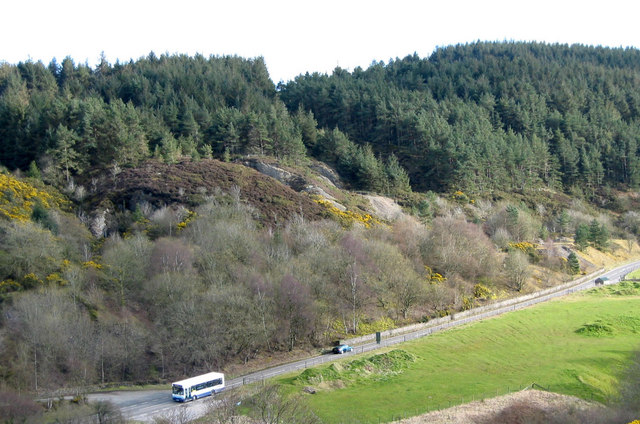
- A photograph of 2008 shows the old workings and spoil on the wooded hillside above the A488 at Gravels. 5
Photographs & further reading
Historic England's scheduling description of the opencuts, engine houses and buried remains, with the mine's history from the Roman period to 1895.
View sourceSources
- (primary) Roman Gravels lead mine, Worthen with Shelve — Historic England (Scheduled Monument record)
- (secondary) Roman Gravels Lead Mine — I.A. Recordings
- (secondary) Roman Gravels Mine (MSA1016) — Shropshire Historic Environment Record, via Heritage Gateway
- (primary) Roman Gravels, Engine Old and New (BGS Mine Plans Catalogue) — British Geological Survey / The Coal Authority
- (observational) Remains of old mines and spoil heaps (photograph, 2008) — Geograph (Dave Croker)
Record created: 22 August 2026 · Last researched: 18 September 2026