 MineArchive
Ladywell Mine
| Location | 850m north-west of Shelve Farm, Worthen with Shelve, Shropshire — 52.6050, -2.9095 (approximate) |
|---|---|
| Commodity | Lead |
| Type | Metal |
| Worked | 1830s–c. 1882 |
| Maximum depth | Unknown. |
| Operators | Lewis & Phillips (1830–1849), Ladywell Mining Company (1871–1882) |
Overview
A Stiperstones-orefield lead mine worked at the junction of the Ladywell and First New veins, whose 1875 beam engine house -- built for a venture that never turned a profit -- survives today as a Grade II listed ruin.
History
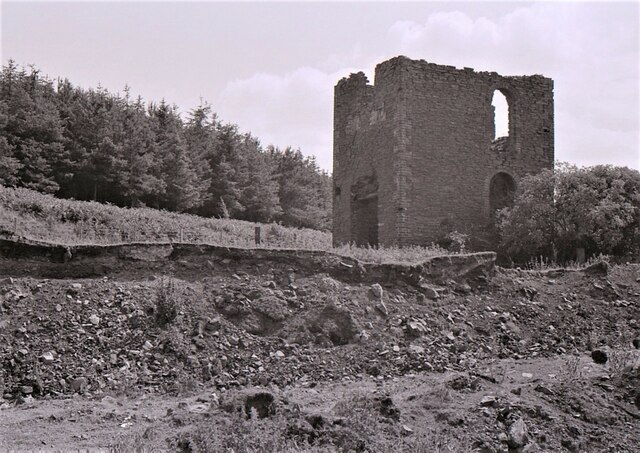
Ladywell Mine worked galena at the junction of the Ladywell vein and the First New vein in the Stiperstones orefield, where mineralisation runs through the steeply-dipping Mytton Flags above the Stiperstones Quartzite. It was first discovered and worked intermittently in the 1830s and 1840s by Lewis & Phillips, who also controlled the nearby Roman Gravels and Grit mines. Large-scale development did not follow until 1871, when the newly formed Ladywell Mining Company took on the site under the management of Captain Arthur Waters. In 1875 Waters had a rotative beam engine -- serving both pumping and winding -- installed in a purpose-built engine house of roughly coursed stone rubble with brick dressings to the corners and window surrounds, its distinctive round-headed flywheel slot in the south-western bob wall echoing similar houses the same operators built at East Grit and New Central Snailbeach. Despite this investment, Waters failed to find the rich lead veins the company had believed lay in the ground, and returns proved consistently poor; the Ladywell Mining Company went into liquidation and the mine closed around 1882.
Geology
Galena at the junction of the Ladywell vein and the First New vein in the Stiperstones orefield.
Workings
Worked galena at the junction of the Ladywell vein and the First New vein, latterly via an engine shaft served by a rotative beam engine used for both pumping and winding.
Closure
Closed around 1882 when the Ladywell Mining Company was liquidated after consistently poor returns.
What remains
The roofless 1875 engine house survives as one of the most visually striking ruins in the Stiperstones orefield, its round-headed flywheel slot still visible in the south-western wall; it is Grade II listed and a Scheduled Monument, with conservation work completed by the Shropshire Mines Trust.
The 1875 engine house, a stone-lined channel or pit marking the former winding drum's position, and a capped mine shaft, all scheduled as archaeological monuments.
Related mines
- Roman Gravels Mine — Lewis & Phillips worked both, and Ladywell's engine house was built in the mid-1870s to exploit the Roman Gravels galena seam.
Nearby mines
- Perkinsbeach Mine — 0.3 miles (0.5 km) S
- Myttonsbeach Mine — 0.4 miles (0.7 km) S
- Snailbeach Mine — 0.8 miles (1.4 km) NW
- Potter's Pit — 1.2 miles (1.9 km) SW
- Gatten Mine — 1.2 miles (2.0 km) S
Straight-line distance, within 9 miles (15 km). Show on the map.
Recorded claims
Individual factual claims, each attached to the source(s) that support it below. Where sources disagree, both are kept.
- Ladywell was first discovered and worked intermittently in the 1830s and 1840s by Lewis & Phillips, who also controlled the nearby Roman Gravels and Grit mines. 1
- The Ladywell Mining Company took on the site in 1871 under Captain Arthur Waters, who installed a rotative beam pumping-and-winding engine in 1875, but failed to find the rich lead veins believed to be in the mine; the company went into liquidation and the mine closed around 1882 for poor returns. 1
- The 1875 engine house is built of roughly coursed stone rubble with brick dressings to the corners and window surrounds, with a round-headed flywheel slot in its south-western wall; it is now a roofless, Grade II listed ruin and Scheduled Monument, alongside a stone-lined winding-drum pit and a capped shaft. 2
Photographs & further reading
The full listed-building description of the surviving engine house, its construction and Scheduled Monument status.
View sourceA dedicated feature page on Ladywell's history, its 1871-82 working life and the surviving 1875 engine house.
View sourceSources
- (secondary) Ladywell Lead Mine — I.A.Recordings
- (primary) Engine House at Ladywell Lead Mine (Historic England list entry 1018075) — Historic England (via Ancient Monuments mirror)
Record created: 31 August 2026 · Last researched: 31 August 2026