 MineArchive
Gatten Mine
| Also known as | Gatten Lodge Mine |
|---|---|
| Location | Gatten Lodge, about 2 km east of the Stiperstones ridge, Shropshire — 52.5870, -2.9061 (approximate) |
| Commodity | Barite |
| Type | Metal |
| Worked | c. 1887–1945 |
| Maximum depth | About 200 m on the vein |
| Operators | Shropshire Mines Ltd (1922–?), Malehurst Barytes Co. Ltd (1945–1945) |
Overview
A barytes mine on the crest of a spur about two kilometres east of the Stiperstones, begun in about 1887 by the landowner and worked down a vein of pinkish-white baryte to about 200 metres. It produced 9,272 tons between 1922 and 1944, was pressed into service in the 1940s to make up for Huglith's falling output, and was abandoned in the mid-1940s, by one account for its remoteness rather than any failure of the ore.
History
Mining at Gatten began in about 1887 under the landowner, Mr Hulton-Harrop, on ground whose minerals had been let before: in 1838 Samuel Smith took a general lease to mine minerals including barytes over 232 acres of the Gatten estate. The vein, pinkish-white baryte up to a metre wide, was worked from the surface down to about 200 metres. In 1915 the mine was active with a ladder shaft and a horse-worked shaft for raising the mineral, water being cleared by bailing. Its ownership is unclear through much of its history, but in 1922 it belonged to Shropshire Mines Co., which sank a shaft 170 feet and installed a steam winding engine; the barytes was hand-picked and taken to Pontesbury. Recorded output between 1922 and 1944 was 9,272 tons. In the 1940s Gatten was worked to supplement the falling returns from Huglith nearby, though it never produced enough to pay on its own account, and in 1945 the Malehurst company sank a vertical shaft but did little further work. The mine was abandoned in 1945, apparently because of its remote position rather than any falling off in the grade or width of the ore; another survey and the Mining Remediation Authority's abandonment plan give 1948.
Geology
A vein of pinkish-white baryte up to a metre wide, whose course shows at the surface as a line of hollows and rock faces along the crest of the hill. An older survey records the ground as Longmyndian sandstone, and the same record gives the Gatten Lodge quarry's stone as Precambrian Bayston-Oakswood Formation sandstone.
Geological setting: Veins and Lodes (well documented example)
Workings
An opencast working along the vein on the hill crest, with shafts: a ladder shaft and a horse-worked shaft by 1915, the 170-foot shaft of 1922 with its steam winder, and the vertical shaft sunk by the Malehurst company in 1945. In 1966 a level fifteen feet long was found leading to the top of a vertical shaft built for a double cage, its runners still in place; it was then flooded 75 feet down, and its original depth was probably at least 150 feet. A Shropshire Caving and Mining Club record of 1994 lists a filled shaft, a collapsed drainage adit, a winding engine base, a fuel tank base, two capped shafts, an intact magazine and an intact open stope. Three small open quarries nearby, mapped from aerial photographs, are thought to belong to the same lead-bearing ground.
Closure
Abandoned in 1945, apparently because of its remote location rather than failing grades or widths of ore, according to the Shropshire Historic Environment Record's desk study source. An earlier survey gives 1948, and the Mining Remediation Authority's abandonment plan for Gatten is dated 30 November 1948, which may mark the formal abandonment after work had stopped.
What remains
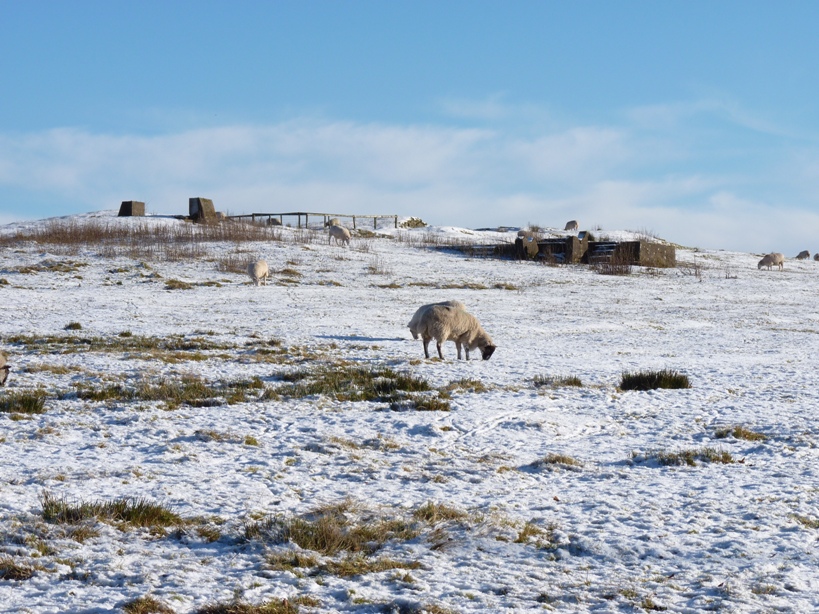
The site is pasture. Concrete bases and floors stand on the south-west side of the hill and a brick structure on the north-east, and the vein's course is a line of hollows and rock faces. There are no significant spoil heaps: a former landowner said waste was tipped into the workings, and in 1983 the remaining spoil was pushed into them and the site levelled. A walking survey in 2016 recorded concrete structures, earthworks and mine shafts on both sides of the lane west of Gatten Lodge, and photographs from 2002 and 2010 show the concrete remains on the open hilltop among grazing sheep.
Concrete bases and floors, a brick structure, a winding engine base and fuel tank base, an intact magazine, capped and filled shafts, and the hollows of the opencast along the vein.
Redevelopment
None: the site has been levelled and returned to pasture.
Related mines
- Huglith Mine — Worked in the 1940s to supplement Huglith's falling returns, and by the Malehurst company, Huglith's owner, which sank a shaft here in 1945.
Nearby mines
- Myttonsbeach Mine — 1.3 km N
- Perkinsbeach Mine — 1.6 km N
- Burgham Mine — 1.8 km N
- Ladywell Mine — 2.0 km N
- Potter's Pit — 2.1 km NW
Straight-line distance, within 15 km. Show on the map.
People
- Hulton-Harrop · landowner, from 1887 — The landowner under whom the mine began in about 1887.
- Samuel Smith · lessee, from 1838 — Took a general lease in 1838 to mine minerals, barytes among them, over 232 acres of the Gatten estate.
What's uncertain
Points where sources disagree or the record could not be settled; both accounts are kept. All open questions in the archive.
- The mine was abandoned in 1945, apparently because of its remote location rather than failing grades or widths of ore. (disputed) 1
- The mine was abandoned in 1948; the Mining Remediation Authority's abandonment plan is dated 30 November 1948. (disputed) 1,3
Recorded claims
Individual factual claims, each attached to the source(s) that support it below. Where sources disagree, both are kept.
- The mine began in about 1887 under the landowner, Mr Hulton-Harrop. 1
- Recorded output between 1922 and 1944 was 9,272 tons of barytes. 1
- In 1922 the mine was owned by Shropshire Mines Co., which sank a shaft 170 feet and installed a steam winding engine. 1
- In the 1940s Gatten was worked to supplement the falling returns from Huglith, but never produced enough to be profitable in its own right. 2
- The mine was abandoned in 1945, apparently because of its remote location rather than failing grades or widths of ore. (disputed) 1
- The mine was abandoned in 1948; the Mining Remediation Authority's abandonment plan is dated 30 November 1948. (disputed) 1,3
- In 1983 the spoil remaining on the site was pushed into the workings and the site levelled. 1
Photographs & further reading
The Gatten estate's mineral history, from the 1750s copper trials at Westcott to the barytes leases and workings.
View sourceThe concrete remains on the hilltop, with a note on the mine's 1940s working alongside Huglith.
View sourceSources
- (primary) Gatten Lodge Mine (Shropshire HER MSA1030) — Shropshire Historic Environment Record, via Heritage Gateway
- (observational) The surface remains of the Gatten barytes mine (photograph, 2010) — Geograph Britain and Ireland
- (primary) Abandonment plan OM14991, GATTEN (barytes), abandoned 30 November 1948 — BGS / Mining Remediation Authority mine plans catalogue
- (observational) Disused barite shaft, near Gatten Lodge (photograph, 2002) — Geograph Britain and Ireland
- (secondary) Minerals and Mining - The Valley of Gatten, Part 5 — Pollardine Farm (James Lawson)
Record created: 18 September 2026 · Last researched: 18 September 2026