 MineArchive
Rockingham Colliery
| Location | Birdwell, near Hoyland, South Yorkshire — 53.5041, -1.4700 (exact) |
|---|---|
| Commodity | Coal |
| Type | Coal |
| Worked | 1873–1875 (sinking)–20 November 1979 |
| Maximum depth | 355 yards (winding shafts), also given as 345 yards; the Hoyland Silkstone service shaft 508 yards |
| Operators | Newton, Chambers and Co. Ltd (1873–1947), National Coal Board (1947–1979), Earls Fitzwilliam of Wentworth Woodhouse |
Overview
A colliery at Birdwell, south of Barnsley, sunk by Newton, Chambers and Co. between 1873 and 1875 and worked for just over a century. It employed more than 1,500 people at its height, opened a drift mine at Skiers Spring in 1952, was merged with Wharncliffe Silkstone in 1967 and closed on 20 November 1979.
History
Rockingham Colliery stood at Birdwell, three and a half miles south of Barnsley. Newton, Chambers and Co., the Thorncliffe ironmasters, leased 1,200 acres of coal from Earl Fitzwilliam and sank the colliery between 1873 and 1875; a sinker, T. Pawson, was killed in February 1875 when he fell into the sump. The Durham Mining Museum counts three shafts sunk in those years. The Friends of Hemingfield Colliery describe two when it was first sunk, fifty yards apart: the No. 1 or South pit, the downcast, 16 feet across, and the No. 2 or North pit, the upcast, 15 feet across, both 345 yards deep to the Silkstone seam.
In 1876 the Inspector of Mines, Frank Wardell, called it a new colliery, one of whose shafts had only lately reached the Silkstone seam at about 350 yards, and reported three fatal shaft accidents there in quick succession. In one, on 30 September, an assistant banksman, Joseph Beaumont, pushed an empty corve into the side of the shaft where no cage was standing and followed it down. The self-acting gates were to have been fixed that same afternoon, and Wardell judged the bar put across the shaft mouth in their place too slight.
The pit was laid out with the newest plant of its day and equipped to make coke, and worked the Parkgate, Thorncliffe Thin and Silkstone seams; by 1894 it was raising 1,600 tons a day. Its 170 beehive coke ovens were drawn three times a week, making 1,500 tons of coke. The colliery sent out coking, household and steam coal in the 1890s, with gas coal as well from 1905. It employed 1,168 people in 1894 and 1,533 in 1910, when it was working the Parkgate, Silkstone, Thorncliffe and Fenton seams, and 727 in 1923. The Durham Mining Museum names 68 people killed there. Four roof falls each took two lives, in March 1884, October 1888, January 1898 and September 1901, and in October 1907 a filler, Albert Sykes, fell from the top deck of a three-decked cage in which fourteen men were being lowered to the Silkstone.
By 1933 the Fenton workings of the company's Thorncliffe Colliery had been joined in the seam to the Skiers Spring shaft at Rockingham. The National Coal Board took the colliery over in 1947, when 1,078 people raised 283,000 tons. A satellite drift mine was opened at Skiers Spring in 1952 to work shallow Swallow Wood coal, and by 1954 the colliery employed 1,561 in the Flockton, Haigh Moor, Lidgett, Low Fenton and Swallow Wood seams. A Coal Board leaflet of 1967 gave 1,680 men and 828,000 tons, with every face mechanised.
Rockingham was merged with Wharncliffe Silkstone Colliery in June 1967. After Smithy Wood Colliery closed in December 1972 the coal from Barley Hall Colliery was carried underground to Skiers Spring on its way to the processing plant at Smithy Wood. Rockingham closed on 20 November 1979, and the site served as a pumping station from 1982 to 1988.
Geology
South Yorkshire Coal Measures. The shafts reached the Silkstone seam at about 350 yards in 1876, and coal was later wound from the Flockton seam at 169 yards and from near the Thorncliffe at 301 yards. The colliery worked the Parkgate, Silkstone and Thorncliffe seams in 1905 and the Fenton as well by 1910. By 1954 it had moved to the Flockton, Haigh Moor, Lidgett, Low Fenton and Swallow Wood, and in 1967 it was working the Harley, Swallow Wood, Flockton Thick and Low Fenton and developing the Lidgett.
Geological setting: Sedimentary Beds and Seams (well documented example)
Workings
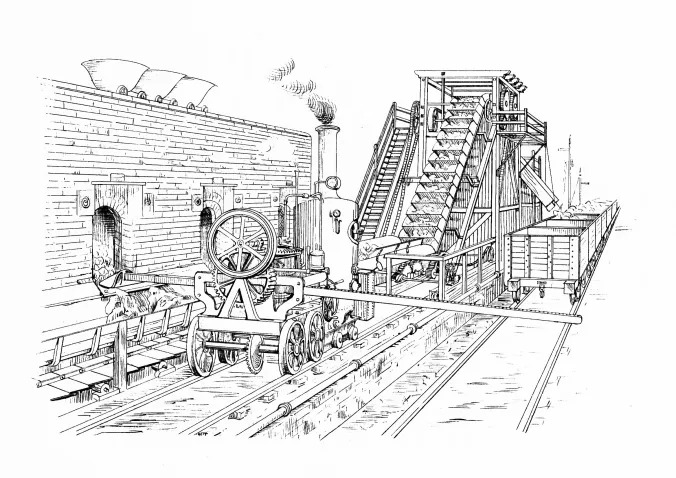
Three shafts were sunk in 1873–75. Two, 355 yards deep, wound coal, and a 508-yard shaft at Hoyland Silkstone served as a service shaft from the Top Fenton level. The two original shafts stood 50 yards apart, the No. 1 or South downcast 16 feet in diameter and the No. 2 or North upcast 15 feet. Each had a pair of vertical high-pressure winding engines with 3-foot cylinders and a 6-foot stroke, driving an 18-foot drum; the upcast engine drew only men and materials. A Guibal fan 45 feet in diameter and 12 feet wide, turning at 45 revolutions a minute, moved 190,000 cubic feet of air. Electric light was put in during 1894, a 105-volt dynamo feeding Swan incandescent lamps in the workshops, the engine house, the pit bank and the Silkstone pit bottom. In 1907 men rode to the Silkstone, 340 yards down the downcast shaft, in a three-decked cage. Underground the coal was moved by ponies and by endless-rope haulage; at the surface there were screens fed by creepers, coke ovens and a private branch railway. There were 170 beehive coke ovens, each 11 feet in diameter and 7 feet 6 inches high. They were emptied by a coke extractor of Chambers and Smith's patent, a vertical boiler, pump and winch running on rails along the front of the ovens, which cleared up to 25 ovens a day and delivered the coke to a 20-inch belt, elevators and jigging screens. A satellite drift mine at Skiers Spring worked shallow Swallow Wood coal from 1952. By 1967 every working face was mechanised.
Closure
Merged with Wharncliffe Silkstone Colliery in June 1967 and closed on 20 November 1979. The site was used as a pumping station from 1982 to 1988. Plans of the colliery's spoil tip are catalogued with an abandonment date of 1 February 1983.
What remains
Unknown.
Related mines
- Barley Hall Colliery — After Smithy Wood closed in December 1972 Barley Hall's coal was conveyed underground to Skiers Spring, part of Rockingham Colliery.
- Hoyland Silkstone Colliery — Hoyland Silkstone became part of Rockingham Colliery when it was discontinued in 1928, and its 508-yard shaft served Rockingham as a service shaft.
- Smithy Wood Colliery — Both Newton, Chambers and Co. collieries, grouped together by the Coal Board in 1962; Skiers Spring passed coal on to the processing plant at Smithy Wood after 1972.
- Tankersley Colliery — Both Newton, Chambers and Co. collieries on the Thorncliffe company's coalfield south of Barnsley.
- Thorncliffe Colliery — Both Newton, Chambers and Co. collieries; by 1933 Thorncliffe's Fenton seam workings were connected in the seam to the Skiers Spring shaft at Rockingham.
- Wharncliffe Silkstone Colliery — Rockingham was merged with Wharncliffe Silkstone Colliery in June 1967.
Nearby mines
- Hoyland Silkstone Colliery — 1.1 miles (1.8 km) E
- Wharncliffe Silkstone Colliery — 1.3 miles (2.0 km) SW
- Tankersley Colliery — 1.4 miles (2.3 km) SW
- Thorncliffe Colliery — 2.1 miles (3.4 km) S
- Elsecar Colliery — 2.2 miles (3.5 km) E
Straight-line distance, within 9 miles (15 km). Show on the map.
What's uncertain
Points where sources disagree or the record could not be settled; both accounts are kept. All open questions in the archive.
- Two shafts 355 yards deep wound coal from the Flockton at 169 yards and from near the Thorncliffe at 301 yards; a shaft at Hoyland Silkstone, 508 yards deep, was a service shaft. (disputed) 1
- When first sunk in 1874–5 the colliery had two shafts 50 yards apart, the No. 1 South downcast of 16 feet diameter and the No. 2 North upcast of 15 feet, both 345 yards deep to the Silkstone seam. (disputed) 8
Recorded claims
Individual factual claims, each attached to the source(s) that support it below. Where sources disagree, both are kept.
- Sinking started in 1873 and three shafts were sunk by 1875 for Newton, Chambers and Co. 1,2
- Two shafts 355 yards deep wound coal from the Flockton at 169 yards and from near the Thorncliffe at 301 yards; a shaft at Hoyland Silkstone, 508 yards deep, was a service shaft. (disputed) 1
- In 1876 the inspector reported three fatal shaft accidents in rapid succession at the new colliery, one of whose shafts had just reached the Silkstone seam at about 350 yards. 3
- The colliery employed 1,168 people in 1894, 1,533 in 1910, 727 in 1923 and 1,561 in 1954. 1
- In 1947 the colliery produced 283,000 tons with 1,078 people. 1
- A satellite drift mine at Skiers Spring was established in 1952 to work shallow Swallow Wood coal. 1
- By 1933 the Fenton seam workings of Thorncliffe Colliery were connected in the seam to the Skiers Spring shaft at Rockingham. 4
- After Smithy Wood Colliery closed in December 1972, Barley Hall coal was conveyed underground to Skiers Spring, part of Rockingham Colliery, for the processing plant at Smithy Wood. 5
- Merged with Wharncliffe Silkstone in June 1967 and closed on 20 November 1979; used as a pumping station from 1982 to 1988. 2
- Plans of the Rockingham spoil tip are catalogued with an abandonment date of 1 February 1983. 6
- Plans of the Silkstone, Parkgate and Thorncliffe Thin seams at Rockingham are held in the mine plans catalogue. 7
- Newton, Chambers and Company established the colliery in the 1870s on 1,200 acres of mineral leased from Earl Fitzwilliam. 8
- When first sunk in 1874–5 the colliery had two shafts 50 yards apart, the No. 1 South downcast of 16 feet diameter and the No. 2 North upcast of 15 feet, both 345 yards deep to the Silkstone seam. (disputed) 8
- By 1894 the colliery's output from the Parkgate, Thorncliffe Thin and Silkstone seams was 1,600 tons a day. 8
- The colliery was ventilated by a Guibal fan 45 feet in diameter and 12 feet wide, running at 45 revolutions a minute and producing 190,000 cubic feet of air. 8
- The colliery had 170 beehive coke ovens emptied by a Chambers and Smith patent coke extractor, with three full draws a week making 1,500 tons of coke. 8
- An electric lighting plant was put down in 1894, lighting the workshops, engine house, pit bank and Silkstone pit bottom. 8
Photographs & further reading
The museum's page for the colliery: owners, employment and seams from the Lists of Mines, a 1967 Coal Board description and the names of 68 people killed there.
View sourceThe Inspector of Mines' account of the banksman's fall down the new shaft on 30 September 1876.
View sourceHistory of the neighbouring Newton, Chambers pit whose coal came out through Skiers Spring after 1972.
View sourceAn account of the colliery as it stood in 1894, drawn from the mining press of the day: its shafts, winding engines, fan, electric light and coke ovens.
View sourceSources
- (primary) Rockingham Colliery — Durham Mining Museum
- (secondary) Coal Mines in Yorkshire 1854 onwards (R) - Northern Mine Research Society — Northern Mine Research Society
- (primary) Rockingham Colliery shaft accident, 30 September 1876 (Inspector of Mines' report) — Durham Mining Museum
- (secondary) Thorncliffe Colliery - Northern Mine Research Society — Northern Mine Research Society
- (secondary) Barley Hall Colliery - Northern Mine Research Society — Northern Mine Research Society
- (primary) Mine plan: ROCKINGHAM, spoil tip (feature 21870182) — British Geological Survey / Mining Remediation Authority mine plans catalogue
- (primary) Mine plan: ROCKINGHAM, Silkstone seam (feature 21838082) — British Geological Survey / Mining Remediation Authority mine plans catalogue
- (secondary) Pits: Rockingham Colliery — Friends of Hemingfield Colliery
Record created: 1 October 2026 · Last researched: 2 October 2026