 MineArchive
Wheldale Colliery
| Location | Castleford, West Yorkshire — 53.7311, -1.3325 (exact) |
|---|---|
| Commodity | Coal |
| Type | Coal |
| Worked | 1868 (sinking)–October 1987 |
| Maximum depth | six seam insets between 600 feet (Warren House) and 1,693 feet (Beeston) |
| Operators | National Coal Board (1947–1987) |
Overview
Wheldale, sunk at Castleford in 1868 and long nicknamed 'the doctor's pit' after one of its original investors, produced coal for 117 years and buried two of its own disasters along the way — a 1891 fire and a 1923 explosion that together killed fourteen men — before closing in 1987 as the last colliery in Yorkshire to use pit ponies and the last in Britain to run a steam locomotive on its sidings.
History
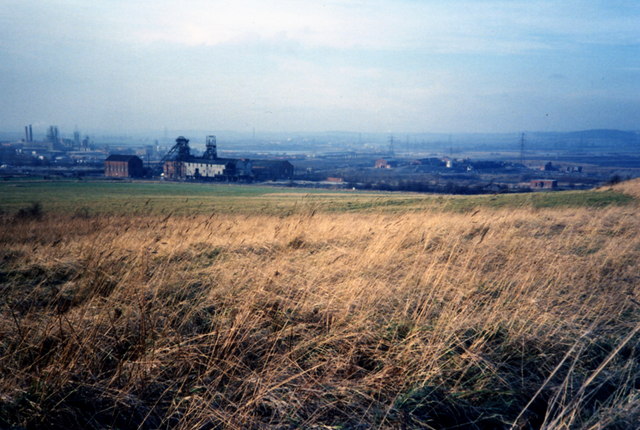
Wheldale Colliery was founded in 1868, when two 13-foot-diameter shafts were sunk to the Beeston seam at a depth of 564 yards; production began in 1870. One of the main investors was a Dr Holt, and for many years the colliery was known locally as 'the doctor's pit'. The Wheldale and Fryston coal companies amalgamated in 1899, and in 1919 Wheldale amalgamated in turn with Allerton Bywater colliery to form Airedale Collieries Ltd. Around 1,000 men and boys worked the mine, producing some 200,000 tons of coal a year. On 8 December 1891 a fire killed five men, and on 22 February 1923 an underground explosion killed nine more (see Disasters, below).
Nationalised in 1947, Wheldale was substantially modernised in 1949: fully electrified, fitted with skip winding and conveyor belts that included, at around a mile long, the longest single conveyor belt in the world at the time. Six seam insets eventually served the shafts, from the Warren House at 600 feet down to the Beeston at 1,693 feet. In 1972 Wheldale was the last colliery in Yorkshire still using pit ponies underground, and in 1982, the year it also set a record output of 500,000 tons, it became the last colliery in Britain to run a steam locomotive on its own sidings. Wheldale finally closed in October 1987; its shafts were left unfilled, and a coal-bed methane plant was later built on the site to convert gas still escaping from the old workings into electricity, generating 10MW — enough to power around 8,000 homes.
Geology
The mine worked Carboniferous Coal Measures of the West Yorkshire Coalfield through six seam insets: Warren House (600 feet), Haigh Moor (846 feet), Flockton Thick (1,135 feet), Middleton Little (1,300 feet), Silkstone (1,430 feet) and Beeston (1,693 feet).
Geological setting: Sedimentary Beds and Seams (well documented example)
Workings
Two 13-foot shafts served the colliery from 1868; a 1949 modernisation added full electrification, skip winding, and conveyor belts including, at roughly a mile long, the longest single conveyor belt in the world at the time.
Closure
Closed in October 1987; the shafts were left unfilled, and a coal-bed methane capture plant was later built on the site to convert gas still escaping the old workings into electricity.
What remains
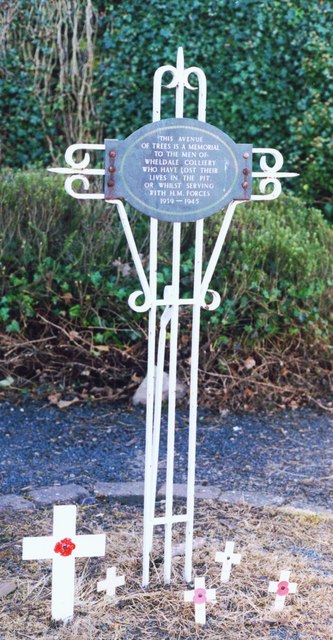
Little of the working colliery survives; a memorial cross made by the colliery's own blacksmith, William Wood, commemorates the men of Wheldale killed in the pit and those who died serving in the Second World War, and part of a winding wheel also survives on the site.
A memorial cross and part of a winding wheel survive on the site, alongside the later coal-bed methane capture plant.
Related mines
- Allerton Bywater Colliery — The Wheldale coal company amalgamated with Allerton Bywater colliery in 1919 to form Airedale Collieries Ltd, which held both pits until nationalisation.
- Fryston Colliery — Both were Airedale Collieries pits, and the connection was operational as well as corporate: Wheldale had no washery, so from the 1930s a mineral line carried its washing coal to Fryston, and after Fryston closed in 1985 Wheldale had to install a barrel washer of its own.
Nearby mines
- Fryston Colliery — 0.9 miles (1.5 km) NE
- Glasshoughton Colliery — 1.6 miles (2.6 km) S
- Allerton Bywater Colliery — 2.3 miles (3.7 km) NW
- Whitwood Colliery — 2.3 miles (3.8 km) W
- Methley Junction Colliery — 2.8 miles (4.4 km) W
Straight-line distance, within 9 miles (15 km). Show on the map.
Disasters & major incidents
-
Wheldale Colliery fire, 1891
8 December 1891 · Fire · 5 fatalities
A fire broke out in the engine plane of Wheldale Colliery's Silkstone Pit on 8 December 1891, killing five men overcome by smoke and fumes while trying to escape; the mine was ultimately flooded to bring the fire under control. -
Wheldale Colliery explosion, 1923
22 February 1923 · Explosion · 9 fatalities
An underground explosion in the Silkstone Seam's No. 2 District at Wheldale Colliery on 22 February 1923 killed nine men — one outright, the rest of severe burns — after the deputy's own shot ignited coal dust during ripping work.
Recorded claims
Individual factual claims, each attached to the source(s) that support it below. Where sources disagree, both are kept.
- Two 13-foot shafts were sunk in 1868 to the Beeston seam at 564 yards; production began in 1870. One of the main investors was a Dr Holt, giving the colliery its long-standing local nickname, 'the doctor's pit'. 1
- A 1949 modernisation fully electrified the colliery and installed skip winding and conveyor belts including, at around a mile long, the longest single conveyor belt in the world at the time. 1
- In 1972 Wheldale was the last colliery in Yorkshire still using pit ponies underground; in 1982, the year it also set a record output of 500,000 tons, it became the last colliery in Britain to run a steam locomotive on its own sidings. 1
- The colliery's shafts were left unfilled at closure; a coal-bed methane capture plant was later built on the site, converting gas still escaping the old workings into 10MW of electricity, enough for around 8,000 homes. 1
- The Wheldale and Fryston coal companies amalgamated in 1899; in 1919 Wheldale amalgamated in turn with Allerton Bywater colliery to form Airedale Collieries Ltd, which also owned Fryston, connected to Wheldale by an underground road. 2
- Located at about 53.731 N, 1.333 W. 1
Sources
- (secondary) Wheldale Colliery — Wikipedia
- (secondary) Wheldale Colliery Explosion - Castleford - 1923 — Northern Mine Research Society
Record created: 27 August 2026 · Last researched: 28 August 2026