 MineArchive
Wheldale Colliery explosion, 1923
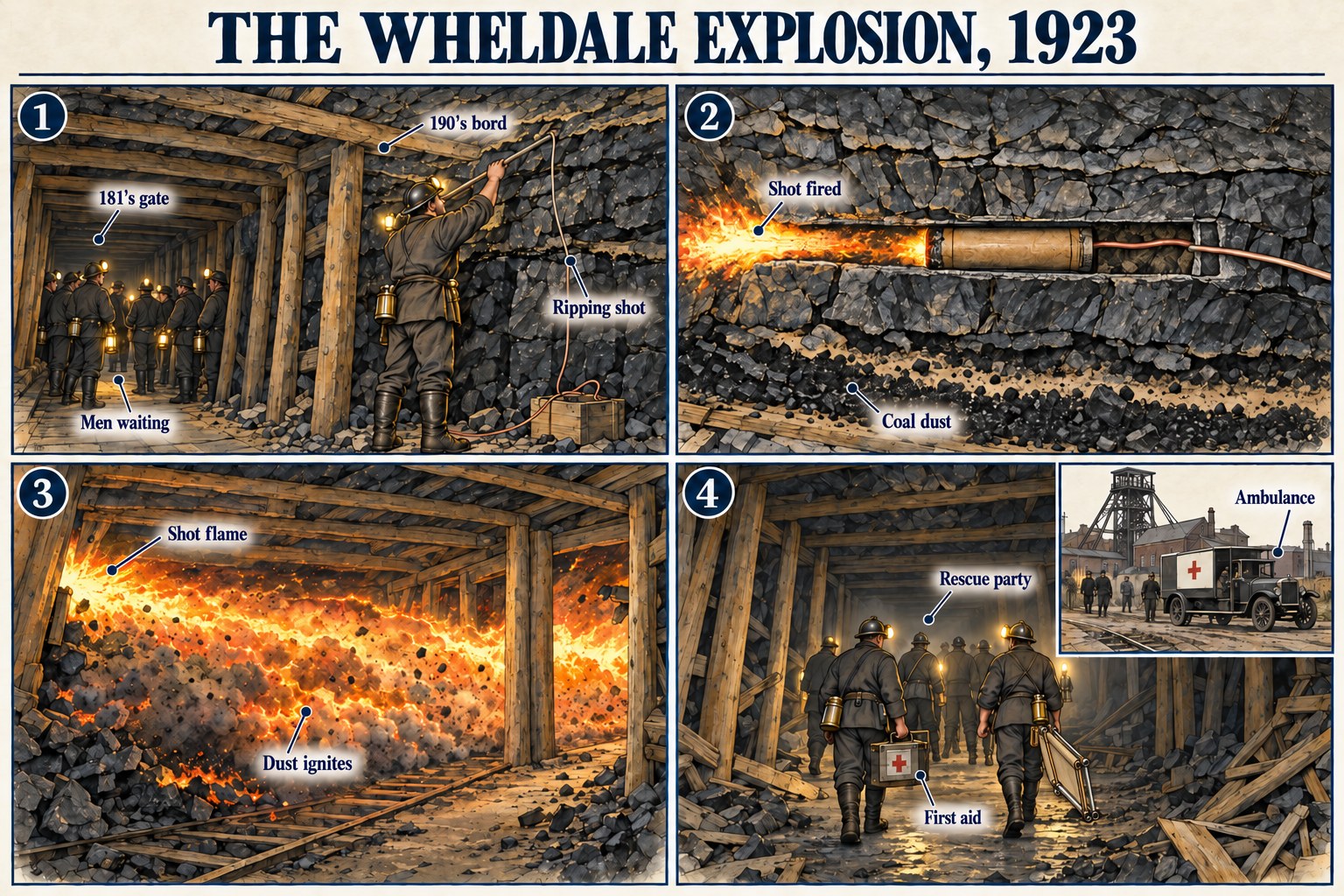
An underground explosion in the Silkstone Seam's No. 2 District at Wheldale Colliery on 22 February 1923 killed nine men — one outright, the rest of severe burns — after the deputy's own shot ignited coal dust during ripping work.
| Date | 22 February 1923 |
|---|---|
| Mine | Wheldale Colliery |
| Region | West Yorkshire |
| Primary type | Explosion |
| Associated types | Rescue |
| Fatalities | 9 (J. Bibb (14, shotfirer's boy) was killed outright; the other eight — C. Booth (19), E. Holmes (35, the deputy who fired the shot), W. Hall (32), J. Anson (33), E. Baker (33), J. Lowe (30), A. Marsden (37) and J.H. Moreton (54) — died later of severe burns.) |
| Context | During active mining |
Location
Plotted at Wheldale Colliery. Recorded location. The large pin is the mine; the small round markers are the nearest mines on record. Click one for its page. View on full map
Cause
HM Chief Inspector of Mines Thomas Mottram's official inquiry found the explosion originated in the ripping (roof-widening) of the '190's' bord, initiated by the flame from a shot fired by deputy Enoch Holmes, who was himself fatally burned in the explosion.
Contributing factors
Eight of the nine victims had been working in the '181's' and '190's' stalls but had gathered in '181's' gate while blasting was under way nearby, so the explosion caught them all together.
What happened
The Silkstone Seam was worked by three deputy districts. The explosion struck No. 2 District, where 69 of the 243 men underground that morning were working. Enoch Holmes, the district's deputy, fired a shot as part of ripping work. It ignited the coal dust or firedamp present, and the explosion caught Holmes and the eight other men who had gathered nearby to wait for the blast. Walter Smith, from the neighbouring No. 3 District, heard the explosion, saw a cloud of dust, and led a rescue effort into the 190's and 181's workings, giving first aid and finding the injured. He found the body of J. Bibb, the only man killed outright, and the eight others, all severely burned, who later died of their injuries. Enoch Holmes himself, terribly burned, was seen making his own way toward the pit bottom before he later died in hospital.
Rescue & recovery
Walter Smith and his fellow rescuers from the unaffected No. 3 District gave first aid and brought the injured out of the pit; motor ambulances were held at the company's Fryston and Allerton Bywater collieries, with a horse ambulance also stationed at Wheldale itself.
Investigation & inquiry
Two inquests were held: one at Leeds before the coroner William Henry Clarke, for the eight men who died there, and one at Castleford before Major W.B. Arundel, Coroner for the Honour of Pontefract, adjourned to run alongside the Leeds proceedings. HM Chief Inspector of Mines Thomas Mottram examined the site and concluded the explosion was caused by the flame from the shot fired by deputy Enoch Holmes during ripping work in the 190's bord.
Related terminology
Mining terms this disaster is structurally linked to, with the nature of the relationship.
- Coal Dust (contextual relationship)
Named twice in this record, first in the summary: “…the rest of severe burns — after the deputy's own shot ignited coal dust during ripping work.” - Deputy (contextual relationship)
Named 5 times in this record, first in the summary: “…killed nine men — one outright, the rest of severe burns — after the deputy's own shot ignited coal dust during ripping work.” - HM Chief Inspector of Mines (contextual relationship)
Named twice in this record, first in the cause: “HM Chief Inspector of Mines Thomas Mottram's official inquiry found the explosion originated in…” - Ripping (contextual relationship)
Named 4 times in this record, first in the summary: “…severe burns — after the deputy's own shot ignited coal dust during ripping work.” - Stall (contextual relationship)
Named in this record’s contributing factors: “Eight of the nine victims had been working in the '181's' and '190's' stalls but had gathered together in '181's' gate while blasting operations…”
Sources
- (secondary) Wheldale Colliery — Wikipedia
- (secondary) Wheldale Colliery Explosion - Castleford - 1923 — Northern Mine Research Society
Record created: 28 August 2026 · Last researched: 28 August 2026