 MineArchive
Glasshoughton Colliery
| Location | Glasshoughton, Castleford, West Yorkshire — 53.7080, -1.3270 (approximate) |
|---|---|
| Commodity | Coal |
| Type | Coal |
| Worked | 1865 (sinking)–March 1986 |
| Maximum depth | Unknown. |
| Operators | Glass Houghton and Castleford Collieries Ltd. (1905–?) |
Overview
The first modern colliery near Pontefract, sunk under an 1865 lease and worked for 117 years, whose 1931 pit-head baths were the largest scheme of their kind in the country and the first completed in West Yorkshire.
History
Glasshoughton Colliery was sunk under a lease taken out in 1865, opening to the Haigh Moor seam by 1869 as the first modern colliery in the immediate vicinity of Pontefract. Wilks & Co. owned the colliery from 1863 to 1876, with several changes of ownership over the following decades before William Moore Wood purchased it in 1898; sinking to the Silkstone seam was completed in 1901. Output before the First World War reached a peak of 850,852 tons in 1913, falling to under 600,000 tons during the war before recovering to over a million tons by 1923.
Glasshoughton's pit-head baths, opened on 30 March 1931 with provision for over 3,000 men, were the largest scheme of their kind in the country and the first pit-head baths scheme completed in West Yorkshire. A coking plant operated alongside the colliery until it ceased in 1978. The colliery itself closed in March 1986 after 117 years, by which point the workforce had fallen to around 300 men; the 336-acre site stood derelict for almost a decade before eventual redevelopment.
Geology
Coal of the West Yorkshire field: the Haigh Moor seam, reached by 1869, with sinking to the Silkstone seam completed in 1901.
Workings
Sunk to the Haigh Moor seam by 1869; sinking to the Silkstone seam completed in 1901.
Closure
Closed in March 1986 after 117 years' working, by which point the workforce had fallen to around 300 men.
What remains
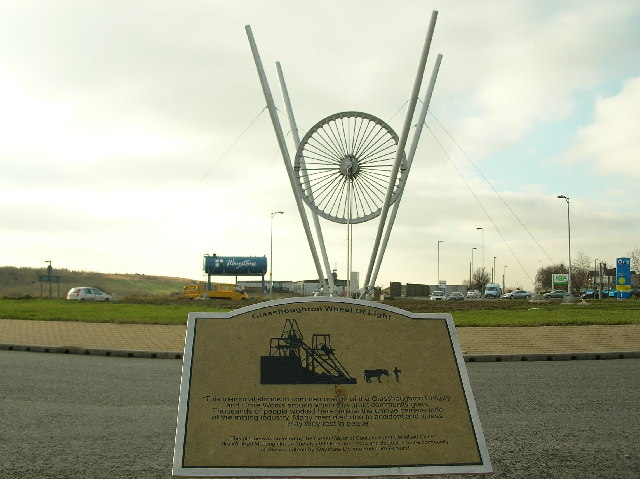
The 336-acre site stood derelict for almost a decade after closure before being redeveloped for retail and housing. A memorial sculpture, the Glasshoughton Wheel of Light — a winding wheel raised on angled steel legs — stands on a roundabout near the site, dedicated to the colliery and coke works workforce.
Nearby mines
- Wheldale Colliery — 1.6 miles (2.6 km) N
- Ackton Hall Colliery — 2.0 miles (3.3 km) SW
- Featherstone Main Colliery — 2.1 miles (3.4 km) SW
- Fryston Colliery — 2.2 miles (3.5 km) N
- Whitwood Colliery — 2.5 miles (4.0 km) W
Straight-line distance, within 9 miles (15 km). Show on the map.
Culture
- Harry Speed and Glasshoughton Colliery (Sports)
Harry Speed worked on the surface at this colliery while playing for Castleford and England.
What's uncertain
Points where sources disagree or the record could not be settled; both accounts are kept. All open questions in the archive.
- The Twentieth Century Society's own record of the pithead baths scheme independently confirms the colliery's ownership (Glass Houghton and Castleford Collieries, Ltd.) and its capacity (3,006 men), but gives the opening date as 6 June 1931 rather than the 30 March 1931 already on this record; both dates are kept as the sources disagree and neither has been reconciled. (disputed) 4
Recorded claims
Individual factual claims, each attached to the source(s) that support it below. Where sources disagree, both are kept.
- The colliery was sunk under a lease taken out in 1865, opening to the Haigh Moor seam by 1869 as the first modern colliery in the immediate vicinity of Pontefract. 1
- Pit-head baths opened on 30 March 1931, with provision for over 3,000 men, were the largest scheme of their kind in the country and the first completed in West Yorkshire. 1
- The colliery closed in March 1986 after 117 years' working, by which point the workforce had fallen to around 300 men. 1,2
- By 1905 the colliery was worked by Glass Houghton and Castleford Collieries Ltd. across its Haigh Moor, Silkstone and Warren House pits (1,449 men); by 1923, under managing director A. Woolley-Hart, the company worked four seams (Beeston, Flockton, Haigh Moor, Silkstone) employing 3,800 men and producing a million tons of coal a year. 3
- The Twentieth Century Society's own record of the pithead baths scheme independently confirms the colliery's ownership (Glass Houghton and Castleford Collieries, Ltd.) and its capacity (3,006 men), but gives the opening date as 6 June 1931 rather than the 30 March 1931 already on this record; both dates are kept as the sources disagree and neither has been reconciled. (disputed) 4
Photographs & further reading
Durham Mining Museum's company record: seam-by-seam employment figures for 1905, 1910 and 1923, plus company directors.
View sourceThe Twentieth Century Society's record of the pit-head baths scheme.
View sourceSources
- (secondary) Yorkshire nostalgia: Looking back to the decline and fall of Glasshoughton Colliery — Yorkshire Post
- (secondary) Take a look back at 25 years of change in Castleford as development of former Glasshoughton Colliery site comes to an end — Wakefield Express
- (primary) Glass Houghton and Castleford Collieries Ltd. — Durham Mining Museum
- (secondary) Glass Houghton (Pithead Baths) — The Twentieth Century Society
Record created: 27 August 2026 · Last researched: 15 September 2026