 MineArchive
Wheldale Colliery fire, 1891
A fire broke out in the engine plane of Wheldale Colliery's Silkstone Pit on 8 December 1891, killing five men overcome by smoke and fumes while trying to escape; the mine was ultimately flooded to bring the fire under control.
| Date | 8 December 1891 |
|---|---|
| Mine | Wheldale Colliery |
| Region | West Yorkshire |
| Primary type | Fire |
| Associated types | Rescue |
| Fatalities | 5 (All five victims were colliers, overcome by smoke and fumes while trying to escape up the engine plane: G. Goodwin (32), Joe Milner (36), John Milner (31), W. Tilley (22) and W. Oakley (30).) |
| Context | During active mining |
Location
Plotted at Wheldale Colliery. Recorded location. The large pin is the mine; the small round markers are the nearest mines on record. Click one for its page. View on full map
Cause
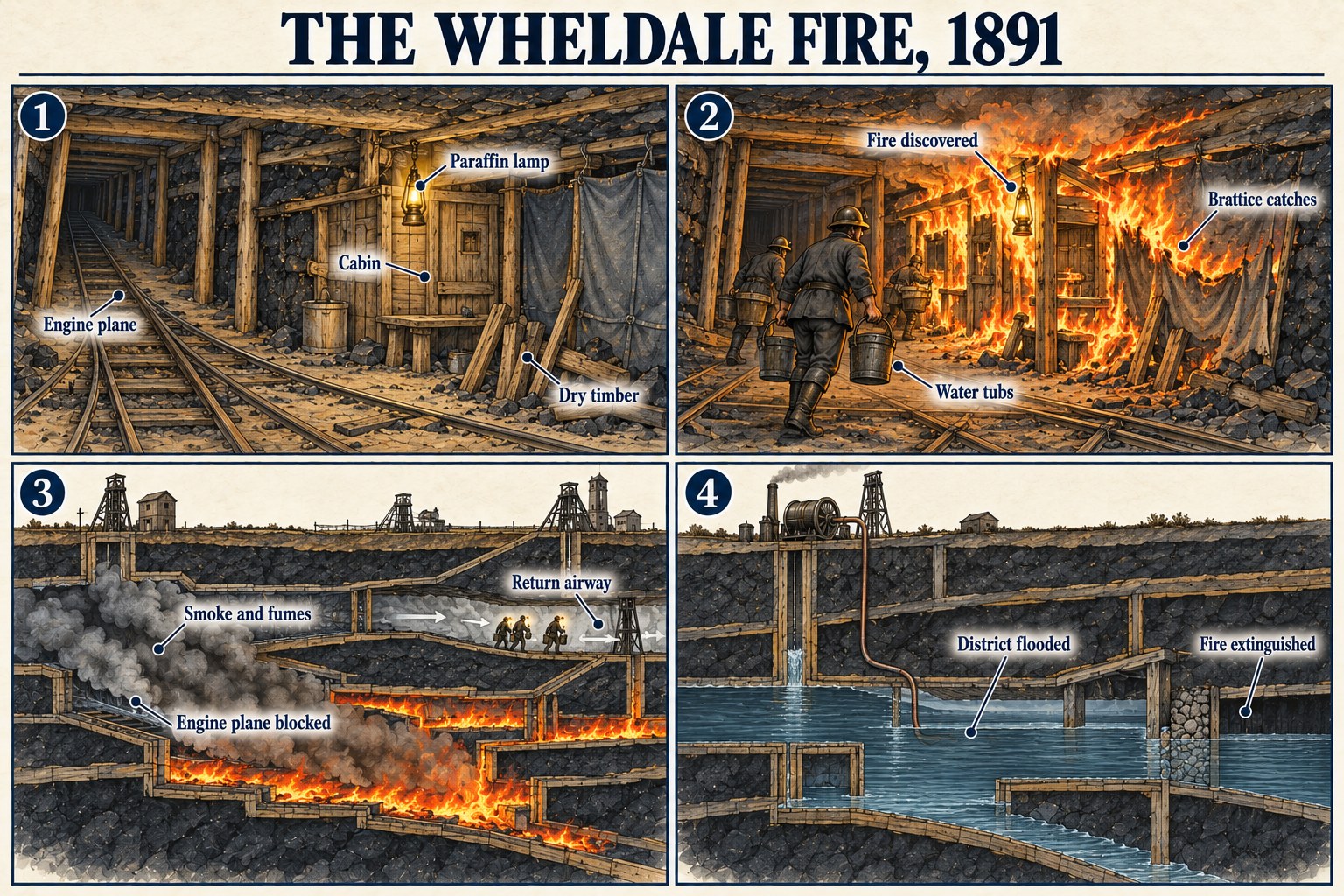
A fire was discovered at a cabin where boys sheltered from the air current, at the junction of the engine plane and the east and west bords. The seam was dry and dusty, with timber and brattice cloth nearby that let the fire take hold quickly. The coroner's jury could not determine how the fire started, though a boy named Gelder was the last person known to have passed the cabin, shortly before, carrying a naked flame lamp.
Contributing factors
Glass paraffin lamps were hung at the junction where the fire started, in a mine otherwise worked by safety lamps. Open lights were permitted at certain stations in the main intakes.
What happened
At 4.30pm a boy named Starbuck, working at a wheel on the engine plane below the junction, spotted fire in the cabin and warned two nearby boys before running to alert the deputy, Goodall, who was at the shaft bottom 500 yards away. Goodall returned at once and tried to extinguish the fire with tubs of water, but it had already grown too large. Knowing 20 men were in the workings below, Goodall crept under the flames without hesitation to warn them. All were told, but in the confusion some were slow to grasp the danger. All but five reached safety by the return airway. The five who tried to travel up the engine plane instead met the fire, smoke and fumes and were overcome.
Rescue & recovery
The manager, undermanager and company chairman, alongside the workmen, made every effort to control the fire and recover the bodies, working for several days in dangerous, superheated conditions with the constant risk that a sudden change in ventilation might trigger an explosion. With no progress after several days, the district, which lay in a dip, was deliberately flooded to put the fire out. When it was reopened, the bodies of the five men were found close together near the junction, confirming that they had tried to escape down the intake.
Investigation & inquiry
An inquest concluded that the men died in the Silkstone Pit on 8 December 1891, but that there was no evidence to show how the fire originated, and that no blame attached to anyone.
Related terminology
Mining terms this disaster is structurally linked to, with the nature of the relationship.
- Brattice (contextual relationship)
Named in this record’s cause: “…the east and west bords. The seam was dry and dusty, with timber and brattice cloth nearby that let the fire take hold quickly. The coroner's jury…” - Engine Plane (contextual relationship)
Named 4 times in this record, first in the summary: “A fire broke out in the engine plane of Wheldale Colliery's Silkstone Pit on 8 December 1891, killing…” - Naked Light (contextual relationship)
Named twice in this record, first in the cause: “…a boy named Gelder, who had passed the cabin shortly before with a naked flame lamp, was the last known to have done so.” - Return Airway (contextual relationship)
Named twice in this record, first in the narrative: “…grasp the danger quickly enough; all but five reached safety via the return airway. The five who tried to travel up the engine plane instead met the…” - Undermanager (contextual relationship)
Named in this record’s rescue and recovery: “The manager, undermanager and company chairman, alongside the workmen, made every effort to…”
Sources
- (secondary) Wheldale Colliery — Wikipedia
- (secondary) Wheldale Colliery Fire Castleford, 1891 — Northern Mine Research Society
Record created: 28 August 2026 · Last researched: 28 August 2026