 MineArchive
Wheal Bellan
| Also known as | Bellan Mine, Belhan |
|---|---|
| Location | Lower Cot valley and Ballowall, St Just, Cornwall — 50.1221, -5.6999 (approximate) |
| Commodity | Tin |
| Type | Metal |
| Worked | By 1717–1919 (abandonment plan); mill dismantled 1947 |
| Maximum depth | Unknown. |
Overview
A St Just tin mine on the north side of the lower Cot valley and the cliffs at Ballowall, recorded as Belhan in 1717. Its electrically driven mill of 1914, powered like Botallack's from gas made on site and later from a Pelton wheel, employed about a hundred men, and its remains are among the best-preserved dressing floors in the district.
History
Wheal Bellan worked several lodes on the north slope of the lower Cot valley at St Just and in the cliff beside it, in a sett between Bosorne Mine to the east and St Just Amalgamated Mines to the north-west. The name was attached to a number of workings at Ballowall: a mine there was recorded as Belhan in 1717, and it may also have been known as Benoal or Benuall, working probably intermittently through the eighteenth and nineteenth centuries on the Bellon lode, which outcrops just north of Carn Gloose Road. A Bellan Mine at work in 1894-96 probably reworked dump material after the closure of St Just United. Its main shafts were Badger's shaft, where a chimney and several dumps remain, and Bellan shaft a little to the south-east. The mine's last and best-recorded phase began around 1914, when about a hundred men were working under Captain N. Nichols and a new mill was built. Like Botallack's, the mill ran at first on electricity generated from coal gas made on site and later from a Pelton wheel; ore crushed near No. 1 shaft ran down to bins behind a ten-head Californian stamp battery and was then dressed on shaking tables, buddles and Frue vanners. The abandonment plans of the mine, for tin ore, are dated September 1919. The mill was modified in the late 1940s and finally dismantled in 1947, its machinery shipped to Nenagh in Ireland, and extensive remains of it survive in the lower Cot valley.
Geology
Tin lodes of the St Just district. The Bellon lode outcrops just north of Carn Gloose Road, between Buck lode to the north and the Widden and Dower lodes to the south.
Geological setting: Veins and Lodes (well documented example)
Workings
Several lodes on the valley slope and the adjoining cliff, worked from Badger's shaft, Bellan shaft and No. 1 shaft. The 1914 mill crushed ore near No. 1 shaft, fed it to a ten-head Californian stamp battery and dressed it on shaking tables, buddles and, by April 1914, six Frue vanners, powered first by electricity from gas made on site and later by a Pelton wheel.
Closure
The mine's abandonment plans for tin ore are dated 1 September 1919. The mill, modified in the late 1940s, was dismantled in 1947 and its machinery shipped to Nenagh in Ireland.
What remains
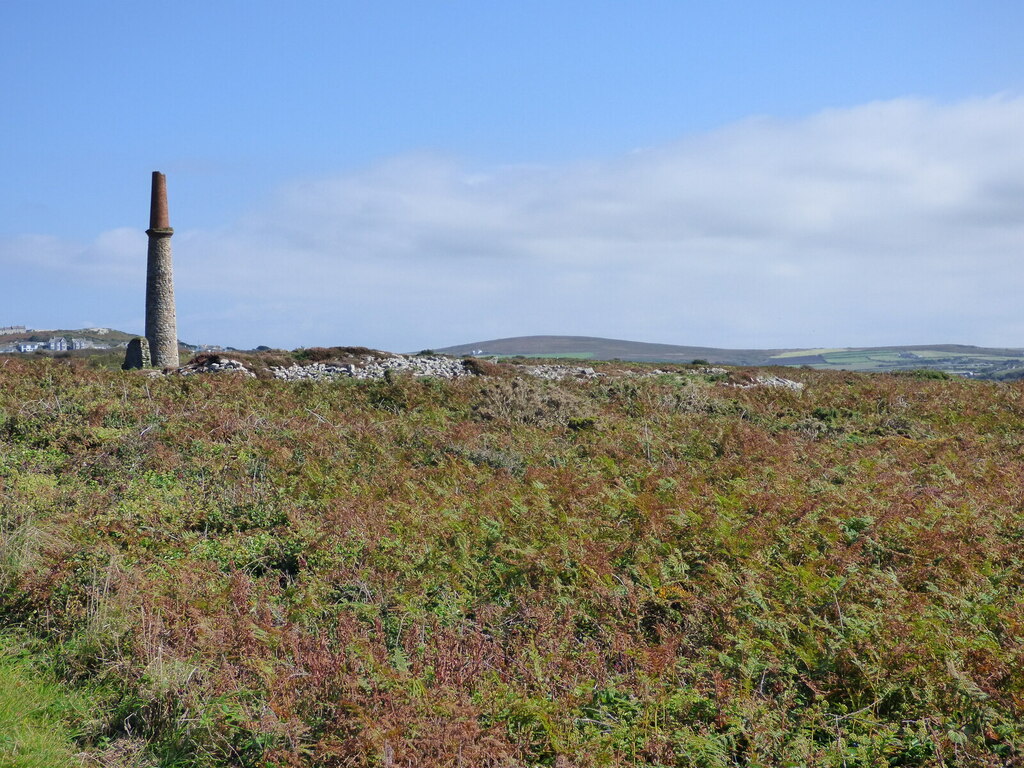
Extensive, well-preserved remains of the 1914 processing plant survive in the lower Cot valley, with the remains of the Pelton wheel on the south side of the stream; a mine chimney stands beside Carn Gloose Road on Ballowall Common (photographed 2020). The area is part of the Cornwall and West Devon Mining Landscape World Heritage Site.
The 1914 mill remains, the Pelton wheel remains, and the chimney and dumps at Badger's shaft.
Nearby mines
- Boswedden Mine — 0.7 km NE
- Cape Cornwall Mine — 1.1 km NW
- Wheal Hermon — 1.1 km NE
- Boscean Mine — 1.2 km NE
- Wheal Drea — 1.6 km NE
Straight-line distance, within 15 km. Show on the map.
People
- N. Nichols · manager, 1914 — Mine captain in April 1914, when about a hundred men worked at Wheal Bellan.
Recorded claims
Individual factual claims, each attached to the source(s) that support it below. Where sources disagree, both are kept.
- Wheal Bellan worked several veins on the north slope of lower Cot valley and the adjoining cliff, its sett lying between Bosorne Mine and St Just Amalgamated Mines; the main shafts were Badger's shaft, with a chimney and several dumps, and Bellan shaft a little to the south-east. 1
- The mine may have been known as Benoal or Benuall and was recorded as Belhan in 1717, working probably intermittently through the 18th and 19th centuries on the Bellon lode; the Bellan Mine at work in 1894-96 probably reworked dump material after the closure of St Just United. 2
- The mill was built about 1914 and, like Botallack's, was first powered by electricity from coal gas made on site, later from a Pelton wheel; it had a ten-head Californian stamp battery, shaking tables and buddles. 1,3
- In April 1914 some 100 men worked at the mine under Captain N. Nichols, with six Frue vanners and two buddles. 1
- The abandonment plans of Wheal Bellan, for tin ore, are dated 1 September 1919. 4
- The mill was modified in the late 1940s and finally dismantled in 1947, its machinery shipped to Nenagh in Ireland; extensive, well-preserved remains of the processing plant survive. 1,3
- A chimney forming part of Wheal Bellan's northern workings stood on Ballowall Common in October 2020. 2,5
Photographs & further reading
The National Trust's record of the northern workings at Ballowall, with the mine's earlier names.
View sourcePhotographs of the Bellan mill remains in the Cot valley.
View sourceThe sett, shafts and the 1914 mill, with its workforce and the fate of its machinery.
View sourceSources
- (secondary) Wheal Bellan Mine, Cornwall — Cornwall Calling
- (primary) Wheal Bellan (northern), Bollowall, St Just Sites (National Trust Heritage Records MNA107139) — National Trust
- (secondary) St Just Mining District — Cornish Mine Images
- (primary) Wheal Bellan (Mining Remediation Authority abandonment plan OM6975, via BGS catalogue item 21862645) — British Geological Survey / Mining Remediation Authority
- (observational) Wheal Bellan Northern, chimney (Geograph photo 6630559, Sandy Gerrard, 2020) — Geograph Britain and Ireland
Record created: 18 September 2026 · Last researched: 18 September 2026