 MineArchive
Wellington Pit
| Also known as | Wellington Colliery |
|---|---|
| Location | Whitehaven, Cumbria — 54.5451, -3.5942 (approximate) |
| Commodity | Coal |
| Type | Coal |
| Worked | 1840–1933 |
| Maximum depth | Coal-drawing shaft 298 yards; workings ran out beneath the Irish Sea |
| Operators | Whitehaven Colliery Company (1840–1933) |
Overview
A Whitehaven pit dressed up as a castle to please the landowner, working coal out under the Irish Sea — and the site of Cumbria's worst mining disaster, when 136 men and boys died in May 1910 and the pit had to be sealed with them still inside.
History
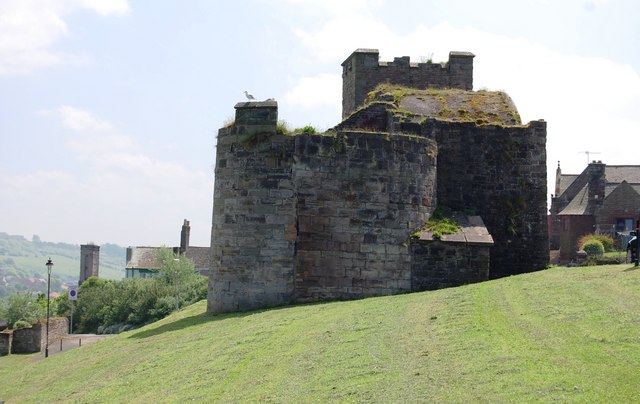
Wellington Pit was sunk from 1840 by the Whitehaven Colliery Company, on the shore of the town itself, and its surface buildings were built in a castellated style so that they would look like a castle rather than a colliery from Lord Lonsdale's grounds above. It worked the Main Band seam out beneath the Irish Sea, employing around 600 men across three shifts and raising some 850 tons a day. On the evening of 11 May 1910 an explosion of firedamp and coal dust in the No. 3 North District killed 136 men and boys — the worst mining accident Cumbria has had. The pit worked on for another two decades and closed in 1933.
Geology
The West Cumberland coalfield runs out from the Whitehaven shore beneath the Irish Sea, and the Wellington's workings went with it. Undersea coal working brings its own problems — water above you and no possibility of a second way out except back through the same shafts — but the hazard that killed here was the ordinary one of any gassy coal: firedamp given off by the seam, and coal dust lying in the roads ready to carry an ignition further than it would otherwise go.
Geological setting: Sedimentary Beds and Seams (well documented example)
Workings
Three shafts served the pit: a coal-drawing shaft 298 yards deep and 12 feet in diameter, an upcast shaft of the same diameter but only 204 yards deep, and a water or pumping shaft 8 feet in diameter and 298 yards deep. The Main Band seam being worked was about ten feet thick. Ventilation came from a 24-foot fan turning at around 126 revolutions a minute.
Closure
Wellington Pit closed in 1933, twenty-three years after the disaster. Coal mining at Whitehaven continued at Haig Pit until 1986.
What remains
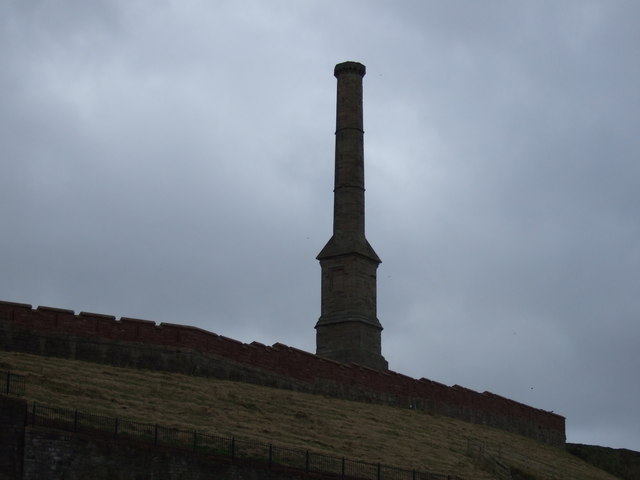
The site is public open ground above the harbour. The most conspicuous survival is the Candlestick — a ventilation chimney built in the shape of a candlestick, and now one of the town's landmarks — together with Wellington Lodge and the castellated gatehouse range.
The Candlestick chimney, Wellington Lodge and the castle-like remains of the surface buildings, all on the cliff above Whitehaven harbour. A memorial on the site records the 1910 disaster.
Redevelopment
Landscaped as public open space overlooking the harbour, with the surviving structures conserved as townscape landmarks.
Related mines
- Croft Pit, Whitehaven — After Wilson closed in 1847 and Saltom in 1848, Wellington and Croft were the Lowthers' only working pits on the Whitehaven coast.
- Duke Pit — Duke Pit's shafts became the upcast for Wellington Pit after Duke closed in 1844, and the Guibal fan of 1870 in the surviving fan house ventilated the Wellington workings until a new shaft took the duty over in 1903–05.
- William Pit — The two Whitehaven pits were connected underground, with a roadway linking William's own workings via Wellington Pit.
Nearby mines
- Duke Pit — 0.2 miles (0.2 km) N
- Haig Colliery — 0.2 miles (0.3 km) SW
- Saltom Colliery — 0.4 miles (0.7 km) SW
- William Pit — 0.6 miles (1.0 km) N
- Kells Pit, Whitehaven — 0.8 miles (1.2 km) S
Straight-line distance, within 9 miles (15 km). Show on the map.
Disasters & major incidents
-
Wellington Pit explosion, 1910
11 May 1910 · Explosion · 136 fatalities
An explosion of firedamp and coal dust in the No. 3 North District of Wellington Pit, Whitehaven, on the evening of 11 May 1910 killed 136 men and boys. The fire that followed could not be fought, and the pit was sealed two days later with the dead still inside; it was not reopened until the end of September.
What's uncertain
Points where sources disagree or the record could not be settled; both accounts are kept. All open questions in the archive.
- An explosion on 11 May 1910 in the No. 3 North District killed 136 men and boys — the figure given by the official adjourned inquest. (disputed) 2
- The death toll is given elsewhere as 147. (disputed) 1
Recorded claims
Individual factual claims, each attached to the source(s) that support it below. Where sources disagree, both are kept.
- The pit had three shafts: a coal-drawing shaft 298 yards deep and 12 feet in diameter, an upcast shaft 12 feet in diameter and 204 yards deep, and a water or pumping shaft 8 feet in diameter and 298 yards deep. 1
- About 600 people were employed across three shifts, raising some 850 tons of coal a day from the Main Band seam, about ten feet thick; ventilation came from a 24-foot fan at around 126 revolutions a minute. 1
- An explosion on 11 May 1910 in the No. 3 North District killed 136 men and boys — the figure given by the official adjourned inquest. (disputed) 2
- The death toll is given elsewhere as 147. (disputed) 1
- The Candlestick ventilation chimney and Wellington Lodge survive on the cliff above Whitehaven harbour. 1
Sources
- (primary) Wellington Pit Explosion, Whitehaven, 1910 — Northern Mine Research Society
- (primary) The Whitehaven Colliery Explosion — report by Mr Samuel Pope, Barrister-at-Law — Durham Mining Museum
- (primary) Mine plans NW1393 and NW1394: Whitehaven / William / Wellington / Saltom / Kells — British Geological Survey / Mining Remediation Authority mine plans catalogue
Record created: 24 August 2026 · Last researched: 24 August 2026