 MineArchive
Wellington Pit explosion, 1910
An explosion of firedamp and coal dust in the No. 3 North District of Wellington Pit, Whitehaven, on the evening of 11 May 1910 killed 136 men and boys. The fire that followed could not be fought, and the pit was sealed two days later with the dead still inside; it was not reopened until the end of September.
| Date | 11 May 1910 |
|---|---|
| Mine | Wellington Pit |
| Region | Cumbria |
| Primary type | Explosion |
| Associated types | Fire, Gas / Asphyxiation |
| Fatalities | 136 (136 is the figure of the official adjourned inquest. NMRS gives 147. Among the dead were 35 men and boys in the No. 5 and No. 6 Districts who suffered no direct injury from the explosion itself. The disaster left 85 women widowed and 260 children fatherless.) |
| Context | During active mining (An evening explosion during a shift change at a working undersea colliery.) |
Cause
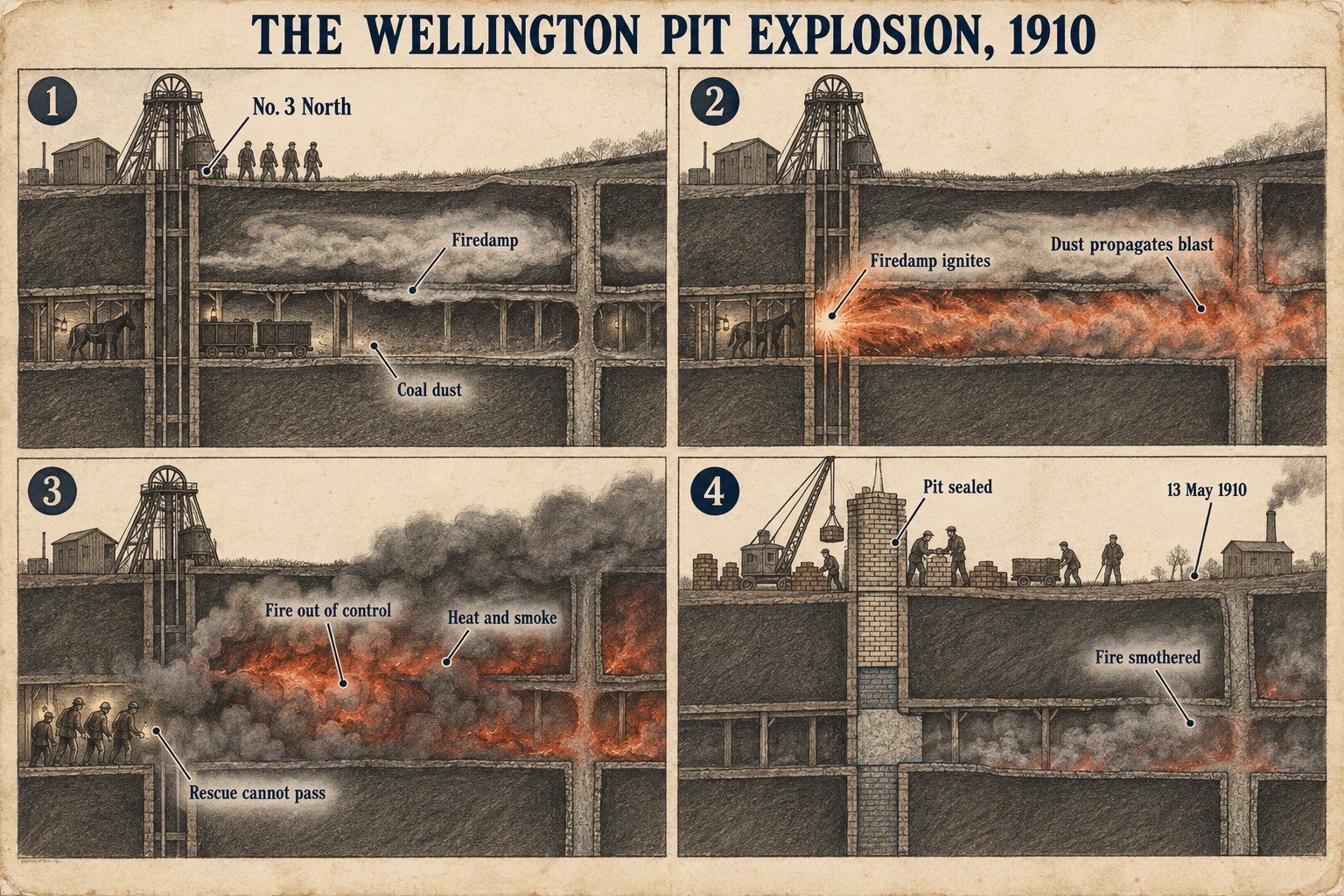
An ignition of firedamp in the No. 3 North District, propagated by coal dust.
Contributing factors
The fire that followed the explosion burned out of control and could not be reached, which is what turned a bad explosion into Cumbria's worst mining disaster.
What happened
The explosion came at about twenty to eight on the evening of 11 May 1910, during a shift change, in the No. 3 North District of Wellington Pit. Firedamp ignited and coal dust carried it. Rescue parties could not get near: the heat and smoke defeated them, and the fire underground went on burning. Thirty-five of the men and boys who died were in the No. 5 and No. 6 Districts and had suffered no direct injury from the blast at all — a fact that drew the sharpest criticism of the whole affair, because it meant they had been alive and unreachable. On 13 May the decision was taken to seal the pit with airtight brick stoppings to smother the fire, with the dead inside. It was not opened again until 29 September, more than four months later, and the inquest could not be concluded until the recovery of bodies was complete.
Rescue & recovery
Rescue was attempted and abandoned as impossible in the heat and smoke. The pit was sealed on 13 May and reopened on 29 September 1910; the formal inquest had to be adjourned twice because bodies were still being recovered.
Investigation & inquiry
R. A. S. Redmayne, HM Chief Inspector of Mines, was appointed by the Secretary of State under section 45 of the Coal Mines Regulation Act 1887 to investigate alongside the coroner, Mr Edward Atter. The adjourned inquest opened at Whitehaven Town Hall on 15 November 1910 and sat through eleven days into early December, with Samuel Pope appearing for the Home Department and the Miners' Federation represented for the relatives. The jury found the explosion had occurred in No. 3 North.
Changes to practice & legislation
The jury's recommendations pressed for trained rescue teams at every colliery, better record-keeping, and improved ventilation — the 35 uninjured dead in No. 5 and No. 6 Districts having made the case for organised rescue capability unanswerable.
Memorials & commemoration
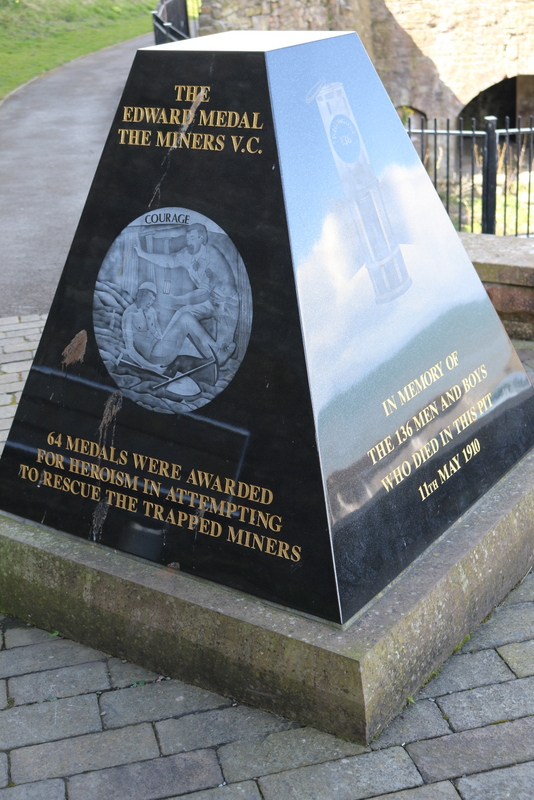
A memorial on the pit site above Whitehaven harbour records the disaster of 11 May 1910.
What's uncertain
Points where sources disagree or the record could not be settled; both accounts are kept. All open questions in the archive.
- The death toll is given elsewhere as 147, of whom 35 men and boys in the No. 5 and No. 6 Districts died without direct injury from the explosion. (disputed) 2
Recorded claims
Individual factual claims, each attached to the source(s) that support it below. Where sources disagree, both are kept.
- The official adjourned inquest was held on the bodies of 136 men killed in the explosion at Wellington Pit on 11 May 1910. 1
- The death toll is given elsewhere as 147, of whom 35 men and boys in the No. 5 and No. 6 Districts died without direct injury from the explosion. (disputed) 2
- The explosion occurred in the No. 3 North District at about 7:40 p.m. during a shift change; rescue proved impossible in the heat and smoke. 2
- The pit was sealed with airtight brick stoppings on 13 May 1910 and not reopened until 29 September, leaving the dead entombed for over four months. 2
- R. A. S. Redmayne, HM Chief Inspector of Mines, was appointed under section 45 of the Coal Mines Regulation Act 1887 to investigate with the coroner; the adjourned inquest opened at Whitehaven Town Hall on 15 November 1910. 1
- The coroner's jury recommended rescue team training at all collieries, better record-keeping and improved ventilation. 2
Related terminology
Mining terms this disaster is structurally linked to, with the nature of the relationship.
- Afterdamp (hazard involved)
Men beyond the seat of the explosion were overcome by smoke and afterdamp. - Coal Mines Act 1911 (contextual relationship)
Killed 136 men in May 1910, seven months before Pretoria Pit and while the Royal Commission on Mines that shaped this Act was still sitting. - Firedamp (direct cause)
The explosion began as an ignition of firedamp in the No. 3 North District. - HM Chief Inspector of Mines (contextual relationship)
Named in this record’s investigation: “R. A. S. Redmayne, HM Chief Inspector of Mines, was appointed by the Secretary of State under section 45 of the…” - Mines Rescue Station (rescue/recovery concept)
The jury's central recommendation was that every colliery should have trained rescue men — the 35 uninjured dead had shown what its absence cost.
Sources
- (primary) The Whitehaven Colliery Explosion — report by Mr Samuel Pope, Barrister-at-Law — Durham Mining Museum
- (primary) Wellington Pit Explosion, Whitehaven, 1910 — Northern Mine Research Society
Record created: 24 August 2026 · Last researched: 24 August 2026