 MineArchive
Duke Pit
| Also known as | Duke Pit fan house |
|---|---|
| Location | Whitehaven, above the South Harbour, Cumbria — 54.5474, -3.5943 (approximate) |
| Commodity | Coal |
| Type | Coal |
| Worked | 1747–1844 |
| Maximum depth | Unknown. Both shafts were sunk to the Six-Quarter seam. |
| Operators | Lowther family (1747–1888), Whitehaven Colliery Company (1888–?) |
Overview
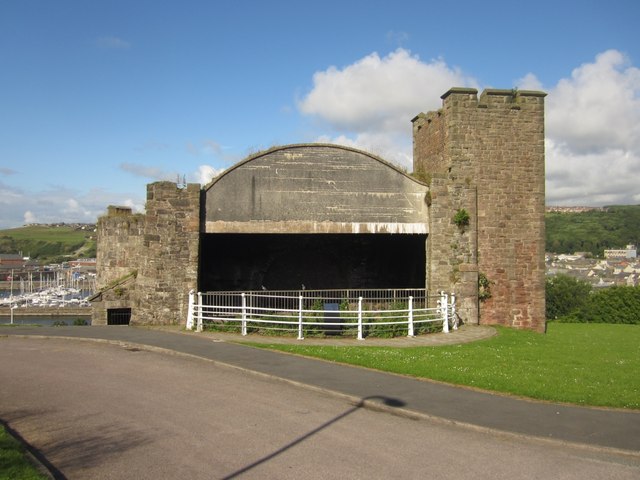
A Whitehaven pit sunk in 1747 on the hillside above the harbour, which became the ventilation shaft of the town's collieries: the first mechanical fan tried in the district turned here in 1841, and the Guibal fan house put up in 1870 — built of brick and sandstone in the castellated style of the Whitehaven pit heads — still stands, reckoned the best surviving example of its kind in the country.
History
The first shaft at Duke Pit was sunk in 1747 as a coal-drawing shaft worked by a horse gin, which with other openings nearby also gave the workings some ventilation. By 1806 firedamp was being burned at the shaft foot in the Main Band to set up a ventilating current. John Peile, in charge of the Whitehaven collieries from 1811, sank a new shaft from the surface to the Six-Quarter seam in 1819 — the club account puts the sinking, with a deepening of the old shaft, in 1820 — and the new shaft became the air shaft, with furnaces at the Main Band horizon, while a steam winder replaced the horse gin on the old one. In 1841 a fan eight feet across and four feet wide, driven by a high-pressure engine and passing 23,000 cubic feet of air a minute, was put to work on the upcast: the first attempt at mechanical ventilation at the Whitehaven pits, and not a success, so that the collieries went on being ventilated by underground furnaces. Duke Pit itself closed in 1844, after which its upcast, with a furnace, ventilated the neighbouring Wellington Pit and the old shaft was used for man-riding. In 1869 a plan was drawn for a Guibal fan 36 feet in diameter, and in 1870 the ventilator was erected on the advice of G. B. Forster, both shafts being connected to it as upcasts. By 1903 the plant was described as a Guibal 36 feet across and 12 feet wide, driven directly by an engine of 30 inch bore and 30 inch stroke at 60 revolutions a minute and moving 54,000 cubic feet of air. A new No. 3 shaft, sunk in 1903–05 on the site of the old boilers, replaced Duke Pit as Wellington's upcast, and the Coal Mines Act of 1911, which required that the airflow could be reversed, could not be met by a Guibal fan without rebuilding it.
Geology
The pit worked the Whitehaven Coal Measures that run out under the sea from the harbour cliffs, its two shafts reaching the Main Band and, from 1819, the Six-Quarter seam.
Workings
Two shafts stood a few yards apart within a walled enclosure: a narrow oval shaft to the south-east, probably of the 18th century, and a larger circular one to the north-west described on the old drawings as the air shaft, with a coal whimsey engine house between them. Drawings of the mid-19th century show the 1841 fan — a 'blowing machine' — connected to the oval shaft by a built airway and driven through gearing by a pair of table engines on a common bedplate, geared up through a pulley and flywheel so that the fan turned much faster than the engines. The Guibal fan house of 1870 was built a few yards south-west of the shafts so as not to interfere with them while it went up; the fan chamber was fully enclosed, with the slots for the movable shutter still in place at the mouth of the evasée, and an access passage into the chamber at its base. The two shafts lie beside it, the upcast under the round tower at the north-west end and the older shaft 49 feet away by the square evasée tower.
Closure
Duke Pit stopped drawing coal in 1844, but its shafts went on working as the upcast for Wellington Pit until the new No. 3 shaft of 1903–05 took that duty over. The fan house is a scheduled monument; the 1911 Act's requirement that ventilation be reversible could not be met by a Guibal without major rebuilding.
What remains
The fan house survives as a scheduled monument, a vaulted brick and sandstone structure about 20 m by 12 m dressed to look like a medieval building: a crenellated rectangular tower at the south end about 10 m high, a sub-circular crenellated tower at the north end, and a stone-roofed porch between them. One metal axle mounting of the fan is still in place inside the brick-lined fan compartment, with sandstone paving in front of it. During the building's rediscovery in 1969 the wall between fan chamber and engine room was demolished and never replaced; the work done since has been to stop the structure collapsing and to let the fan chamber be seen, with a concrete lintel carrying the roof above a fence. The engine house that drove the fan was largely demolished in 1969, though part of one wall survives, joined to the fan house by an arch.
The fan house with its two crenellated towers, evasée and shutter slots, the fan axle mounting, part of the engine house wall with its arch and blocked doorway, and the sealed shaft tops.
Redevelopment
The site is open ground on the hillside above Whitehaven's South Harbour, the fan house preserved as a monument to the town's collieries.
Related mines
- Wellington Pit — Duke Pit's shafts became the upcast for Wellington Pit after Duke closed in 1844, and the Guibal fan of 1870 in the surviving fan house ventilated the Wellington workings until a new shaft took the duty over in 1903–05.
Nearby mines
- Wellington Pit — 0.2 km S
- William Pit — 0.7 km N
- Saltom Colliery — 1.4 km NW
- Haig Colliery — 1.8 km SW
- Woodhouse Colliery — 2.4 km S
Straight-line distance, within 15 km. Show on the map.
What's uncertain
Points where sources disagree or the record could not be settled; both accounts are kept. All open questions in the archive.
- A new shaft was sunk from the surface to the Six-Quarter seam in 1819 by John Peile. (disputed) 2
- The old shaft was deepened and a new one sunk, both to the Six Quarters seam, in 1820. (disputed) 1
Recorded claims
Individual factual claims, each attached to the source(s) that support it below. Where sources disagree, both are kept.
- The first shaft was sunk in 1747 as a coal-drawing shaft worked by a horse gin. 1
- In 1841 a fan eight feet in diameter and four feet wide, passing 23,000 cubic feet of air a minute, was erected on the upcast — the first attempt at mechanical ventilation at the Whitehaven pits, and not considered a success. 2
- A Guibal ventilator was erected at Duke Pit in 1870 on the advice of G. B. Forster, after which both shafts served as upcasts. 1,2
- By 1903 the fan was a Guibal 36 feet in diameter and 12 feet wide, turning at 60 revolutions a minute and moving 54,000 cubic feet of air a minute. 2
- Duke Pit closed in 1844, after which its upcast ventilated the adjacent Wellington Pit. 1
- A new shaft was sunk from the surface to the Six-Quarter seam in 1819 by John Peile. (disputed) 2
- The old shaft was deepened and a new one sunk, both to the Six Quarters seam, in 1820. (disputed) 1
- The Lowther family, later Earls of Lonsdale, worked the Whitehaven collieries directly until 1888, when the Earl leased them to the Whitehaven Colliery Company, ending some 250 years of Lowther control. 2
Photographs & further reading
A site-by-site account of the Whitehaven collieries — Duke, Wellington, Saltom, King and Haig — with the shaft and ventilation history of each and notes on Carlisle Spedding.
View sourceThe National Trust's survey of the Whitehaven coast by Cranstone Consultants and Ironbridge Archaeology, whose third appendix is a detailed account of the Duke Pit Guibal fan house and its machinery.
View sourceSources
- (secondary) Whitehaven Pits, Cumbria — Shropshire Caving & Mining Club
- (primary) Whitehaven Coast Archaeological Survey, including Appendix 3: Duke Pit fanhouse (Simon Chapman) — Cranstone Consultants and Ironbridge Archaeology, for the National Trust
Record created: 22 September 2026 · Last researched: 22 September 2026