 MineArchive
Saltom Colliery
| Location | Whitehaven, Cumbria — 54.5410, -3.6022 (exact) |
|---|---|
| Commodity | Coal |
| Type | Coal |
| Worked | 1729–1848 (pumping continued to 1866) |
| Operators | Lowther family (1729–1848) |
Overview
Saltom Colliery, sunk into the cliffs at Whitehaven from 1729, was the first large-scale mine in England to work coal from beneath the sea — a legally as well as technically remarkable venture, since undersea coal was Crown property — and its engineer, Carlisle Spedding, tried piping the methane it gave off to light the streets of Whitehaven.
History
In 1729 the Lowther family began sinking Saltom Pit on a strip of flat ground below the cliffs at Whitehaven, engineered by their chief steward Carlisle Spedding. It reached the Main Band seam at 456 feet (138m), pumped by a pair of atmospheric engines erected in 1729-31 and housed in engine houses built in 1731 and 1739; a second, larger engine with a 42-inch cylinder was added in 1739. Coal was raised by horse gin and carried by tunnel to the neighbouring Ravenhill Pit for loading at the clifftop, and from 1813 by an incline down to the harbour. Spedding pioneered the use of gunpowder for breaking rock during the sinking, and — working at a site notorious for firedamp — devised a flint-and-steel sparking 'mill' to provide light underground without a naked flame; he is also said to have tried piping the gas given off by the workings to light the streets of Whitehaven. In 1820 the shaft was deepened to 838 feet (255m) to reach the Six Quarters seam, and a steam winder replaced the original horse gin. By the 1790s Saltom had become a central pumping station, draining several of the district's other pits through a drift. Coal-getting ended in 1848, but the pumping engines continued working until 1866.
Geology
Coal of the Cumberland field, won from under the sea: the Main Band seam at 456 feet, the shaft deepened in 1820 to 838 feet to reach the Six Quarters seam.
Workings
Sunk from 1729 on a strip of flat ground below the cliffs at Whitehaven, engineered by Carlisle Spedding, and pumped by a pair of atmospheric engines erected in 1729-31 in engine houses of 1731 and 1739.
Closure
Unknown.
What remains
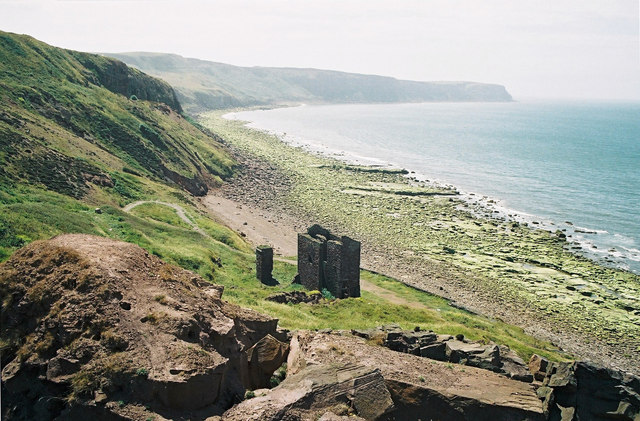
Surviving remains include a stone chimney, the 1820 vertical winding engine house, and the site of the horse gin; the covered shaft and the footings of former dwelling houses are also still traceable. The remains are Grade II listed, but ongoing land slippage on the cliffs has been reported as a threat to the site's future, and the pump houses themselves were already gone by the early 1970s.
Related mines
- Croft Pit, Whitehaven — Lowther coast pits worked together until Saltom closed in 1848.
- Kells Pit, Whitehaven — Both Lowther pits of the Howgill Colliery on the Whitehaven cliffs.
Nearby mines
- Haig Colliery — 0.2 miles (0.4 km) NE
- Wellington Pit — 0.4 miles (0.7 km) NE
- Kells Pit, Whitehaven — 0.5 miles (0.8 km) SE
- Duke Pit — 0.5 miles (0.9 km) NE
- Croft Pit, Whitehaven — 0.9 miles (1.5 km) S
Straight-line distance, within 9 miles (15 km). Show on the map.
Recorded claims
Individual factual claims, each attached to the source(s) that support it below. Where sources disagree, both are kept.
- Saltom Pit reached the Main Band seam at 456 feet (138m), pumped by a pair of atmospheric engines erected in 1729-31; in 1820 the shaft was deepened to 838 feet (255m) to reach the Six Quarters seam, and a steam winder replaced the original horse gin. 1
- Carlisle Spedding devised a flint-and-steel sparking 'mill' to light the workings without a naked flame, given the risk of firedamp, and is said to have attempted to pipe gas from the workings to light the streets of Whitehaven. 2
- Surviving remains — a stone chimney, the 1820 winding engine house and the horse-gin site — are Grade II listed, though ongoing land slippage has been reported as a threat to the site. 1
Sources
- (secondary) Whitehaven Pits, Cumbria — Shropshire Caving & Mining Club
- (secondary) 56 Saltom Pit — GeoGuide (Scottish Geology Trust)
Record created: 29 August 2026 · Last researched: 29 August 2026