 MineArchive
Talargoch Mine
| Location | Dyserth, Flintshire — 53.3095, -3.4108 (exact) |
|---|---|
| Commodities | Lead, Zinc |
| Type | Metal |
| Worked | From 1303–1884 (underground) |
| Maximum depth | 1,080 feet (Mostyn Shaft) |
| Operators | Paul Panton (1753–?), Talargoch Mining Company Ltd (1857–1883), Hughes and Lancaster (1883–1884) |
Overview
Talargoch was one of the largest lead and zinc mines in North Wales, worked at Dyserth on the north-west edge of the Flintshire orefield from at least the 17th century until 1884. Its defining problem was water: the mineral veins lay in limestone under up to 200 feet of saturated glacial gravel, and the mine fought a long, expensive battle against flooding using a succession of increasingly powerful pumping engines before finally being allowed to flood at closure.
History
German prospectors searched the area for copper as early as 1303, finding only small quantities of lead, and mining rights were formally leased to Sir John Conway and Robert Davies in 1632. Early working concentrated on cheaply won near-surface ore on Graig Fawr hill from the 1630s, but this was largely exhausted by the end of the century. Attention then turned to the far wetter Talargoch Vein itself: in 1753 Paul Panton of Bagillt and the Reverend Thomas Ince took a 21-year lease and invested heavily in reopening the abandoned workings, joined in 1763 by Daniel Seaman of Flint and Thomas Smedley of Bagillt; the venture, initially loss-making, turned profitable by 1775. Talargoch was unusual among Flintshire mines in that its minerals belonged to the landowner rather than to one of the mineral-owning families, such as the Grosvenors, that controlled much of the wider orefield. Charles Howard of Hawarden built an engine, whimsey and waterwheel at the Engine Shaft in 1782, and in 1802 an accident destroyed this arrangement when the headgear and waterwheels fell into the shaft — no reliable casualty figures for the incident are recorded. The mine grew substantially through the 19th century: by 1830 it employed around 200 people, and a school was built for miners' children in 1840. The Talargoch Mining Company Ltd was formed in 1857 to work the site, and by 1851 employment had reached 350 men at the southern Clive workings, though only 34 at the northern Mostyn end, where water problems were already limiting progress. With lead prices falling and the water fight increasingly one the mine was losing, Talargoch closed in May 1884; a skeleton crew continued removing equipment until 1899, when the last six underground workers finished and the mine was allowed to flood completely. Hughes and Lancaster of Acrefair, Wrexham, had purchased the mine in 1883, shortly before its closure.
Geology
The Talargoch veins occupy Carboniferous limestone, with associated sandstone and chert, at the north-western end of the Halkyn-Minera orefield — the same broad style of non-magmatic, low-temperature hydrothermal lead-zinc mineralisation found across North Wales's limestone orefields, with no local igneous source. What made Talargoch exceptional was the ground above the veins: up to 200 feet of saturated glacial gravel and drift sat directly over the workings, keeping the mine permanently waterlogged and making shaft-sinking and pumping a constant, expensive struggle for the whole of its working life.
Geological setting: Hydrothermal Deposits (well documented example), Veins and Lodes (well documented example)
Workings
Two main shafts served the mine. Clive Shaft, sunk 1842-1845 at the southern end, was fitted first with a hydraulic pumping engine and later a 100-inch Cornish engine (sources differ on whether this dates to 1860 or 1862); a 50-inch cylinder engine with a 10-foot stroke, built at John Taylor's Rhydymwyn foundry, had already been installed there in 1845. At its peak the mine's pumping plant also included an 80-inch engine and thirteen smaller engines, reflecting just how much power was needed to keep the workings dry. Two leats brought additional water from the Afon Ffyddion to drive waterwheels: one following the 200-foot contour from the mid-1750s, and a larger one on the 300-foot contour built in 1845, sixteen feet wide at the top and nine feet at the bottom. Mostyn Shaft, at the northern end, was sunk to 1,080 feet and became the mine's main focus after June 1882, when heavy water inflow forced the closure of most of the southern workings; the mine's main haulage level ran at 220 yards, with ore continuing down to the 360-yard level in the limestone.
Closure
Underground working ended in May 1884 as falling lead prices made the unrelenting cost of pumping unsustainable, and the mine was allowed to flood. A reduced workforce continued salvaging equipment until 1899, and the waste tips were reworked for their zinc content for a further few years, into 1905.
What remains
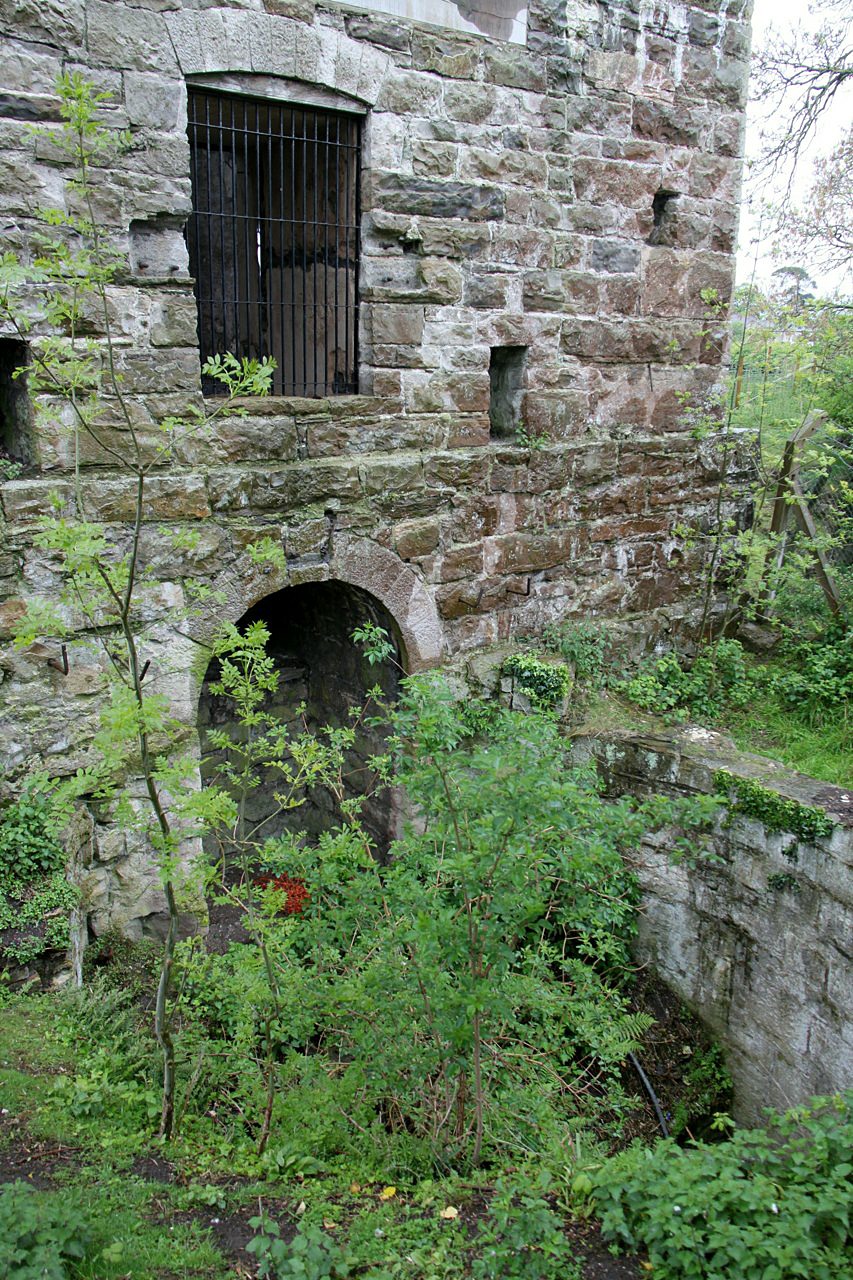
The engine house at Clive Shaft survives above ground and is both a Grade II listed building and a scheduled monument.
Besides the Clive Shaft engine house, surface traces of the wider mine complex — shaft mounds, leat lines and spoil heaps — survive around Dyserth and Graig Fawr, though the workings themselves have been flooded since the 1880s.
Nearby mines
- Meliden Lead Mines — 1.0 miles (1.7 km) SW, Denbighshire
- Trelogan Mine — 4.1 miles (6.6 km) E
- Point of Ayr Colliery — 4.7 miles (7.5 km) NE
- Mostyn Colliery — 6.1 miles (9.9 km) E
Straight-line distance, within 9 miles (15 km). Show on the map.
Recorded claims
Individual factual claims, each attached to the source(s) that support it below. Where sources disagree, both are kept.
- Between 1845 and 1884 Talargoch produced 57,752 tons of lead ore and 49,810 tons of zinc blende, with lead production peaking in the 1850s and zinc around 1880. 1,2
- Mostyn Shaft, at the mine's northern end, was sunk to 1,080 feet, with the main haulage level at 220 yards and ore continuing down to the 360-yard level. 1
- In 1851 the mine employed 350 men at the southern Clive workings but only 34 at the northern Mostyn end, where water problems were already limiting progress; by 1830 total employment was around 200. 2
- The mineral veins were hosted in limestone, sandstone and chert, covered by up to 200 feet of saturated glacial gravel and drift, making shaft-sinking and dewatering exceptionally difficult throughout the mine's working life. 1
Sources
- (secondary) Talargoch Mine — Northern Mine Research Society
- (secondary) Talargoch — Dyserth.com (local history)
- (primary) Talargoch Mine Plan (BGS Mine Plans Catalogue) — British Geological Survey
Record created: 22 August 2026 · Last researched: 22 August 2026