 MineArchive
Point of Ayr Colliery
| Location | Talacre/Ffynnongroyw, Flintshire — 53.3430, -3.3127 (exact) |
|---|---|
| Commodity | Coal |
| Type | Coal |
| Worked | 1883 (company formed)–1996 |
| Operators | Point of Ayr Colliery Company (1883–1947) |
Overview
North Wales's last working colliery, extending its workings out beneath the Dee Estuary until closure in 1996, and the site of a fatal shaft-sinking accident that killed six men in 1952.
History
The Point of Ayr Colliery Company was established in 1883 near Ffynnongroyw and Mostyn in Flintshire, on the North Wales coast at the mouth of the Dee Estuary, striking its main productive seam in 1890 and employing 356 men by 1896. Welsh remained the predominant working language at the colliery through to the 1930s. In 1899 an underground explosion killed the colliery manager Lewis Jenkins and his deputy Samuel Pearson, both 46, who had gone below with an inspection party following an earlier blast; two brothers, John and Ernest Parry, working in the Three Yard Seam, were also among those killed in the incident, caused when a wedge flying off the coal face chipped a safety lamp's glass and ignited a pocket of methane. In 1909 one of the colliery's most productive seams caught fire and had to be sealed off, laying off around 150 workers. The colliery was nationalised in 1947 under the North Wales Area of the NUM, and on 4 July 1952 six contractors' employees were killed in a shaft-sinking accident while developing a new shaft. Point of Ayr survived the 1974 miners' strike and the 1992 coal crisis as one of only two remaining North Wales collieries alongside Bersham, was privatised in 1994 under RJB Mining, and adopted American shuttle-car and roof-bolting methods before finally closing on 23 August 1996 as the last colliery in North Wales.
Geology
Point of Ayr worked coal seams of the North Wales Coalfield, extending out beneath the Dee Estuary.
Workings
Coal was worked by conventional longwall methods for most of the colliery's life, before RJB Mining introduced American-style shuttle cars and roof bolting in its final years.
Closure
Point of Ayr closed on 23 August 1996, the last working colliery in North Wales.
What remains
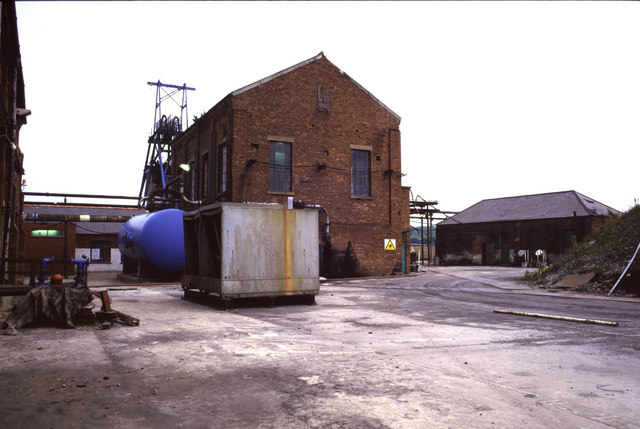
The colliery site has been redeveloped; a headgear monument marks the former site at Talacre.
A preserved headgear monument stands at the former colliery site.
Related mines
- Bersham Colliery — The last two working collieries in north Wales, closing within a few years of each other.
Nearby mines
- Trelogan Mine — 1.8 miles (2.9 km) S
- Mostyn Colliery — 2.6 miles (4.2 km) SE
- Talargoch Mine — 4.7 miles (7.5 km) SW
- Meliden Lead Mines — 5.6 miles (9.1 km) SW, Denbighshire
- Bettisfield Colliery — 7.3 miles (11.8 km) SE
Straight-line distance, within 9 miles (15 km). Show on the map.
Disasters & major incidents
-
Point of Ayr Colliery shaft-sinking accident, 1952
4 July 1952 · Winding / Shaft Accident · 6 fatalities
Six men employed by a civil engineering contractor were killed on the night shift of 4 July 1952 while sinking a new shaft at Point of Ayr Colliery under compressed air, when the air lock at the shaft top failed about 96 feet down and the workings flooded.
What's uncertain
Points where sources disagree or the record could not be settled; both accounts are kept. All open questions in the archive.
- An underground explosion in 1899, caused by a flying wedge chipping a safety lamp's glass and igniting methane, killed colliery manager Lewis Jenkins, his deputy Samuel Pearson, and brothers John and Ernest Parry, among others. (uncertain) 2
Recorded claims
Individual factual claims, each attached to the source(s) that support it below. Where sources disagree, both are kept.
- The Point of Ayr Colliery Company was formed in 1883, striking its main productive seam in 1890 and employing 356 men by 1896. 1
- An underground explosion in 1899, caused by a flying wedge chipping a safety lamp's glass and igniting methane, killed colliery manager Lewis Jenkins, his deputy Samuel Pearson, and brothers John and Ernest Parry, among others. (uncertain) 2
- One of the colliery's most productive seams caught fire in 1909 and had to be sealed off, laying off around 150 workers. 2
- Point of Ayr closed on 23 August 1996 as the last working colliery in North Wales. 1,3
Sources
- (secondary) Point of Ayr Colliery Company — Wikipedia
- (secondary) Point of Ayr — University of Wolverhampton
- (secondary) Point of Ayr — Coal and Community
Record created: 21 August 2026 · Last researched: 21 August 2026