 MineArchive
Point of Ayr Colliery shaft-sinking accident, 1952
Six men employed by a civil engineering contractor were killed on the night shift of 4 July 1952 while sinking a new shaft at Point of Ayr Colliery under compressed air, when the air lock at the shaft top failed about 96 feet down and the workings flooded.
| Date | 4 July 1952 |
|---|---|
| Mine | Point of Ayr Colliery |
| Region | Flintshire |
| Primary type | Winding / Shaft Accident |
| Associated types | Entrapment, Flooding / Inundation |
| Fatalities | 6 (Six. Accounts differ over how they died. The Durham Mining Museum and Welsh Coal Mines' index of North Wales fatalities record five men drowned at the shaft bottom and Edward James Hill killed at the surface by a piece of steel casting; Welsh Coal Mines' own colliery page lists four as drowned and gives Goronwy Jones fatal head and chest injuries. Two names are also given differently between the same pages: James Nicholson Copson and Percy Perry in the fatalities index and at the Durham Mining Museum, James Nicholas Thompson and Percy Maisey on the colliery page.) |
| Context | During active mining |
Cause
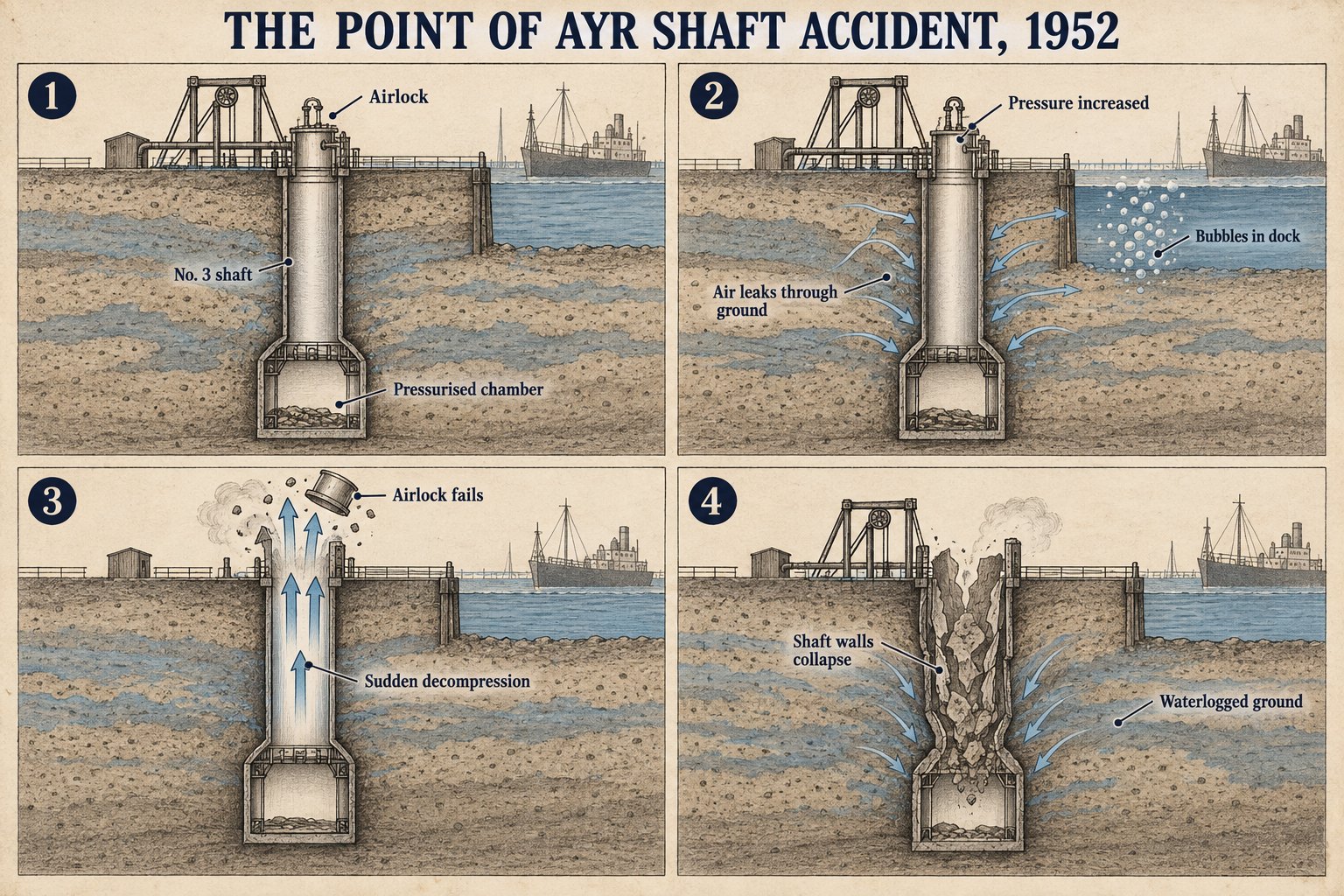
The new No. 3 shaft was being sunk through soft, waterlogged ground using the compressed-air ('caisson') method, in which the whole working chamber at the shaft bottom is kept pressurised to hold back groundwater and loose ground while men work inside it. Air was steadily seeping out through the shaft walls — enough that it could be seen bubbling up in the dock area at high tide — and pressure was repeatedly increased to compensate. The airlock at the top of the shaft eventually failed to contain the rising pressure and blew off, and the instantaneous decompression that followed let the unsupported shaft walls collapse into the working chamber below. Accounts of what actually broke the seal differ. That sequence — air lost through the walls, pressure raised to compensate, the air lock blown off from below — is the account given by the University of Wolverhampton's Coal and Community study. The inquest was told instead that the 950-ton concrete block carrying the caisson at the surface had settled, and that this movement broke the air-lock seals, after which the water rushed in; on that account the exact cause was never established.
Contributing factors
The method hung the safety of everyone at the shaft bottom on one air lock at the surface holding the pressure of the whole working chamber. Air was being lost continuously through the shaft walls, so the pressure had to be raised again and again to keep the water back. The caisson and its air lock were carried on a 950-ton concrete block at the shaft top, whose settlement was afterwards thought to have broken the seals. When the structure came down the lights went out, and the men at the bottom, trapped by fallen timber, could not find the ladder in the dark.
What happened
On the night shift of 4 July 1952, contractors were sinking a new downcast shaft, No. 3, at Point of Ayr Colliery using the compressed-air caisson method to work through soft, waterlogged ground. The sinking had reached about 96 feet, the working chamber held by a caisson 24 feet high beneath a 950-ton concrete block at the surface; the shaft was designed to go on to 1,103 feet. As pressure in the shaft was raised to counter air loss through the walls, the airlock fitted at the top of the shaft failed and the structure came down. The sudden loss of pressure let the shaft walls give way, and waterlogged ground and water poured in on the men working at the bottom. Two of them got out — Bernard Flanagan, the general foreman, and George Thorley, who climbed the steel rung ladder to the surface; in the darkness they could hear the others calling out, trapped by fallen timber and unable to find the ladder after the lights went out. Those recovered from the bottom of the shaft were recorded as having drowned in the inrush, and three of them were also found to have nitrogen bubbles in their bloodstream, consistent with decompression sickness from the pressurised working conditions. The sixth man, Edward James Hill, was working at the surface and was struck by a piece of steel casting as the structure fell. All six men were employed by the civil engineering contractor carrying out the shaft-sinking work, not by the National Coal Board directly.
Rescue & recovery
Two men climbed out of the shaft on the ladder before the water rose. The men trapped at the bottom could be heard calling out but could not be reached, and it was ten days before the bodies could be recovered, gangs of men working through some ten feet of silt and forty feet of water to clear the shaft.
Investigation & inquiry
An inquest was held. It was told that the accident was thought to have been caused by settlement of the concrete block at the top of the shaft, breaking the air-lock seals and letting the water in, but the exact cause could not be ascertained. The National Coal Board's published accounts for 1952 recorded the deaths in a single sentence, and its North Western Division file on the accident survives as COAL 77/5385 at The National Archives.
What's uncertain
Points where sources disagree or the record could not be settled; both accounts are kept. All open questions in the archive.
- The six men killed were Patrick Joseph McPartland (28, leading miner, of Dyserth), Samuel Dempster (37, miner's labourer, of Prestatyn), James Nicholson Copson (43, labourer, of Prestatyn), Percy Perry (33, labourer, of Gwelfor), Goronwy Jones (30, labourer, of Holywell) and Edward James Hill (31, of Deptford, London), who was working at the surface. Two of the names appear differently on Welsh Coal Mines' colliery page, which gives them as James Nicholas Thompson and Percy Maisey. (disputed) 1
Recorded claims
Individual factual claims, each attached to the source(s) that support it below. Where sources disagree, both are kept.
- The six men killed were Patrick Joseph McPartland (28, leading miner, of Dyserth), Samuel Dempster (37, miner's labourer, of Prestatyn), James Nicholson Copson (43, labourer, of Prestatyn), Percy Perry (33, labourer, of Gwelfor), Goronwy Jones (30, labourer, of Holywell) and Edward James Hill (31, of Deptford, London), who was working at the surface. Two of the names appear differently on Welsh Coal Mines' colliery page, which gives them as James Nicholas Thompson and Percy Maisey. (disputed) 1
- Three of the men recovered from the bottom of the shaft — McPartland, Dempster and the man Welsh Coal Mines' colliery page names as Percy Maisey — were found to have nitrogen bubbles in their bloodstream, indicating decompression sickness from the pressurised caisson working conditions, in addition to drowning in the inrush that followed the collapse. 1
- No. 3 shaft was designed to reach 1,103 feet (336 m) at a diameter of 18 feet (5.5 m). The sinking had reached about 96 feet when the accident happened, the working chamber held down by a caisson 24 feet high beneath a 950-ton concrete block at the surface. 2
- The accident was thought to have been caused by settlement of the concrete block at the top of the shaft, which broke the air-lock seals and let the water in, but the exact cause could not be ascertained at the inquest. 3
- Ten days passed before the bodies could be recovered, gangs of men working through some ten feet of silt and forty feet of water to clear the shaft. 3
- Two men got out: Bernard Flanagan, the general foreman, and George Thorley, who climbed the steel rung ladder to the surface. They could hear their colleagues calling out below, trapped by fallen timber and unable to find the ladder in the dark once the lights went out. 3
- The National Coal Board's published accounts for 1952 disposed of the accident in a single sentence. Its North Western Division file on the sinking accident survives as COAL 77/5385 at The National Archives. 4,5
Related terminology
Mining terms this disaster is structurally linked to, with the nature of the relationship.
- Coal (contextual relationship)
Point of Ayr was a coal colliery and the shaft being sunk was a new downcast for it; the men killed were civil engineering contractors sinking that shaft, not colliers working coal. - Downcast Shaft and Upcast Shaft (contextual relationship)
The new No. 3 downcast shaft was being sunk by the compressed-air caisson method through soft, waterlogged ground, with pressure raised to hold the water back — until the airlock failed. - Inrush (contextual relationship)
The men recovered from the shaft bottom were recorded as having drowned: the loss of air pressure let the walls give way and waterlogged ground poured in on top of them. - Shaft (contextual relationship)
Named 18 times in this record, first in the summary: “…were killed on the night shift of 4 July 1952 while sinking a new shaft at Point of Ayr Colliery under compressed air, when the air lock at…” - Shaft Sinking (contextual relationship)
A sinking accident rather than a mining one: the dead were civil engineering contractors, not colliers, killed driving a new shaft through waterlogged ground under compressed air.
Photographs & further reading
This page doesn't try to reproduce everything — these are the best original sources found for this disaster.
The National Coal Board North Western Division's own file on the accident, held at The National Archives, Kew. Open, and not digitised.
View sourceWelsh Coal Mines' index of North Wales deaths, which carries the fullest account of the accident read for this record: the caisson dimensions, the escape, the inquest and the ten-day recovery.
View sourceDurham Mining Museum's page for the colliery: ownership, output and employment figures, and its list of those killed there, which includes all six of 4 July 1952.
View sourceSources
- (secondary) Point of Ayr Colliery, Ffynnongroyw — Welsh Coal Mines
- (secondary) Point of Ayr Colliery — Northern Mine Research Society
- (secondary) North Wales mining fatalities, 1950s — Welsh Coal Mines
- (primary) Point of Ayr Colliery: accident during the sinking of No 3 shaft, 4.7.52 (COAL 77/5385) — The National Archives
- (observational) Point of Ayr (discussion thread) — Welsh Coal Mines Forum
- (primary) Point of Ayr Colliery — Durham Mining Museum
- (secondary) Point of Ayr — University of Wolverhampton
Record created: 21 August 2026 · Last researched: 29 September 2026