 MineArchive
Sneyd Colliery
| Location | Burslem, Stoke-on-Trent, Staffordshire — 53.0466, -2.1825 (exact) |
|---|---|
| Commodities | Coal, Fireclay, Ironstone |
| Type | Coal |
| Worked | Early 19th century–July 1962 |
| Maximum depth | The Banbury seam workings lay about 800 yards (730 m) below the surface at the point of the 1942 explosion. |
| Operators | Sneyd Colliery and Brickworks Co. Ltd. (1881–?), Sneyd Collieries Ltd. (?–1947), National Coal Board (1947–1962) |
Overview
Sneyd Colliery worked the North Staffordshire Coalfield between Burslem and Smallthorne, on the north side of the Potteries, and was for a century one of the largest industrial concerns in the district: at its height four pits, a brickworks and a silica works under one company, employing well over two thousand people. It is remembered for the explosion of 1 January 1942, when 57 men and boys were killed in the Banbury seam of No. 4 pit on a day the men would ordinarily not have worked at all (see Disasters, below). Coal winding ended in July 1962, the workings having been joined underground to Wolstanton, and the site is now an industrial estate, a college and a public park on the old spoil tip.
History
Coal had been worked in the Sneyd area of Burslem since the eighteenth century. H.M. Inspector for North Staffordshire, W. N. Atkinson, writing in 1896, traced the business to the Sneyd Colliery Company early in the nineteenth century, then to Messrs C. and J. May from 1844 to 1875, then to a purchase by William Heath, Arthur Dean and W. A. M. Telwright, who converted it into a limited company in 1881 as the Sneyd Colliery and Brickworks Company; its board included the local member of parliament William Woodall. Atkinson called it one of the most considerable industrial establishments in North Staffordshire, on account of the extent and variety of its operations. The Home Office lists show the scale: in 1894 the company was returning four separate mines, including a fireclay marl pit, with No. 2 alone employing over five hundred; No. 4 was being sunk in 1900 and by 1910 employed 841. Ironstone was raised from No. 3 alongside household, manufacturing and steam coal, and fireclay from 1915. The company also made glazed bricks and tiles and fire and silica brick. Employment reached about 2,300 in the 1930s. The pit was idle in 1940 when an underground fire was found. On New Year's Day 1942, worked for the war effort against the miners' own custom of not cutting coal on that day, an explosion in the Banbury seam of No. 4 killed 57. Nationalised in 1947 with an output of 450,000 tons and 1,460 employees, Sneyd was modernised and linked underground to Wolstanton and Hanley Deep, and after 1942 its coal was increasingly raised at Wolstanton rather than at Sneyd. Winding ceased in July 1962 and the remaining workforce transferred to Wolstanton.
Geology
Sneyd worked the Middle Coal Measures of the North Staffordshire Coalfield, a thick sequence of Westphalian coals separated by shales, mudstones and seatearths, with ironstone and fireclay won from the same shafts. The names in the Home Office returns are the local seam names of the coalfield: Bowling Alley, Hard Mine, Holly Lane, Mossfield, Rough Seven Feet, Two Feet, Yard, Burnwood, Cockshead and Banbury. The Banbury lay above the Cockshead, and the Banbury Crut Jig of 1937 was driven up at a gradient of one in three from one to the other, its first ninety yards in strong bind and the rest in shale that had to be carried on steel arches.
Geological setting: Sedimentary Beds and Seams (well documented example)
Workings
Four shafts, of which No. 2, No. 3 and No. 4 were the principal coal winders, with a brickworks and silica works alongside and the Potteries Loop Line running between them. Underground, the 1942 accounts describe a system typical of a modernised North Staffordshire pit between the wars: longwall faces worked alternately week and week about, coal cut by machine and carried on conveyors, main-and-tail electric haulage on the level roads, a compressed-air endless rope on another, and self-acting jigs on the inclines, loaded tubs running down to pull empties up on the same road. A six-inch compressed-air range and cables carrying 3,000 volts to a 50-horsepower haulage motor were carried along the Banbury Crut Jig, both within inches of the passing tubs. The Banbury seam sent about 1,700 tons a week down the jig to be wound at No. 4.
Closure
Coal winding at Sneyd ceased in July 1962, the workings having been linked underground to Wolstanton between the late 1950s and the early 1960s and the coal drawn there instead; the men transferred to Wolstanton. Accounts of the closure date differ in print: Wikipedia says only that the colliery closed in the 1960s and the Potteries local-history site gives the 1970s, both of which appear to describe the continued life of the joined Wolstanton workings rather than winding at Sneyd itself.
What remains
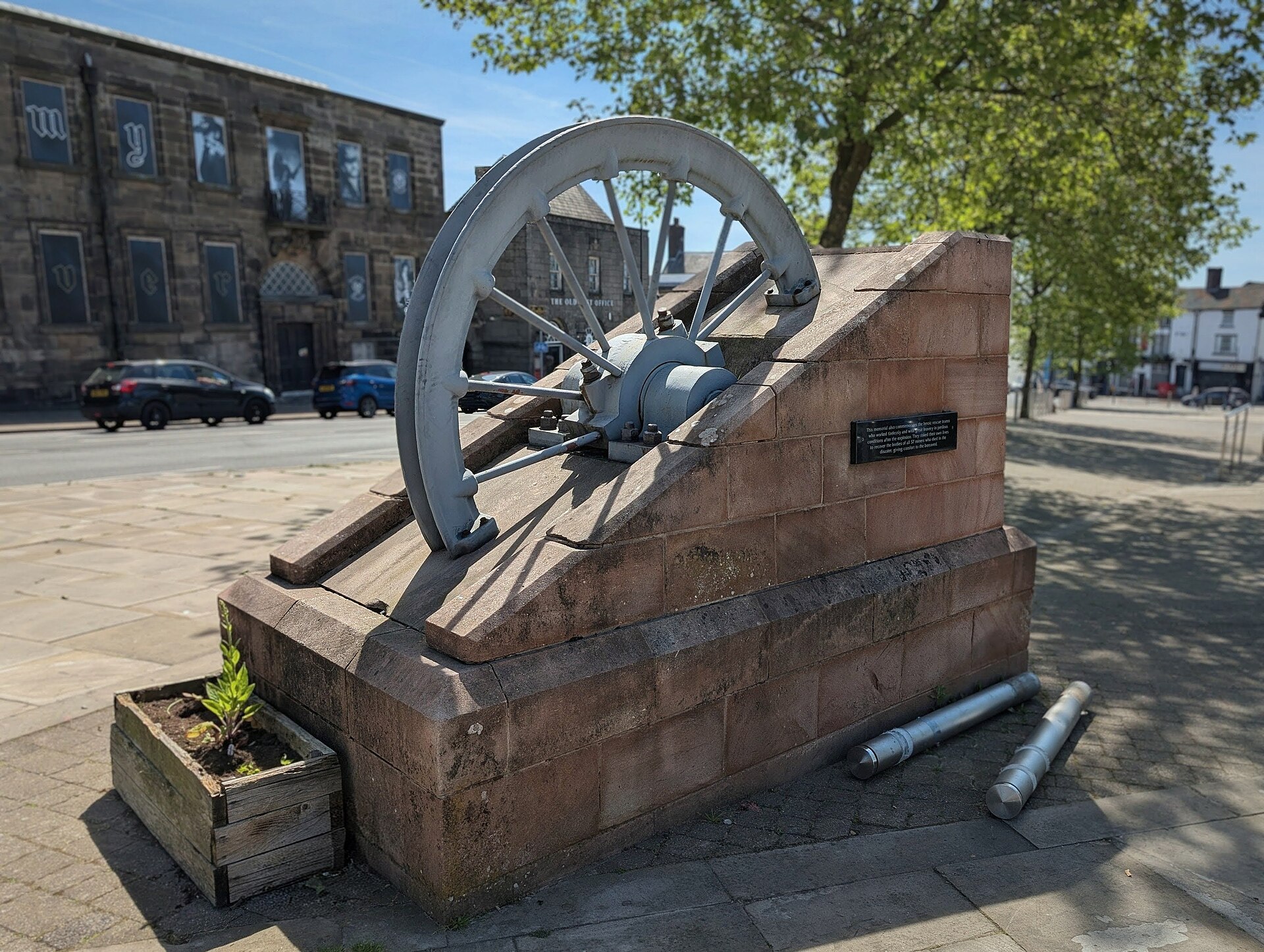
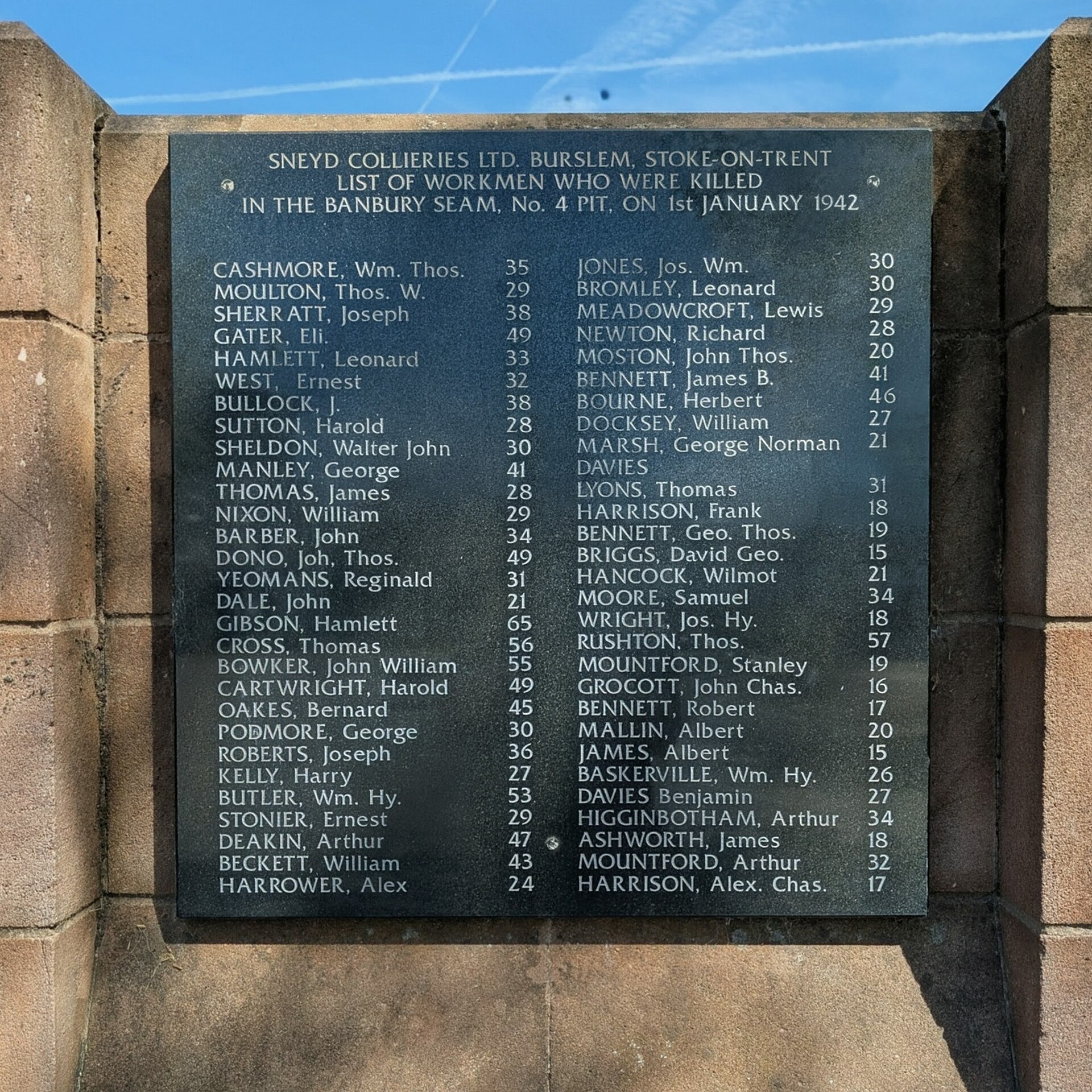
Nothing of the colliery survives above ground. The site carries the Sneyd Industrial Estate and part of Stoke on Trent College, and the spoil tip has been landscaped into Sneyd Hill Park, a steep-sided, roughly conical hill recorded as such by a Geograph photographer in 2016. A memorial pit wheel to the 57 men of 1942 was unveiled in Burslem town centre in 2007 and carries a plaque naming them all.
No headgear, engine house or pithead buildings remain. The colliery's railway embankments and the line of the Potteries Loop Line can still be traced through the industrial estate, and the profile of the spoil heap survives as Sneyd Hill Park.
Redevelopment
Industrial estate, further-education college and public park.
Related mines
- Wolstanton Colliery — Sneyd was linked underground to Wolstanton during the modernisation of the late 1950s and early 1960s; after the 1942 explosion its coal was increasingly wound at Wolstanton, and when winding ceased at Sneyd in July 1962 the remaining men transferred there.
Nearby mines
- Boothen Colliery — 1.1 miles (1.7 km) S
- Far Green Colliery — 1.2 miles (2.0 km) SE
- Racecourse Colliery, Hanley — 1.6 miles (2.6 km) S
- Wolstanton Colliery — 1.6 miles (2.6 km) SW
- Chatterley Whitfield Colliery — 2.0 miles (3.3 km) N
Straight-line distance, within 9 miles (15 km). Show on the map.
Disasters & major incidents
-
Sneyd Colliery shaft accident, 1895
21 April 1895 · Winding / Shaft Accident · 2 fatalities
Two ostlers going down Sneyd Colliery, Burslem, on 21 April 1895 were lowered into the water at the shaft bottom because a new winding rope was too long. -
Sneyd Colliery explosion, 1904
23 August 1904 · Explosion · 3 fatalities
An explosion of firedamp and coal dust, ignited by a broken safety lamp, fatally injured three men at Sneyd Colliery, Burslem, on 23 August 1904. -
Sneyd Colliery Explosion
1 January 1942 · Explosion · 57 fatalities
An explosion of coal dust in the Banbury seam of No. 4 pit at Sneyd Colliery, Burslem, at about ten minutes to eight on the morning of New Year's Day 1942, killed 57 men and boys. Miners traditionally did not cut coal on New Year's Day, but the manager had asked them to work for the war effort and they had agreed. The explosion was confined to one district; four of the sixty-one men in it came out alive. -
Sneyd Colliery manriding accident, 1949
4 October 1949 · Haulage / Transport · 2 fatalities
Two men were killed in a manriding accident at Sneyd Colliery, Burslem, on 4 October 1949, in the National Coal Board's third year.
What's uncertain
Points where sources disagree or the record could not be settled; both accounts are kept. All open questions in the archive.
- The Durham Mining Museum's colliery page gives 55 lives lost in the 1942 explosion, the number killed outright; Wikipedia, Healey Hero and the North Staffordshire Mining Group all give 57, including two men who died later in hospital. (disputed) 2,3,4
- Coal winding at Sneyd ended in July 1962 and the remaining men transferred to Wolstanton, to which the workings had been linked underground; published accounts otherwise give the closure only as 'the 1960s' or 'the 1970s'. (uncertain) 1,4
Recorded claims
Individual factual claims, each attached to the source(s) that support it below. Where sources disagree, both are kept.
- H.M. Inspector W. N. Atkinson recorded in 1896 that the business began early in the nineteenth century as the Sneyd Colliery Company, was carried on by Messrs C. and J. May from 1844 to 1875, was then bought by William Heath, Arthur Dean and W. A. M. Telwright, and became a limited company in 1881. 1
- Home Office returns show Sneyd No. 2 employing 515 in 1894 and 743 in 1915, No. 4 sinking in 1900 and employing 875 by 1915, with about 2,300 employed at the colliery in the 1930s and 1,460 at nationalisation in 1947, when output was returned as 450,000 tons. 2
- The seams returned for the Sneyd pits include Bowling Alley, Hard Mine, Holly Lane, Mossfield, Rough Seven Feet, Two Feet and Yard at No. 2; Burnwood, Rough Seven Feet and Two Feet at No. 3; and Bowling Alley, Cockshead and Holly Lane at No. 4. 2
- Besides household, manufacturing and steam coal, Sneyd raised ironstone from No. 3 and fireclay, and the company made glazed bricks and tiles and fire and silica brick. 2,1
- The Banbury Crut Jig, driven in late 1937, was a self-acting incline about 200 yards long rising one in three from the Cockshead seam to the Banbury, carrying about 1,700 tons of coal a week down to be wound at No. 4 shaft. 3
- The Durham Mining Museum's colliery page gives 55 lives lost in the 1942 explosion, the number killed outright; Wikipedia, Healey Hero and the North Staffordshire Mining Group all give 57, including two men who died later in hospital. (disputed) 2,3,4
- Coal winding at Sneyd ended in July 1962 and the remaining men transferred to Wolstanton, to which the workings had been linked underground; published accounts otherwise give the closure only as 'the 1960s' or 'the 1970s'. (uncertain) 1,4
- The colliery site now carries an industrial estate and part of Stoke on Trent College, and the spoil tip has become Sneyd Hill Park, photographed in 2016 as a steep-sided, roughly conical hill. 5
- The BGS and Mining Remediation Authority mine-plans catalogue holds one record for Sneyd Colliery, a Network Rail plan. 6
Photographs & further reading
The Home Office returns for the Sneyd pits between 1894 and 1947 — output, seams worked and numbers employed above and below ground — with the museum's roll of those killed at the colliery.
View sourceJohn Lumsdon's two-part account, the fullest description available of the Banbury seam workings, the haulage arrangements in the crut jig and the rescue and recovery that followed.
View sourcePhotographs of the headgear and colliery wagons, a 1955 map showing the colliery and its brickworks either side of the Loop Line, and the 1896 inspector's account of the company's descent from the older Sneyd Colliery Company.
View sourceThe North Staffordshire Mining Group's collection of family recollections of New Year's Day 1942, gathered from relatives of men who were killed or who worked on the rescue.
View sourceA 2016 photograph of the landscaped colliery spoil tip, now a public park on the hill above Smallthorne.
View sourceSources
- (secondary) Sneyd Colliery, Burslem — thepotteries.org, quoting W. N. Atkinson, H.M. Inspector for North Staffordshire, 1896
- (primary) Durham Mining Museum: Sneyd Colliery — Durham Mining Museum
- (secondary) Sneyd Colliery Explosion, part 1: the workings and the Banbury Crut Jig — Healey Hero (John Lumsdon)
- (secondary) Sneyd Colliery Disaster — Wikipedia
- (observational) Sneyd Hill Park, the former Sneyd Colliery spoil tip (photographed 2016) — Geograph Britain and Ireland, Jonathan Hutchins
- (primary) BGS mine plans catalogue: Network Rail Plan (Sneyd Colliery) — British Geological Survey / Mining Remediation Authority
- (primary) Durham Mining Museum: Sneyd Collieries Ltd. — Durham Mining Museum
- (secondary) Sneyd Colliery Explosion, part 2: rescue, recovery and the relief fund — Healey Hero (John Lumsdon)
- (secondary) The Sneyd Colliery Disaster: the families left behind — North Staffordshire Mining Group, Apedale Heritage Centre
Record created: 9 September 2026 · Last researched: 9 September 2026