 MineArchive
Sneyd Colliery Explosion
An explosion of coal dust in the Banbury seam of No. 4 pit at Sneyd Colliery, Burslem, at about ten minutes to eight on the morning of New Year's Day 1942, killed 57 men and boys. Miners traditionally did not cut coal on New Year's Day, but the manager had asked them to work for the war effort and they had agreed. The explosion was confined to one district; four of the sixty-one men in it came out alive.
| Date | 1 January 1942 |
|---|---|
| Mine | Sneyd Colliery |
| Region | Staffordshire |
| Primary type | Explosion |
| Associated types | Entrapment, Gas / Asphyxiation, Rescue |
| Fatalities | 57 (Fifty-five men and boys were killed outright and two more died later in hospital, giving the toll of 57 carried on the Burslem memorial. The Durham Mining Museum's colliery page gives the figure as 55, counting only those killed underground.) |
| Injuries | A small number of survivors were brought out injured; two of them died in hospital and are counted in the 57. |
| Context | During active mining |
Cause
A coal-dust explosion originating in the Banbury Crut Jig, the self-acting haulage incline between the Cockshead and Banbury seams. A set of tubs ran away down the jig and came off the road, and the ignition followed immediately. The official inquiry under Sir Henry Walker attributed the ignition to derailed tubs damaging an electric cable, whose sparks fired the dust; the Durham Mining Museum records the finding as friction between the ascending rope and the underside of a descending tub of the runaway set.
Contributing factors
A haulage road carrying, within inches of the passing tubs, both a six-inch compressed-air range with a gland and cock in it and cables at 3,000 volts slung four feet above the floor; dust along a jig down which about 1,700 tons of coal a week and loads of stone were run; and a working day taken on only because of the wartime demand for coal.
What happened
Coal was being drawn from the 22s face in the Banbury seam and the 21s face was being made ready for the afternoon shift; 295 men were in No. 4 pit and 61 of them in the district affected. At about 7.50 a.m. a set of tubs ran away down the Banbury Crut Jig, left the rails, and the explosion followed, some 800 yards below ground. It blew men off their feet: one sixteen-year-old apprentice was thrown round a corner and stopped by a water drum, while the man working with him was thrown against a wall and killed. Evidence given later showed the force at the top of the jig had been directed inbye towards the faces and at the bottom outbye towards the shaft, placing the origin in the jig itself. Everything beyond the point where two men were found close to the No. 4 shaft bottom and in the Cockshead level was destroyed; no one further into the Banbury seam was found alive. No other part of the pit was affected, and No. 4 and No. 2 were cleared of their remaining workers at once.
Rescue & recovery
The Sneyd rescue team went down first, followed within hours by teams from Chatterley Whitfield, Black Bull, Hanley Deep and Shelton, three of the Shelton men having survived the Holditch explosions of 1937. Wives and relatives gathered at the pit head through the morning. The company's general manager, I. W. Cumberbatch, announced at one o'clock that rescue teams were working towards the faces, that one road was clear and the other blocked by roof falls, and that there was no sign of fire. By six in the evening the rescuers were still two hundred yards short of the coal face, and by the following morning all hope had been given up. Sixteen bodies were recovered that day, after which two large falls had to be cleared; work went on continuously in fresh air, with breathing-apparatus teams standing by. The last of the dead were brought out by 9 January. Coal drawing resumed on the Monday, with 79 per cent of the day shift reporting for work.
Investigation & inquiry
A formal inquiry was held under Sir Henry Walker, H.M. Chief Inspector of Mines, with mining, electrical and ventilation experts brought in from across the country. It concluded that tubs of the runaway set had left the rails and damaged an electric cable, and that the resulting sparks had ignited coal dust. That finding has been questioned since: some later writers attribute the spark to a steel rope that snapped, and others to the descending empties striking the compressed-air pipe, blowing dust into suspension where a spark reached it, noting that the cable was tested afterwards and found sound.
Legal & regulatory aftermath
The Lord Mayor of Stoke-on-Trent opened a relief fund the same day. Sneyd Collieries Ltd gave £5,000 and undertook to pay the funeral expenses; Imperial Chemical Industries gave £500, the Shelton Iron, Steel and Coal Company £262 10s and the Staffordshire Sentinel £200. By 9 January the fund stood at £12,278 and the first payments were made to families according to their dependants and circumstances. The disaster left 32 widows and 35 fatherless children, and of the 24 unmarried men who died, eight left mothers already widowed. Because of wartime censorship much of the personal detail only came out long afterwards.
Memorials & commemoration
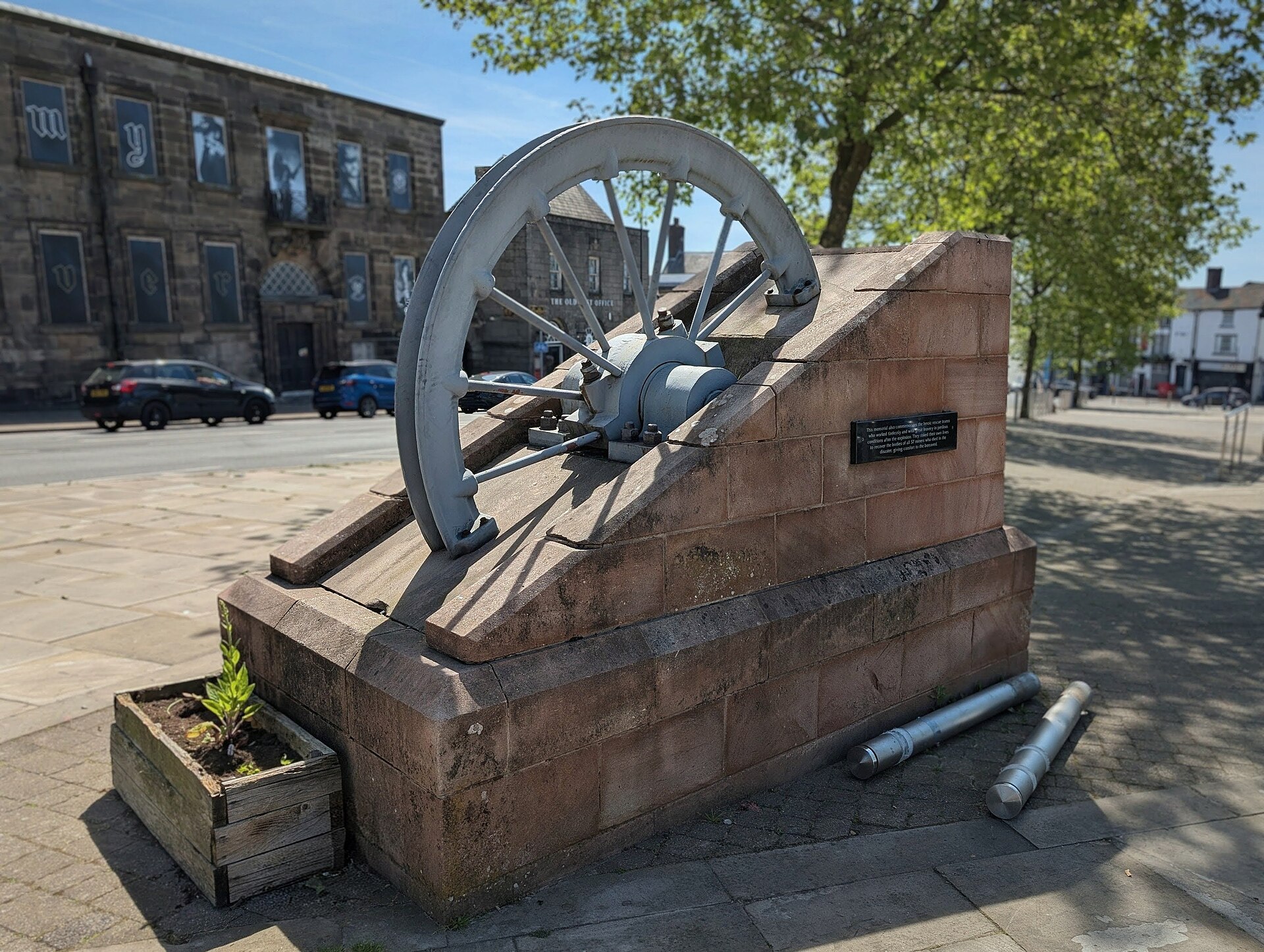
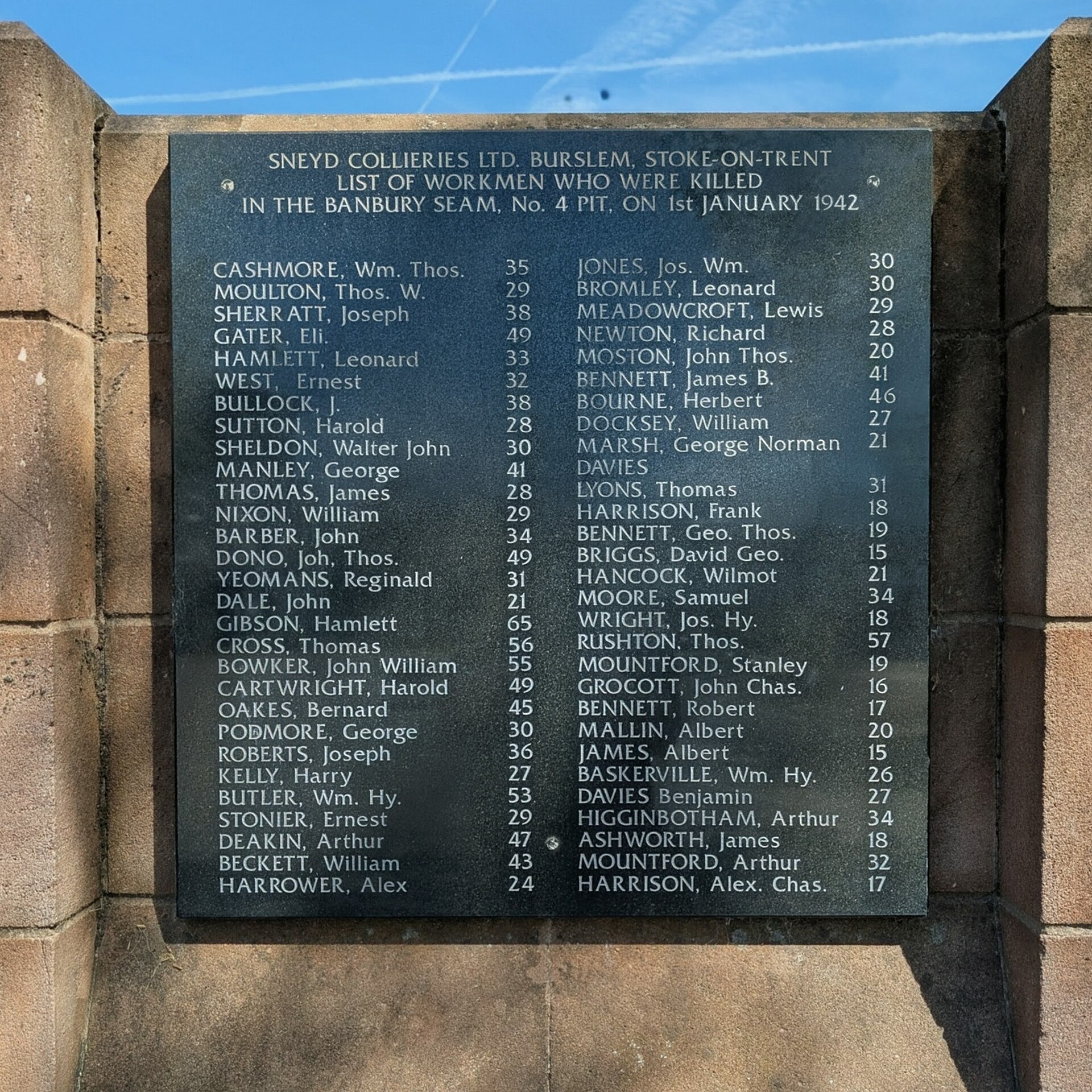
A memorial in the form of a colliery pit wheel was unveiled in Burslem town centre in 2007, carrying a plaque with the names of all 57. The North Staffordshire Mining Group gathered accounts from surviving relatives towards its construction.
What's uncertain
Points where sources disagree or the record could not be settled; both accounts are kept. All open questions in the archive.
- Fifty-five were killed outright and two died in hospital, a total of 57; the Durham Mining Museum's colliery page records 55. (disputed) 3,1,2
- The inquiry under Sir Henry Walker found that derailed tubs damaged an electric cable and the sparks ignited coal dust; the Durham Mining Museum records friction between the ascending rope and a descending tub, and later writers have blamed a snapped steel rope or the empties striking the compressed-air pipe. (disputed) 3,1,2
Recorded claims
Individual factual claims, each attached to the source(s) that support it below. Where sources disagree, both are kept.
- The explosion occurred at about 7.50 a.m. on 1 January 1942 in the Banbury seam of No. 4 pit, about 800 yards below ground. 1,2
- 295 men were at work in No. 4 pit and 61 in the district affected, of whom four came out alive. 2
- Fifty-five were killed outright and two died in hospital, a total of 57; the Durham Mining Museum's colliery page records 55. (disputed) 3,1,2
- The inquiry under Sir Henry Walker found that derailed tubs damaged an electric cable and the sparks ignited coal dust; the Durham Mining Museum records friction between the ascending rope and a descending tub, and later writers have blamed a snapped steel rope or the empties striking the compressed-air pipe. (disputed) 3,1,2
- Evidence showed the force of the explosion was directed inbye at the top of the Banbury Crut Jig and outbye at its foot, placing the origin within the jig. 4
- The Sneyd rescue team descended first, followed by teams from Chatterley Whitfield, Black Bull, Hanley Deep and Shelton; sixteen bodies were recovered on the second day and the last of the dead by 9 January. 4,2
- By 9 January the relief fund had reached £12,278, Sneyd Collieries Ltd having given £5,000 and undertaken to pay the funeral expenses. 4
- The disaster left 32 widows and 35 children without fathers, and eight of the unmarried men who died left mothers who were themselves widows. 2
- A memorial pit wheel with a plaque naming all 57 was unveiled in Burslem town centre in 2007. 5,2
Related terminology
Mining terms this disaster is structurally linked to, with the nature of the relationship.
- Breathing Apparatus (contextual relationship)
Named in this record’s rescue and recovery: “…had to be cleared; work went on continuously in fresh air, with breathing-apparatus teams standing by. The last of the dead were brought out by 9…” - Crosscut (contextual relationship)
Named twice in this record, first in the cause: “A coal-dust explosion originating in the Banbury Crut Jig, the self-acting haulage incline between the Cockshead and…” - Haulage (contextual relationship)
Named twice in this record, first in the cause: “…explosion originating in the Banbury Crut Jig, the self-acting haulage incline between the Cockshead and Banbury seams. A set of tubs ran…” - Rescue Brigade (contextual relationship)
Named twice in this record, first in the rescue and recovery: “The Sneyd rescue team went down first, followed within hours by teams from Chatterley…” - Tub (contextual relationship)
Named 6 times in this record, first in the cause: “…haulage incline between the Cockshead and Banbury seams. A set of tubs ran away down the jig and came off the road, and the ignition…”
Photographs & further reading
This page doesn't try to reproduce everything — these are the best original sources found for this disaster.
John Lumsdon's account of the disaster in two parts, setting out the layout and haulage of the Banbury seam from the inquiry evidence and then the rescue, the company's statements and the relief fund.
View sourceThe North Staffordshire Mining Group's collection of accounts from relatives of the men killed and of those who worked on the rescue, gathered in support of the Burslem memorial.
View sourceSources
- (secondary) Sneyd Colliery Explosion, part 1: the workings and the Banbury Crut Jig — Healey Hero (John Lumsdon)
- (secondary) Sneyd Colliery Disaster — Wikipedia
- (primary) Durham Mining Museum: Sneyd Colliery — Durham Mining Museum
- (secondary) Sneyd Colliery Explosion, part 2: rescue, recovery and the relief fund — Healey Hero (John Lumsdon)
- (secondary) The Sneyd Colliery Disaster: the families left behind — North Staffordshire Mining Group, Apedale Heritage Centre
Record created: 9 September 2026 · Last researched: 9 September 2026