 MineArchive
Shirebrook Colliery
| Location | Shirebrook, Derbyshire — 53.1967, -1.2070 (exact) |
|---|---|
| Commodity | Coal |
| Type | Coal |
| Worked | 1896–April 1993 |
| Maximum depth | 1,630 feet (No. 2 shaft, Top Hards seam) |
| Operators | Shirebrook Coal and Iron Company (1896–1947), Shirebrook Colliery Ltd (1915–1946), National Coal Board (1947–1987), British Coal Corporation (1987–1993) |
Overview
A Derbyshire pit sunk from 1896 whose population exploded from 600 to 11,000 within fifteen years, survived a fatal 1907 cage accident, and closed in 1993 after a 1976 drift investment had briefly pushed it to its highest-ever output.
History
Shirebrook Colliery was sunk from 1896 by the Shirebrook Coal and Iron Company, under engineer Arnold Lupton, with two 18-foot-diameter shafts; No. 2 shaft reached the Top Hards seam at 1,630 feet. The new colliery transformed the surrounding area almost overnight — in the fifteen years after sinking began, the village's population grew from around 600 to 11,000 as newcomers arrived in search of a home and a job.
On 26 March 1907 three men were killed when a conductor broke and tipped them out of a descending cage (see Disasters, below). The colliery was vested into the National Coal Board at nationalisation on 1 January 1947. In 1976, the Jubilee Drift was driven to link the surface directly to the Main Hard seam, speeding up coal transport, and the investment paid off: Shirebrook produced over 1.7 million tons in 1986-87, its best output on record. The colliery nonetheless closed in April 1993, one of the last six Derbyshire collieries still working after the 1984-85 strike; the site has since been redeveloped as a large business park. The company's name changed with its shape: Shirebrook Colliery Co. from the sinking to about 1910, Shirebrook Colliery Ltd from 1915 to 1946, and then the National Coal Board from 1947, with British Coal running the pit to its closure in April 1993.
Geology
Two shafts were sunk to the Top Hard seam, the No. 2 shaft reaching it at 1,630 feet. The Main Hard seam lies higher and nearer the surface to the east, which is what the Jubilee Drift of 1976 was driven to reach directly from the surface.
Geological setting: Sedimentary Beds and Seams (well documented example)
Workings
Two 18-foot-diameter shafts sunk from 1896, No. 2 reaching the Top Hards seam at 1,630 feet; the Jubilee Drift, added 1976, gave direct surface access to the Main Hard seam. Both shafts were 18 feet in diameter, with the No. 2 shaft down 1,630 feet to the Top Hards; the Jubilee Drift of 1976 added surface access to the Main Hard seam alongside them.
Closure
Closed April 1993, one of the last six Derbyshire collieries still working after the 1984-85 strike; the site has since been redeveloped as a business park.
What remains
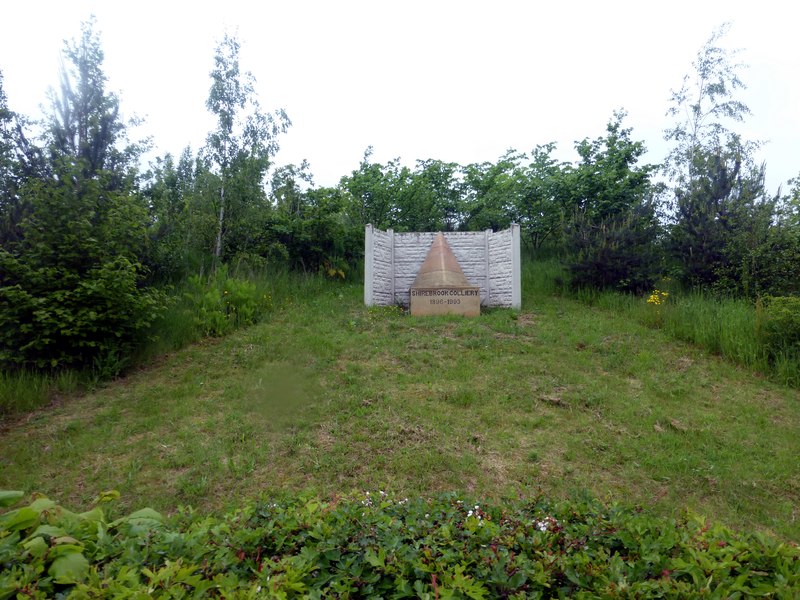
The colliery site has been cleared and largely redeveloped, and a marker stone photographed in May 2016 stands to record where the pit was.
No colliery structures stand. A marker stone commemorating the colliery survives on the site.
Related mines
- Pleasley Colliery — Pleasley's remaining reserves were linked underground to Shirebrook before Pleasley's 1983 closure.
Nearby mines
- Warsop Main Colliery — 1.3 miles (2.1 km) NE, Nottinghamshire
- Langwith Colliery — 2.3 miles (3.7 km) N
- Pleasley Colliery — 2.5 miles (4.1 km) SW
- Sherwood Colliery — 2.9 miles (4.6 km) S, Nottinghamshire
- Welbeck Colliery — 3.7 miles (6.0 km) NE, Nottinghamshire
Straight-line distance, within 9 miles (15 km). Show on the map.
Disasters & major incidents
-
Shirebrook Colliery cage accident, 1907
26 March 1907 · Winding / Shaft Accident · 3 fatalities
On 26 March 1907 a worn conductor broke as a cage of fourteen men descended Shirebrook's No. 2 shaft; the cage tilted and three men fell to the bottom. The inquest jury blamed the shaftsmen's judgment and asked for gates on cages.
Culture
- Shirebrook Miners Welfare F.C. (Sports)
The club was the football side of the Shirebrook colliery town and in 1953 took the name Shirebrook Miners Welfare, tying it to the pit and the miners' welfare movement. - Shirebrook Town F.C. (Sports)
Founded in 1985 as Shirebrook Colliery, under the pit's name, and renamed Shirebrook Town in 1993, the year the colliery closed (Wikipedia; Football Club History Database).
Recorded claims
Individual factual claims, each attached to the source(s) that support it below. Where sources disagree, both are kept.
- Shirebrook Colliery was sunk from 1896 by the Shirebrook Coal and Iron Company under engineer Arnold Lupton, with two 18-foot-diameter shafts, No. 2 reaching the Top Hards seam at 1,630 feet. 1
- In the fifteen years after sinking began, the surrounding village's population grew from around 600 to 11,000. 1
- The Jubilee Drift, driven in 1976, gave direct surface access to the Main Hard seam; the colliery produced over 1.7 million tons in 1986-87, its best output on record. 1
- The colliery closed in April 1993, one of the last six Derbyshire collieries still working after the 1984-85 strike. 1
- The colliery was held by Shirebrook Colliery Co. from the 1896 sinking to about 1910, by Shirebrook Colliery Ltd from 1915 to 1946, and by the National Coal Board from 1947; British Coal worked it to its closure in April 1993. 2
- Two shafts of 18 feet diameter were sunk, the No. 2 reaching the Top Hard seam at 1,630 feet, with a later drift from the surface. 2
- The colliery produced over 1.7 million tons in 1986-87. 2
- The colliery site has been cleared and redeveloped; a marker stone recording the pit stood on the site in May 2016. 3
Photographs & further reading
A detailed independent colliery history, the fullest account of the sinking, the 1907 cage accident and the pit's later working.
View sourceSources
- (secondary) Shirebrook — oldminer.co.uk
- (secondary) List of collieries in Derbyshire — Wikipedia
- (observational) Shirebrook Colliery marker stone — Geograph Britain and Ireland, via Wikimedia Commons
- (primary) BGS/Mining Remediation Authority mine plans — Shirebrook — British Geological Survey / Mining Remediation Authority
- (primary) The Shirebrook Cage Disaster, March 26th 1907 — Durham Mining Museum

Record created: 27 August 2026 · Last researched: 23 September 2026