 MineArchive
Pleasley Colliery
| Also known as | Pleasley Pit |
|---|---|
| Location | Pleasley, Derbyshire — 53.1740, -1.2554 (exact) |
| Commodity | Coal |
| Type | Coal |
| Worked | 1873 (shaft sinking)–1983 |
| Maximum depth | 904 yards (826 m), the southern shaft to the Blackshale seam |
| Operators | Stanton Iron Company (1872–1947), National Coal Board (1947–1983) |
Overview
A Derbyshire colliery whose two steam winding engines, set back-to-back in a single engine house between twin shafts, form the only surviving example of that once-rare arrangement anywhere in Britain — preserved and still run today by volunteers.
History
The Stanton Iron Company took a lease from William Edward Nightingale, father of Florence Nightingale, in 1872 and began sinking two 14.5-foot-diameter shafts the following year, working the Top Hard seam reached in the No. 1 shaft in February 1877 and the No. 2 shaft in February 1879. Output grew quickly, from around 9,600 tons a month in October 1881 to 17,250 tons a month by August 1884, helped by a genuinely pioneering piece of engineering: in 1890 Pleasley installed what is claimed as the world's first underground rope haulage system driven by an electric motor. Electric lighting at the pit bottom had already been demonstrated in 1881. The colliery went on to work several further seams — Deep Hard from 1921, and Dunsil and First Waterloo from the late 1930s — with a large washery added in the same decade capable of handling 150 tons of coal an hour. Employment peaked in 1938 at 1,261 men underground and 283 on the surface. Coal winding ceased when the colliery's remaining reserves were linked underground to the neighbouring Shirebrook colliery, and Pleasley closed in December 1983, having by then spent some years working purely as a means of transporting men and materials to the linked workings. Pleasley was twice an early proving ground for electricity underground. In 1881 R. E. B. Crompton demonstrated electric lighting of the pit bottom and coal face to the Royal Commission on Accidents in Mines, and in 1890 a 60 hp electrically driven rope haulage, described as the first of its kind in the world, was installed near the downcast pit bottom; four more followed within seven years, releasing 44 horses and lifting output to 1,700 tons a day.
Geology
Pleasley worked the Top Hard seam and several others in the Nottinghamshire-Derbyshire coalfield; the colliery's early growth benefited from relatively trouble-free geology, though a disturbed fault zone was encountered a short distance to the north-east of the shafts.
Geological setting: Faults and Fractures (historical documentary reference)
Workings
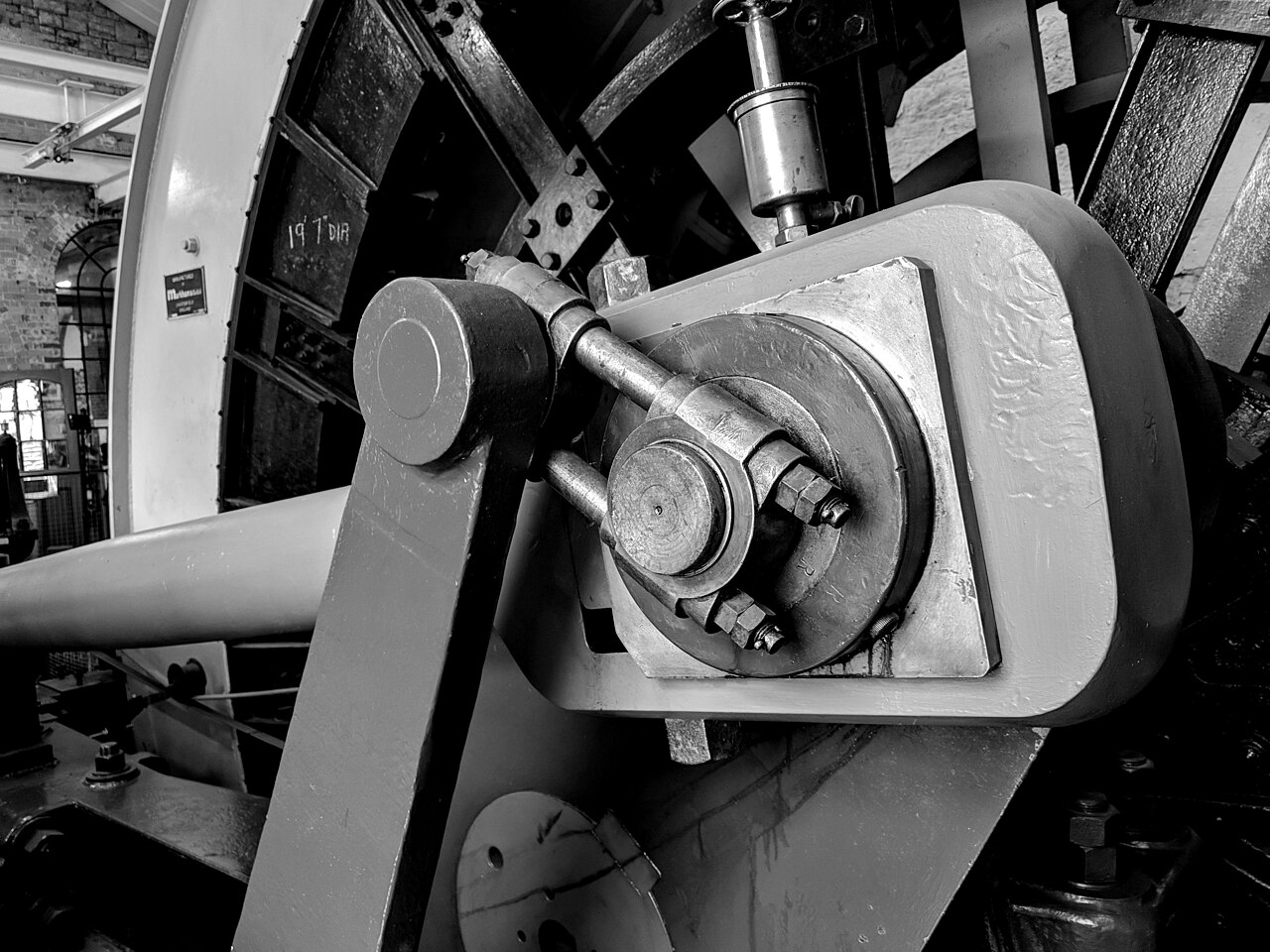
Coal was raised via twin shafts served by two steam winding engines housed back-to-back within a single engine house — an arrangement that was already unusual nationally when built, and Pleasley is now the only surviving example of it anywhere in Britain. The south engine was supplied by the Markham Company of Chesterfield in 1922 and the north engine by the Lilleshall Company in 1904.
Closure
The colliery was scheduled as an Ancient Monument in 1996 and its surface buildings — engine house, headstocks and chimney — were saved from dereliction by volunteers who restored both steam winding engines to working order.
What remains
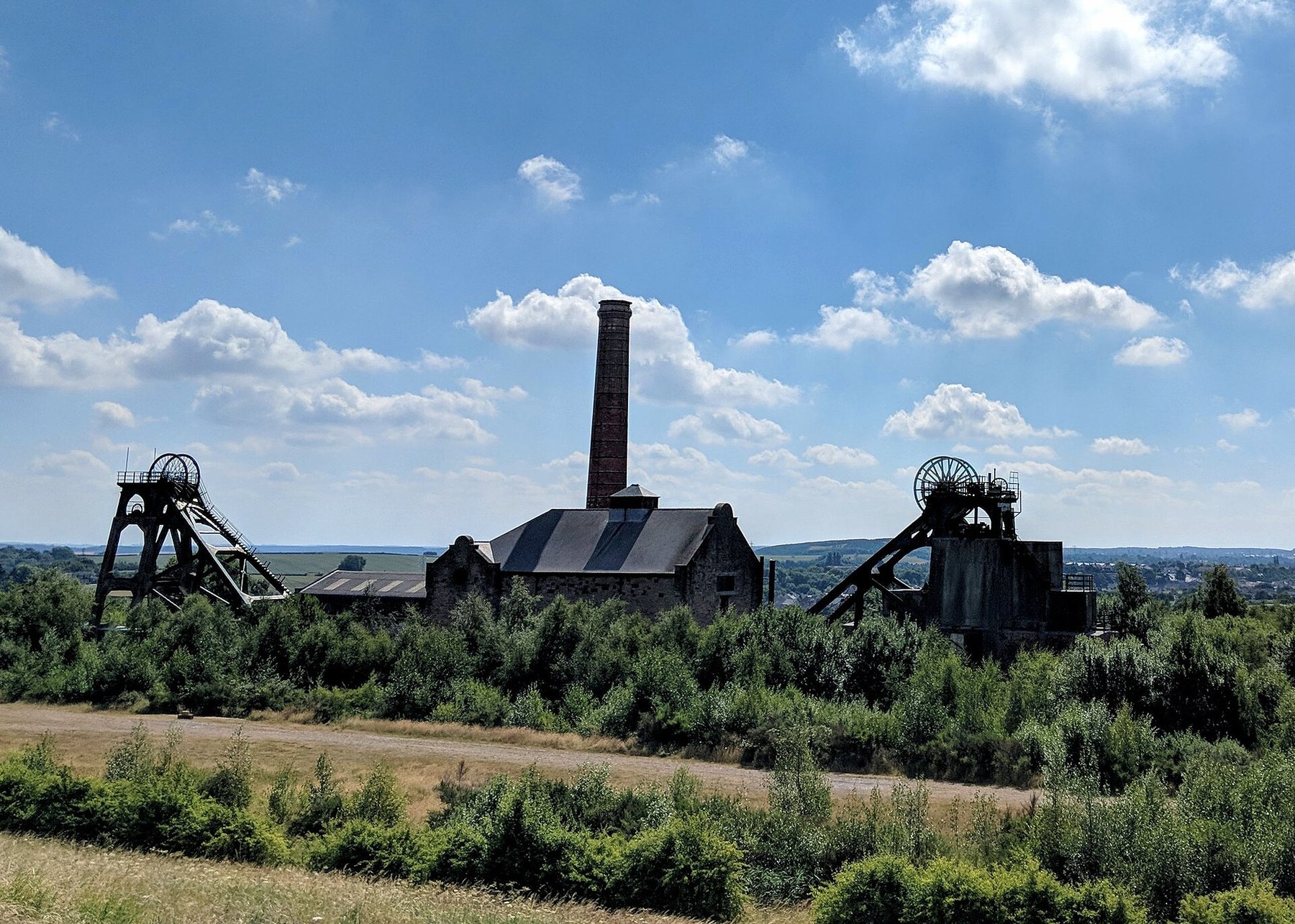
Now run by the Pleasley Pit Trust as a heritage museum and country park, with the two headstocks, the Grade II listed engine house, and one of the original brick chimneys all preserved; the winding engines are run for visitors on the second Sunday of the month from March to October. A £1 million restoration completed in 2010 made the buildings and headgear safe, sandblasted and repainted the exposed steelwork of both headframes and unblocked the engine-house windows so visitors can see both winding engines; work on the site continues, and there is an open day each September.
Preserved twin headstocks, the back-to-back winding engine house, and a 40m brick chimney, set within a country park landscaped from the former colliery site.
Related mines
- Sherwood Colliery — Neighbouring Nottinghamshire and Derbyshire border pits; the Sherwood spoil heap is visible from the landscaped Pleasley tip.
- Shirebrook Colliery — Pleasley's remaining reserves were linked underground to Shirebrook before Pleasley's 1983 closure.
- Westthorpe Colliery — Westthorpe's steam winding engine survives at Pleasley, where it was taken after the Killamarsh site was cleared.
Nearby mines
- Teversal Colliery — 2.0 miles (3.1 km) SW, Nottinghamshire
- Glapwell Colliery — 2.5 miles (4.0 km) NW
- Shirebrook Colliery — 2.5 miles (4.1 km) NE
- Silverhill Colliery — 2.5 miles (4.1 km) S, Nottinghamshire
- Sherwood Colliery — 2.7 miles (4.4 km) SE, Nottinghamshire
Straight-line distance, within 9 miles (15 km). Show on the map.
Recorded claims
Individual factual claims, each attached to the source(s) that support it below. Where sources disagree, both are kept.
- The Stanton Iron Company took a lease from William Edward Nightingale in 1872 and began sinking two shafts in 1873, reaching the Top Hard seam in the No. 1 shaft in February 1877 and the No. 2 shaft in February 1879. 1,2
- In 1890 Pleasley installed what is claimed as the world's first electrically driven underground rope haulage system, and had already demonstrated electric lighting at the pit bottom in 1881. 1
- Employment peaked in 1938 at 1,261 men working underground and a further 283 on the surface. 1
- Pleasley's engine house holds two steam winding engines set back-to-back between the twin shafts — the north engine built by Lilleshall in 1904, the south by Markham of Chesterfield in 1922 — the only surviving example of this once-rare arrangement in Britain. 1,2
- Pleasley closed in December 1983 after its coal reserves were linked underground to the neighbouring Shirebrook colliery, ending winding at the site. 1,3
- The southern shaft reached 904 yards, working down through the Top Hard and other seams to the Blackshale; its Markham winder could raise men and coal up to 46 times an hour. 4
- Electric lighting of Pleasley's pit bottom and coal face was demonstrated to the Royal Commission on Accidents in Mines by R. E. B. Crompton in 1881, and the 60 hp underground rope haulage installed in 1890 is described as the first electrically driven haulage of its kind anywhere. 5
Photographs & further reading
Video of the preserved Lilleshall and Markham steam winding engines running for visitors.
View sourceSources
- (primary) Pleasley Pit - History — Pleasley Pit Trust
- (primary) Pleasley Colliery, Pleasley — Historic England
- (secondary) Pleasley — oldminer.co.uk
- (observational) Markham Steam Winder, Pleasley Colliery — Geograph Britain and Ireland
- (secondary) Pleasley Colliery — Wikipedia
- (primary) BGS mine plans catalogue: Pleasley — British Geological Survey
Record created: 20 August 2026 · Last researched: 9 September 2026