 MineArchive
Pye Hill Colliery
| Location | Jacksdale, Selston, near Underwood, Nottinghamshire — 53.0656, -1.3339 (exact) |
|---|---|
| Commodity | Coal |
| Type | Coal |
| Worked | 1874–1985 |
| Maximum depth | 235 yards, as given in the National Coal Board's 1967 account of the pit. |
| Operators | James Oakes and Company (1874–1947), National Coal Board (1947–1985) |
Overview
A colliery on the Nottinghamshire-Derbyshire border at Jacksdale, sunk in 1874 by James Oakes and Company of Riddings on an exposed part of the coalfield, and worked until August 1985. In its last decades it was the surface for three amalgamated pits, its own becoming Pye Hill No. 2 and Selston at Underwood becoming No. 1, and a new surface drift let coal that had previously gone out through Moorgreen be raised at Jacksdale instead. Its spoil heaps are now a nature reserve and its winding wheel a memorial at Underwood.
History
Jacksdale was three farms in 1811 and barely a village in 1850. What made it was the pit sunk on Selston Road in 1874 by James Oakes and Company, the Riddings ironmasters, on an exposed part of the Nottinghamshire coalfield where the measures come to the surface; the fatality registers show earlier workings in the district under the Riddings name, including a man killed by an explosion of methane there in 1853. Housing and services followed the colliery and the company's ironworks through the second half of the century. The pit worked two seams from the start, the Tupton at No. 1 and the Silkstone at No. 2, and raised manufacturing and household coal; it employed 424 men in 1894, 514 in 1910 and 859 in 1933, and passed to the National Coal Board in 1947 with 635 men and an output of 240,000 tons.
Under the Board the pit was reorganised around a single set of shafts and a mechanised face. By 1967 it was 235 yards deep and nine hundred men were producing 470,000 tons a year from a fully mechanised Black Shale, and a new surface drift eight hundred yards long was being driven so that output from Selston, at Underwood, could be brought up at Pye Hill instead of travelling underground to Moorgreen. Selston had been merged into the complex in 1967 and renamed Pye Hill No. 1, the Jacksdale pit becoming No. 2 and New Selston No. 3; Brinsley Colliery, which stopped drawing coal in 1934, had been kept open until 1970 as a second way in to Moorgreen and Pye Hill. Coal was drawn at Pye Hill until August 1985, when the complex closed. The spoil heaps have since been made safe and landscaped for walking, giving access to Jubilee Hill, where the nature reserve shows colonising vegetation and scrub over the old tips.
Geology
The pit stood on an exposed part of the Nottinghamshire coalfield, where the Middle Coal Measures reach the surface rather than being buried under later rocks as they are further east. It worked the Tupton and Silkstone seams from its two original shafts, and in its mechanised last decades the Black Shale, which is the Silkstone under its other name.
Geological setting: Sedimentary Beds and Seams (well documented example)
Workings
Two shafts of 1874, No. 1 to the Tupton and No. 2 to the Silkstone, later reorganised into a single mechanised operation. A surface drift eight hundred yards long was driven in the later 1960s to bring Selston's output up at Pye Hill rather than send it underground to Moorgreen. The colliery's own fatality record traces the ordinary hazards of such a pit: falls of coal while holing, a shot fired short in the gate ripping in 1893, a locomotive off the rails in 1902, timber drawn back from the goaf with a hammer instead of a ringer and chain in 1913, and a pump minder found dead in the flywheel race in 1911.
Closure
Closed in August 1985 after the merger that had made it the surface for the Selston and New Selston pits as well as its own. The Historic Environment Record gives the site as opened 1874 and closed August 1985. The spoil heaps were made safe and landscaped afterwards and are now walked as a nature reserve.
What remains
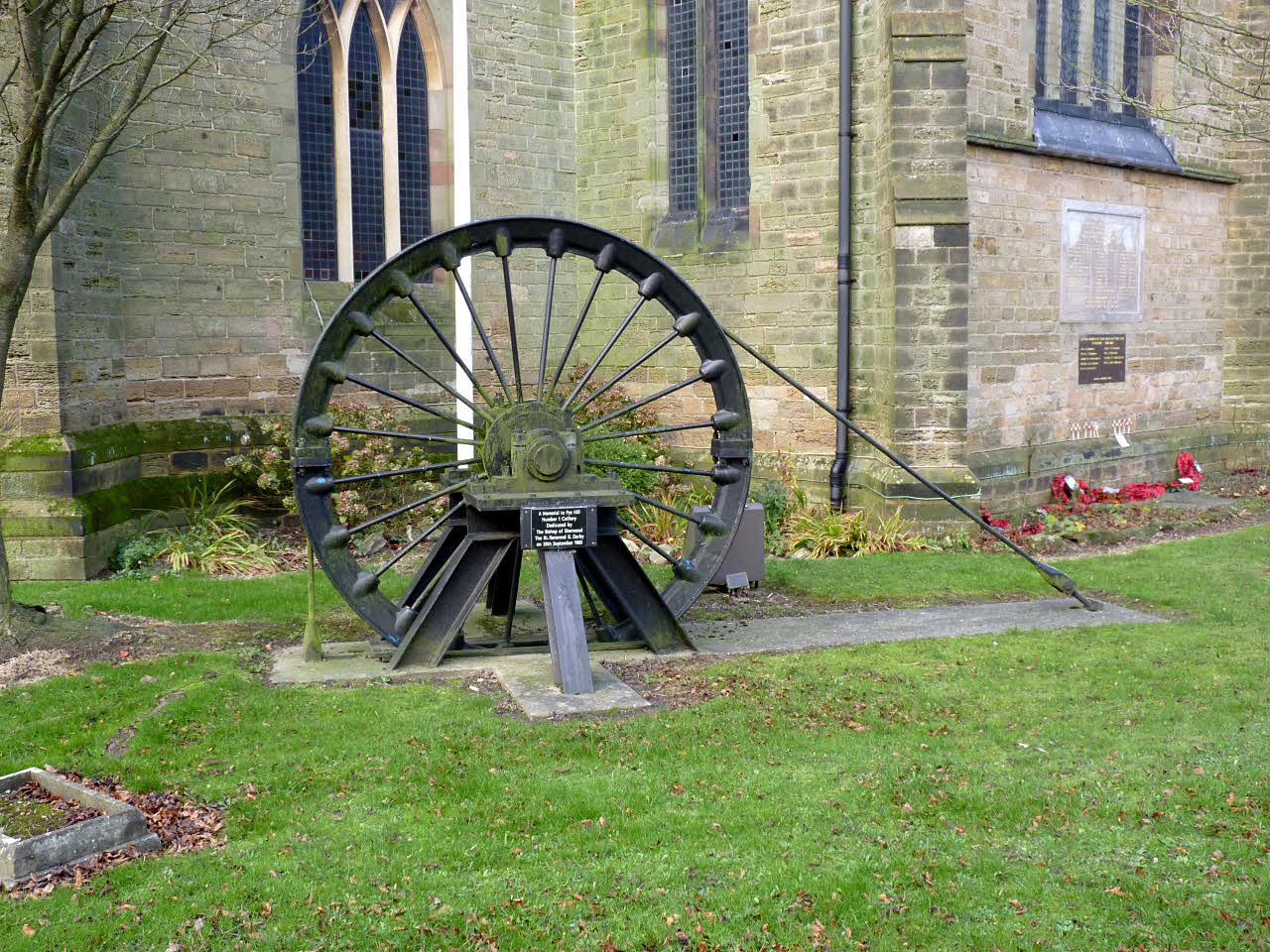
Cleared. The spoil heaps were made safe and landscaped for walking, and the nature reserve on them, giving access to Jubilee Hill, shows colonising vegetation and scrub. At Underwood the wheel from the headstock stands as a memorial to Pye Hill No. 1, dedicated by the Bishop of Sherwood, and a second memorial stands at Underwood church.
The headstock wheel, re-erected at Underwood as a memorial; otherwise the landscaped tips.
Redevelopment
Landscaped spoil heaps and nature reserve.
Related mines
- Brinsley Colliery — Brinsley stopped drawing coal in 1934 but its shafts were kept open until 1970 as a second means of access to Pye Hill and Moorgreen.
- Moorgreen Colliery — Worked together underground: output from the Selston pit, which became Pye Hill No. 1, was raised at Moorgreen until the National Coal Board drove an 800-yard surface drift at Pye Hill in the later 1960s so that it could come up at Jacksdale instead.
- Underwood Colliery — The Selston or Underwood colliery was joined with Pye Hill at Jacksdale and New Selston and became Pye Hill No. 1.
Nearby mines
- Pinxton Colliery — 1.3 miles (2.0 km) N, Derbyshire
- Underwood Colliery — 1.7 miles (2.7 km) SE
- Brookhill Colliery — 1.8 miles (2.9 km) NE, Derbyshire
- Brinsley Colliery — 2.4 miles (3.8 km) SE
- Britain Colliery — 2.4 miles (3.8 km) W, Derbyshire
Straight-line distance, within 9 miles (15 km). Show on the map.
Recorded claims
Individual factual claims, each attached to the source(s) that support it below. Where sources disagree, both are kept.
- The pit was first sunk in 1874 by James Oakes & Co, its entrance on Selston Road on an exposed section of the Nottinghamshire coalfield. 1,2
- Pye Hill was an amalgamation of three pits sunk by different companies: the Jacksdale pit became Pye Hill No. 2, No. 1 was Selston at Underwood and No. 3 was New Selston; Selston merged with Pye Hill in 1967. 3,2
- The pit worked the Tupton seam at No. 1 and the Silkstone at No. 2 from 1894 to 1915, raising household and manufacturing coal. 1
- Employment was 424 in 1894, 514 in 1910, 763 in 1923, 859 in 1933 and 635 at nationalisation in 1947, when output was 240,000 tons. 1
- By 1967 the pit was 235 yards deep with 900 men producing 470,000 tons a year from a fully mechanised Black Shale, and an 800-yard surface drift was being driven so that Selston's output could be raised at Pye Hill instead of Moorgreen. 1
- The colliery opened in 1874 and closed in August 1985. 2,4
- The spoil heaps have been made safe and landscaped for walking, giving access to Jubilee Hill, where the nature reserve shows colonising vegetation and scrub. 2
- The wheel from the headstock stands at Underwood as a memorial to Pye Hill No. 1 Colliery, dedicated by the Bishop of Sherwood, and a second memorial stands at Underwood church. 5,6
- The fatality register for the pit, which also calls it Riddings Colliery, records deaths in earlier workings from 1851, including a man killed by an explosion of methane at Riddings in 1853. 3
Photographs & further reading
Deaths at the pit and its earlier Riddings workings from 1851 onwards, with inquest dates and places.
View sourceOwners, decade-by-decade employment and seams, the National Coal Board's 1967 description of the modernised pit, and the inspectors' accounts of individual accidents.
View sourceSources
- (primary) Durham Mining Museum: Pye Hill Colliery — Durham Mining Museum
- (secondary) Jacksdale (Wikipedia) — Wikipedia
- (secondary) Pye Hill Colliery fatalities (healeyhero.co.uk) — healeyhero.co.uk
- (primary) Nottinghamshire HER L2483: site of Pye Hill Colliery, Selston — Nottinghamshire Historic Environment Record
- (observational) Pye Hill Colliery headstock memorial, Underwood (Geograph photograph, 26 August 2005) — Geograph / Garth Newton
- (observational) Pye Hill Colliery memorial, Underwood church (Geograph photograph, 5 December 2014) — Geograph / Alan Murray-Rust
Record created: 9 September 2026 · Last researched: 9 September 2026