 MineArchive
Brinsley Colliery
| Also known as | Brinsley New; Fenton's |
|---|---|
| Location | Brinsley, Broxtowe, Nottinghamshire — 53.0350, -1.3085 (exact) |
| Commodity | Coal |
| Type | Coal |
| Worked | 1842–1934 (shafts retained until 1970) |
| Maximum depth | 780 feet (238m, second shaft, sunk 1872) |
| Operators | Barber, Walker and Company (1842–1934) |
Overview
A Nottinghamshire colliery on the Derbyshire border, worked by Barber, Walker & Company from 1842 to 1934, best known today as the pit where D. H. Lawrence's father worked for over twenty years — inspiration for 'Beggarlee' colliery in Sons and Lovers and a setting referenced in Odour of Chrysanthemums.
History
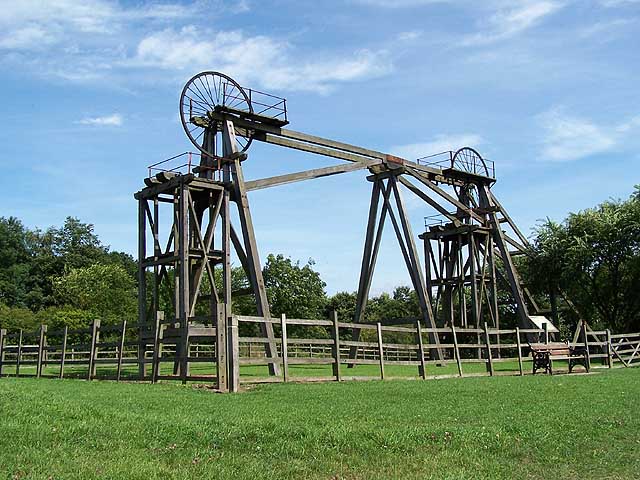
Brinsley Colliery was opened in 1842 by Barber, Walker & Company, who had leased and then bought much of the parish of Brinsley from the Duke of Newcastle. Two shafts were sunk: the first to 450 feet, and a second in 1872 to 780 feet, the two eventually crowned by tandem timber headstocks — the last surviving example of that construction type in Britain. At peak production the colliery raised 500 tons of coal a day, employing 361 men, of whom 282 worked at the coal face. Among them was Arthur John Lawrence, father of the novelist D. H. Lawrence, who began work at Brinsley at the age of seven and worked there until his retirement in 1909; his own father had also worked the pit. D. H. Lawrence drew directly on Brinsley and the mining communities of Eastwood and Underwood for his fiction, most explicitly as the colliery 'Beggarlee' in Sons and Lovers (1913), and the pit is also referenced in his short story Odour of Chrysanthemums. The colliery closed as a working pit in 1934 once its seams were exhausted, though the shafts themselves were kept open until 1970 to give access to neighbouring mines.
Geology
Coal of the Nottinghamshire field; the seams are not named on the record, and were worked out by 1934.
Workings
Two shafts, the first sunk to 450 feet in 1842 and a second to 780 feet in 1872, crowned by tandem timber headstocks — the last surviving example of that particular construction style in Britain.
Closure
Closed as a working pit in 1934 once its seams were exhausted; the shafts themselves remained open until 1970 to serve neighbouring mines.
What remains
The site is now reclaimed as a picnic site and conservation area beside the A608. The colliery's tandem timber headstocks — the last surviving example of that construction style in Britain — stood until a structural survey found them dangerous; Broxtowe Borough Council salvaged the original winding wheels and as much timber and ironwork as possible before dismantling them in December 2023. Following a public consultation, the council is rebuilding the headstocks as an exact timber replacement reusing the original wheels, with the restoration project under way as of 2026.
Related mines
- Moorgreen Colliery — Both Barber Walker pits; Brinsley stopped drawing coal in 1934 but its shafts were kept open until 1970 as a second means of access to Moorgreen and Pye Hill.
- Pye Hill Colliery — Brinsley stopped drawing coal in 1934 but its shafts were kept open until 1970 as a second means of access to Pye Hill and Moorgreen.
- Underwood Colliery — Both Barber Walker pits in the Eastwood group, and both in the country D. H. Lawrence grew up in.
In fiction
- Minton Pit (Sons and Lovers) — Brinsley is the pit D. H. Lawrence's father Arthur worked for over twenty years and the model for the colliery of Sons and Lovers (Wikipedia; this archive's Brinsley record), whose headstocks appear in the 1960 film. In the text Walter Morel's pit is Minton, with Beggarlee a separate pit of the same company; Wikipedia's Brinsley article gives the fictional name as Beggarlee.
Nearby mines
- Underwood Colliery — 1.0 miles (1.6 km) N
- Moorgreen Colliery — 1.1 miles (1.8 km) SE
- New London Colliery — 2.2 miles (3.5 km) SE
- Cotmanhay Colliery — 2.4 miles (3.8 km) S, Derbyshire
- Pye Hill Colliery — 2.4 miles (3.8 km) NW
Straight-line distance, within 9 miles (15 km). Show on the map.
Culture
- D. H. Lawrence and Brinsley Colliery (Literature)
Brinsley Colliery is the real pit fictionalised as 'Beggarlee' in Sons and Lovers, and where Lawrence's father Arthur John Lawrence worked for over fifty years.
Recorded claims
Individual factual claims, each attached to the source(s) that support it below. Where sources disagree, both are kept.
- The colliery had two shafts, the first sunk in 1842 to 450 feet and a second in 1872 to 780 feet, with tandem timber headstocks — the last surviving example of that construction style in Britain. 1
- At peak production the colliery raised 500 tons of coal a day, employing 361 men, 282 of them at the coal face. 1
- Arthur John Lawrence, father of the novelist D. H. Lawrence, worked at Brinsley Colliery from the age of seven until his retirement in 1909; his own father had also worked there. 1,2
- The colliery's tandem timber headstocks survived on site until 2023, when Broxtowe Borough Council dismantled and removed them after a structural engineer's report found them dangerous. 1
- Following demolition, a public consultation on the headstocks' future came back strongly in favour of an exact timber replacement; Broxtowe Borough Council salvaged the original winding wheels and as much original ironwork and timber as possible, and a restoration project using the salvaged wheels was under way as of 2026. 3
Photographs & further reading
Broxtowe Borough Council update on the dismantling and planned restoration of the tandem timber headstocks.
View sourceSources
- (secondary) Brinsley Colliery — Wikipedia — Wikipedia
- (secondary) Notts Villages: Brinsley — Nottinghamshire History
- (secondary) Brinsley Headstocks — Latest update — Broxtowe Borough Council
Record created: 2 September 2026 · Last researched: 2 September 2026