 MineArchive
Britain Colliery
| Also known as | Brittain Colliery, Brittain Pit, Britain Pit |
|---|---|
| Location | Butterley Park, Ripley, Derbyshire — 53.0614, -1.3904 (approximate) |
| Commodity | Coal |
| Type | Coal |
| Worked | 1827 (shallow shafts)–1946 |
| Maximum depth | About 250 yards |
| Operators | Butterley Company (1845–1946) |
Overview
A Butterley Company colliery in Butterley Park, Ripley, worked from shallow shafts of 1827 and deepened in the 1840s; it employed over a thousand people in 1923 and closed in 1946.
History
Britain Colliery, often spelt Brittain, lay in Butterley Park on the south side of Ripley. It is thought to take its name from Gabriel Britain, who owned several mines around Newlands and Golden Valley in the early 1800s. Shafts about 125 yards deep were sunk in 1827. One account credits them to the Butterley Company and another to Gabriel Britain himself, with Butterley taking over afterwards. In 1845-48 the Butterley Company deepened the pit to about 250 yards, to the Deep Soft at 160 yards, the Deep Hard at 185 and the Low Main at 241.
Western Pit and Brands Pit nearby later served as its ventilation, pumping and upcast shafts. A railway ran from the colliery over an iron bridge to Ripley Colliery. In 1874 the Butterley miners struck, partly over a new, wider screen at Britain that they said robbed them of at least a hundredweight in every ton. Eleven men were refused re-employment afterwards.
The workforce grew from 179 in 1894 to 1,031 in 1923. By then the colliery worked the Deep Hard, Deep Soft, Silkstone and Tupton seams for gas, household and manufacturing coal. Employment was still 770 in 1940. The colliery closed in 1946, and the Midland Railway Centre's Swanwick site now occupies the ground.
Geology
Derbyshire Coal Measures: the Deep Soft at about 160 yards, the Deep Hard at 185 yards and the Low Main at 241 yards, with the Tupton and Silkstone also worked. Western Pit is thought to have worked ironstone as well as coal.
Workings
The Britain shaft, with Western and Brands Pits as ventilation, pumping and upcast shafts. In 1907 a pair of 30-inch horizontal winding engines built by the Butterley Company wound the coal. Endless-rope haulage ran beneath the tubs on the main roads, driven by 75 and 50 hp electric motors. A Rateau exhaust-steam turbine powered the electricity plant, a 30-foot Waddle fan ventilated the pit, and an old beam pumping engine in Butterley Park dealt with water from the old workings to the south.
Closure
Closed in 1946; plans of the Silkstone and Threequarter workings at Britain and Western were deposited as abandoned in March 1946. The reason for closure is unknown.
What remains
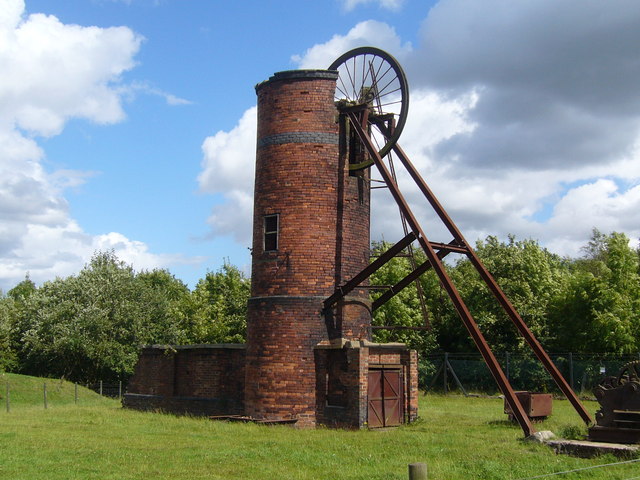
The site is within the Midland Railway Centre at Swanwick. A 2022-23 report shows the headframe standing inside a round brick tower.
A Grade II listed engine house of about 1848 on Butterley Park Road, with unusual headstocks partly enclosed in a round brick tower. The listing places it at Western Pit, and a 2008 photograph describes it as the Western upcast headstocks; a 2022-23 report calls it the tower over the Britain shaft.
Redevelopment
The site forms part of the Midland Railway Centre (Swanwick), formerly the Brittain Pit Farm Park.
Related mines
- Ripley Colliery — Butterley Company neighbour, joined to Britain by the colliery railway over the iron bridge at Steam Mill Lane.
Nearby mines
- Ripley Colliery — 1.1 miles (1.8 km) S
- Swanwick Colliery — 1.8 miles (2.8 km) N
- Pye Hill Colliery — 2.4 miles (3.8 km) E, Nottinghamshire
- Wingfield Manor Colliery — 2.6 miles (4.2 km) NW
- Denby Hall Colliery — 2.7 miles (4.3 km) S
Straight-line distance, within 9 miles (15 km). Show on the map.
What's uncertain
Points where sources disagree or the record could not be settled; both accounts are kept. All open questions in the archive.
- The first shafts, about 125 yards deep, were sunk by the Butterley Company in 1827. (disputed) 1
- Gabriel Britain worked shallow shafts here from 1827; the Butterley Company took them over and deepened them in 1845-48. (disputed) 2
- The surviving headframe tower stands over the Western Pit shaft. (disputed) 5,6
- The surviving headframe tower stands over the Britain shaft. (disputed) 2
Recorded claims
Individual factual claims, each attached to the source(s) that support it below. Where sources disagree, both are kept.
- The first shafts, about 125 yards deep, were sunk by the Butterley Company in 1827. (disputed) 1
- Gabriel Britain worked shallow shafts here from 1827; the Butterley Company took them over and deepened them in 1845-48. (disputed) 2
- Deepened in 1848 to about 250 yards, reaching the Deep Soft at 160 yards, the Deep Hard at 185 and the Low Main at 241. 1
- Employed 1,031 people in 1923, 803 of them underground. 3
- Closed in 1946. 2,1,4
- The engine house of about 1848 on Butterley Park Road, with headstocks in a round brick tower, is listed Grade II. 5
- The surviving headframe tower stands over the Western Pit shaft. (disputed) 5,6
- The surviving headframe tower stands over the Britain shaft. (disputed) 2
- In the 1874 strike the Butterley miners objected to a new, wider screen at Britain Colliery. 1
Photographs & further reading
A survey of surviving Midlands headstocks, including the brick tower at Britain.
View sourceSinking and deepening, the 1874 strike, the 1907 Butterley Company description of the plant, and photographs.
View sourceThe Grade II listed engine house and headstock tower on Butterley Park Road.
View sourceOwners, seams and employment from the lists of mines, and recorded fatalities.
View sourceSources
- (secondary) Britain Pit — Codnor history (codnor.info)
- (observational) Deep Mine Headstocks, Part 1: the Midlands, 2022-23 (28DaysLater) — 28DaysLater
- (primary) Britain Colliery — Durham Mining Museum
- (primary) Mine plan: Britain, Western, Silkstone seam (abandoned 1946) — British Geological Survey
- (primary) MDR14121 - Brittain Colliery Engine House, Butterley Park Road, Ripley — Derbyshire Historic Environment Record
- (observational) Brittain Pit Shaft (photograph, 2008) — Geograph
Record created: 1 October 2026 · Last researched: 2 October 2026