 MineArchive
Pentrich Colliery
| Location | Asher Lane, Pentrich, near Ripley, Derbyshire — 53.0620, -1.4140 (exact) |
|---|---|
| Commodities | Coal, Ironstone |
| Type | Coal |
| Worked | By c.1750–1946 |
| Maximum depth | Unknown. |
| Operators | Pentrich Colliery Company Limited (?–1946), Messrs Haslam |
Overview
A colliery off Asher Lane, Pentrich, near Ripley, said to have employed the village's men from about 1750, worked as the Hartington and Speedwell pits in the 1890s and closed in 1946; its atmospheric pumping engine of 1791 is now in the Science Museum.
History
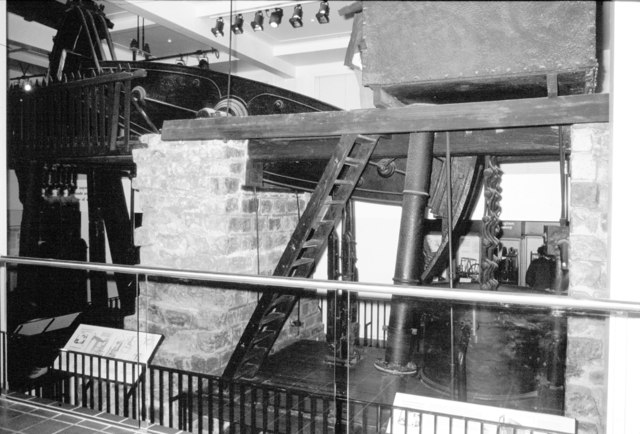
Coal was dug at Pentrich long before the colliery: medieval bell pits came to light when the land was reclaimed in the 1980s. The colliery is said to have been employing men from the village by about 1750, and its earliest part lay south of the railway. In 1841 an atmospheric pumping engine built in 1791 by Francis Thompson for Oakerthorpe Colliery was re-erected at Pentrich. It had a cylinder of 51¼ inches bore and a seven-foot stroke, and could raise 220 gallons a minute through 360 feet at eight strokes a minute, about 25 horsepower. It is preserved in the Science Museum.
The first Ordnance Survey map of the 1880s shows the colliery with railway sidings, shafts and a limekiln, and it had grown by the end of the century, adding a saw pit. It had two engine houses and worked coal and some iron. In 1894 it was worked as two pits: Hartington, with 245 people raising household coal from the Tupton and Silkstone seams, and Speedwell, with 51 in the Deep Soft and Deep Hard. Workings in the Deep Hard and Deep Soft were abandoned in 1898.
Its owners are listed as Messrs Haslam, W. C. Haslam and the Pentrich Colliery Company Limited. The colliery employed about 250 people from 1900 to 1915, 300 in 1923 and 500 in 1933. In 1940, working the Kilburn, Silkstone and Tupton seams, 420 men raised 186,000 tons of gas, household and manufacturing coal. Two miners were overcome by gas in August 1936. The pits closed in 1946, as the industry was being nationalised.
Bell pits were exposed again when the site was cleared after closure. By 1993 a few single-storey brick buildings were all that remained, and the site later became a scrap-metal yard; the main surviving building was demolished in the early 2000s.
Geology
Coal Measures of the Derbyshire coalfield: the Deep Hard, Deep Soft, Tupton, Silkstone, Kilburn and Blackshale seams, with some ironstone.
Workings
Two pits in the 1890s, Hartington and Speedwell; shafts, railway sidings, a limekiln and later a saw pit; two engine houses; an atmospheric pumping engine of 1791, re-erected here in 1841.
Closure
Closed in 1946, before nationalisation; the site was cleared and later occupied by a scrap-metal business.
What remains
A scrap-metal yard. The main surviving colliery building was demolished in the early 2000s; a brick building of the 1950s, possibly from the colliery, stands on the north edge of the site.
A brick building on the north edge of the site, possibly from the colliery.
Redevelopment
Industrial use: a scrap-metal business.
Nearby mines
- Britain Colliery — 1.0 miles (1.6 km) E
- Ripley Colliery — 1.4 miles (2.2 km) SE
- Swanwick Colliery — 2.1 miles (3.4 km) NE
- Wingfield Manor Colliery — 2.3 miles (3.7 km) N
- Denby Hall Colliery — 2.8 miles (4.5 km) S
Straight-line distance, within 9 miles (15 km). Show on the map.
Recorded claims
Individual factual claims, each attached to the source(s) that support it below. Where sources disagree, both are kept.
- Pentrich Colliery was employing men from the village from about 1750; medieval bell pits were found when the land was reclaimed in the 1980s. 1,2
- An atmospheric engine built by Francis Thompson in 1791 for Oakerthorpe Colliery was later moved to Pentrich Colliery. 3,4
- The engine was re-erected at Pentrich in 1841; it had a 51¼-inch cylinder and could raise 220 gallons a minute through 360 feet. 4
- In 1894 the colliery worked the Hartington pit, with 245 people, and the Speedwell pit, with 51. 5
- In 1940 the colliery employed 420 people and produced 186,000 tons. 5
- The pits closed in 1946. 2
- By 1993 only a few single-storey brick buildings survived, and the site is now occupied by a scrap-metal business. 1
Sources
- (secondary) MDR10108 - Pentrich Colliery (site of), Asher Lane, Pentrich — Derbyshire Historic Environment Record
- (secondary) Pentrich Colliery, off Asher Lane, Pentrich, c 1940 — Picture the Past
- (secondary) Pentrich Colliery Co — Grace's Guide
- (observational) Science Museum - Pentrich atmospheric engine — Geograph (Chris Allen)
- (primary) Durham Mining Museum: Pentrich Colliery — Durham Mining Museum
- (primary) BGS mine plans: Pentrich, Hard (Deep Hard) seam, abandoned 1898 — British Geological Survey / Mining Remediation Authority
Record created: 16 October 2026 · Last researched: 16 October 2026