 MineArchive
Nunnery Colliery
| Location | Darnall, Sheffield, South Yorkshire — 53.3854, -1.4353 (exact) |
|---|---|
| Commodity | Coal |
| Type | Coal |
| Worked | 1868–August 1953 |
| Maximum depth | The No. 1 or East Silkstone shaft was about 307 yards (281 m) deep to the Silkstone seam. |
| Operators | Nunnery Colliery Co., Ltd. (?–1947), National Coal Board (1947–1953) |
Overview
Nunnery Colliery stood on the eastern edge of Sheffield, between the city centre and Darnall, and was for most of its life the pit that supplied the city itself with house coal. It was worked by the Nunnery Colliery Company, trading as the Waverley Coal Company, which also held High Hazels Colliery about three miles further east and ran its own locomotives between the two. In December 1923 a haulage rope broke on the Main East engine plane and a train of 120 men and boys ran away down the incline, killing seven and injuring more than fifty (see Disasters, below). The colliery passed to the National Coal Board in 1947 and closed in August 1953 with its reserves said to be worked out.
History
Coal winding began on the Nunnery site in 1868, though the Northern Mine Research Society's account of the 1923 accident dates the start of winding to 1866. The colliery took its name from the medieval nunnery whose land it occupied. Its output is said to have supplied the bulk of Sheffield's coal trade, and by 1890 the company was among the principal coke makers of the district. A fire broke out in one of the shafts on 12 July 1871; every man underground escaped by the other shaft and the fire was soon put out, but work stopped for several days. The Home Office return for 1894 shows the company working two mines from the site, Nunnery Manor under S. Bacon with 116 below ground and Nunnery Parkgate under W. G. Todd with 361, the seam names recording the South Yorkshire beds worked at each. The company was known in the coal trade as the Waverley Coal Company, and its locomotives worked at Nunnery or at High Hazels interchangeably. By 1923 the colliery was winding from two shafts, both downcast, and working the Silkstone seam to the dip through the Main East engine plane, which ran nearly two thousand yards from the pit bottom. The colliery was nationalised in 1947 and closed in August 1953, its reserves said to be exhausted.
Geology
Nunnery worked the Middle Coal Measures of the South Yorkshire Coalfield. The Silkstone, reached at about 307 yards, was the seam worked at the time of the 1923 accident; it dipped to the north-east at an average of about four inches in the yard, so that all the workings lay to the dip of the shaft and had to be worked from a succession of levels driven off an inclined main plane. The Parkgate seam gave one of the two mines returned in 1894 its name.
Geological setting: Sedimentary Beds and Seams (well documented example), Strike and Dip (well documented example)
Workings
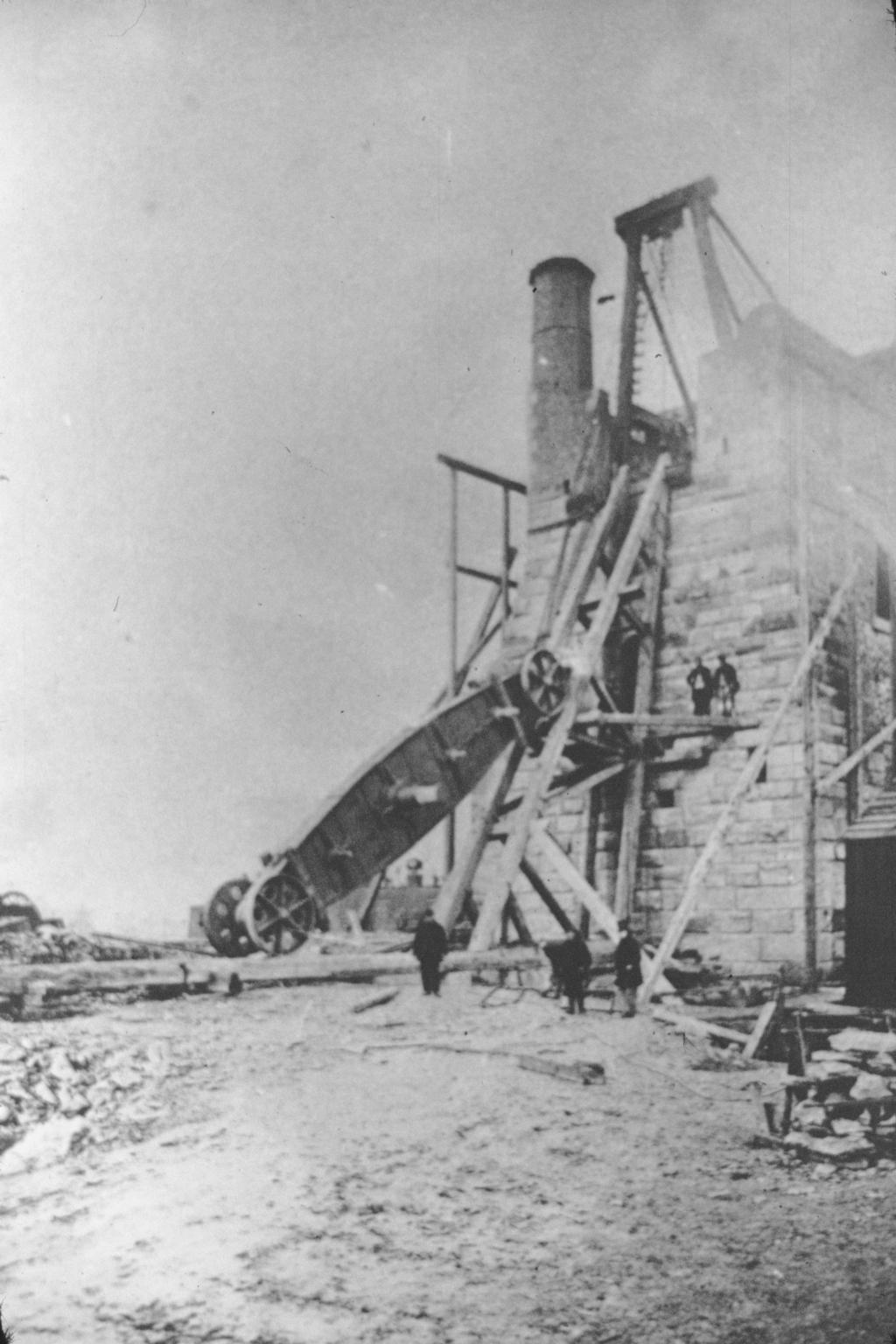
Two winding shafts, both downcast, one of them the No. 1 or East Silkstone pit. Because the Silkstone dipped away from the shaft, coal was brought up a main inclined haulage plane by a single rope driven by a surface steam engine of two 24-inch cylinders, the rope running down cast-iron pipes in the shaft lining to the pit bottom and then out along the plane on rollers. The Main East engine plane ran straight for 1,156 yards before dividing, the two branches each reaching about 1,950 yards from the pit bottom, the roads averaging five feet six inches high and seven feet wide. Men rode the same rope at the start and end of each shift in a train of tubs known as the Paddy Mail, a practice that had gone on for six years by 1923; signals were passed along the plane by shorting a pair of overhead wires together, in practice with the blade of a pocket knife.
Closure
Nationalised on 1 January 1947 and closed in August 1953, the reserves being reported as exhausted. Pumping continued in the district afterwards, since other pits in the coalfield were still working and needed the water kept down.
What remains
The colliery has gone entirely. Parkway Avenue and its industrial units cover the site. A capped shaft survives: forum contributors reported in November 2020 that the small building inside a square of tall conifers opposite Makro on Parkway Avenue is the shaft cap, one of them confirming it from having worked at the depot built above it, with discussion in the same thread of the pipe that formerly discharged mine water towards the canal.
A capped shaft within a fenced enclosure off Parkway Avenue is the only identified survival; no colliery buildings, headgear or spoil heap remain.
Redevelopment
Industrial and commercial units along Parkway Avenue, with the Sheffield Parkway running past the site.
Related mines
- Handsworth Colliery — Both were worked by the Nunnery Colliery Company, and NMRS records Handsworth Pit as part of Nunnery Colliery.
- High Hazels Colliery — Both worked by the Nunnery Colliery Company as the Waverley Coal Company, whose locomotives served either colliery.
Nearby mines
- Brightside Colliery — 1.2 miles (2.0 km) NE
- High Hazels Colliery — 2.0 miles (3.2 km) E
- Handsworth Colliery — 2.1 miles (3.4 km) E
- Tinsley Park Colliery — 2.2 miles (3.6 km) NE
- Orgreave Colliery — 2.9 miles (4.7 km) E
Straight-line distance, within 9 miles (15 km). Show on the map.
Disasters & major incidents
-
Nunnery Colliery overwinding, 1867
25 March 1867 · Winding / Shaft Accident · 2 fatalities
Two sinkers, Thomas Jepson and Samuel Slack, were killed by an overwind at the Duke of Norfolk's Nunnery Colliery, Sheffield, on 25 March 1867. -
Nunnery Colliery roof fall, 1879
18 October 1879 · Collapse / Roof Fall · 2 fatalities
A fall of roof at the Nunnery Coal Company's colliery in Sheffield killed a 62-year-old contractor and a trammer on 18 October 1879. -
Nunnery Colliery Paddy Mail Accident
3 December 1923 · Haulage / Transport · 7 fatalities
On the afternoon of 3 December 1923 a haulage rope broke on the Main East engine plane at Nunnery Colliery while 120 men and boys were riding down it in the Paddy Mail, a train of forty-four tubs. The set ran away, gathered speed and crashed at Cain's Junction 377 yards below the starting point, some of the tubs leaving the rails. Seven men died and fifty-five were injured. The inquiry led to recommendations that ropes used for riding be limited in life, never spliced, and fitted with runaway catches.
What's uncertain
Points where sources disagree or the record could not be settled; both accounts are kept. All open questions in the archive.
- Wikipedia and Grace's Guide both date the start of mining on the Nunnery site to 1868; the Northern Mine Research Society's account of the 1923 accident says the colliery had been winding coal since 1866. (disputed) 1,2,3
- Forum contributors reported in November 2020 that the capped Nunnery shaft stands inside a conifer-screened enclosure opposite Makro on Parkway Avenue, one of them confirming it from having worked at the depot built over it. (uncertain) 5
Recorded claims
Individual factual claims, each attached to the source(s) that support it below. Where sources disagree, both are kept.
- Wikipedia and Grace's Guide both date the start of mining on the Nunnery site to 1868; the Northern Mine Research Society's account of the 1923 accident says the colliery had been winding coal since 1866. (disputed) 1,2,3
- The colliery's output is said to have supplied the bulk of the coal trade within Sheffield, and by 1890 the company was one of the principal coke makers of the district. 2,3
- The mining company was known as the Waverley Coal Company and also worked High Hazels Colliery about three miles further east, its locomotives working at either pit. 2
- The Home Office return for 1894 lists the company working Nunnery Manor, under manager S. Bacon with 116 below ground and 14 above, and Nunnery Parkgate under W. G. Todd with 361 below ground. 4
- At the time of the 1923 accident the colliery wound from two shafts, both downcast, the No. 1 or East Silkstone pit being about 307 yards deep to the Silkstone seam, which dipped north-east at about four inches to the yard. 1
- A fire broke out in one of the shafts on 12 July 1871; all the men underground escaped by the other shaft and the fire was soon extinguished, but work was halted for several days. 2
- Nunnery was nationalised in 1947 and closed in August 1953, its reserves said to be exhausted. 2,3
- Forum contributors reported in November 2020 that the capped Nunnery shaft stands inside a conifer-screened enclosure opposite Makro on Parkway Avenue, one of them confirming it from having worked at the depot built over it. (uncertain) 5
- The BGS and Mining Remediation Authority mine-plans catalogue holds one record for Nunnery Colliery, a Network Rail plan. 6
Photographs & further reading
The fullest account of the colliery's shafts, the Silkstone workings and the main haulage plane, written around the 1923 disaster and quoting Sir Thomas Mottram's inquiry report and its recommendations on haulage ropes.
View sourceThe 1894 Home Office return for the company, listing Nunnery Manor and Nunnery Parkgate with their managers and the numbers employed above and below ground.
View sourceA November 2020 thread identifying the capped Nunnery shaft in its conifer-screened enclosure off Parkway Avenue, with recollections from someone who worked at the depot built above it.
View sourceSources
- (secondary) Nunnery Colliery Manrider Accident, Sheffield, 1923 — Northern Mine Research Society
- (secondary) Nunnery Colliery — Wikipedia
- (secondary) Nunnery Colliery — Grace's Guide to British Industrial History
- (primary) Durham Mining Museum: Nunnery Colliery Co., Ltd. — Durham Mining Museum
- (observational) Nunnery colliery shaft cap (Sheffield History forum thread, November 2020) — Sheffield History forums
- (primary) BGS mine plans catalogue: Network Rail Plan (Nunnery Colliery) — British Geological Survey / Mining Remediation Authority
Record created: 9 September 2026 · Last researched: 9 September 2026