 MineArchive
Nunnery Colliery Paddy Mail Accident
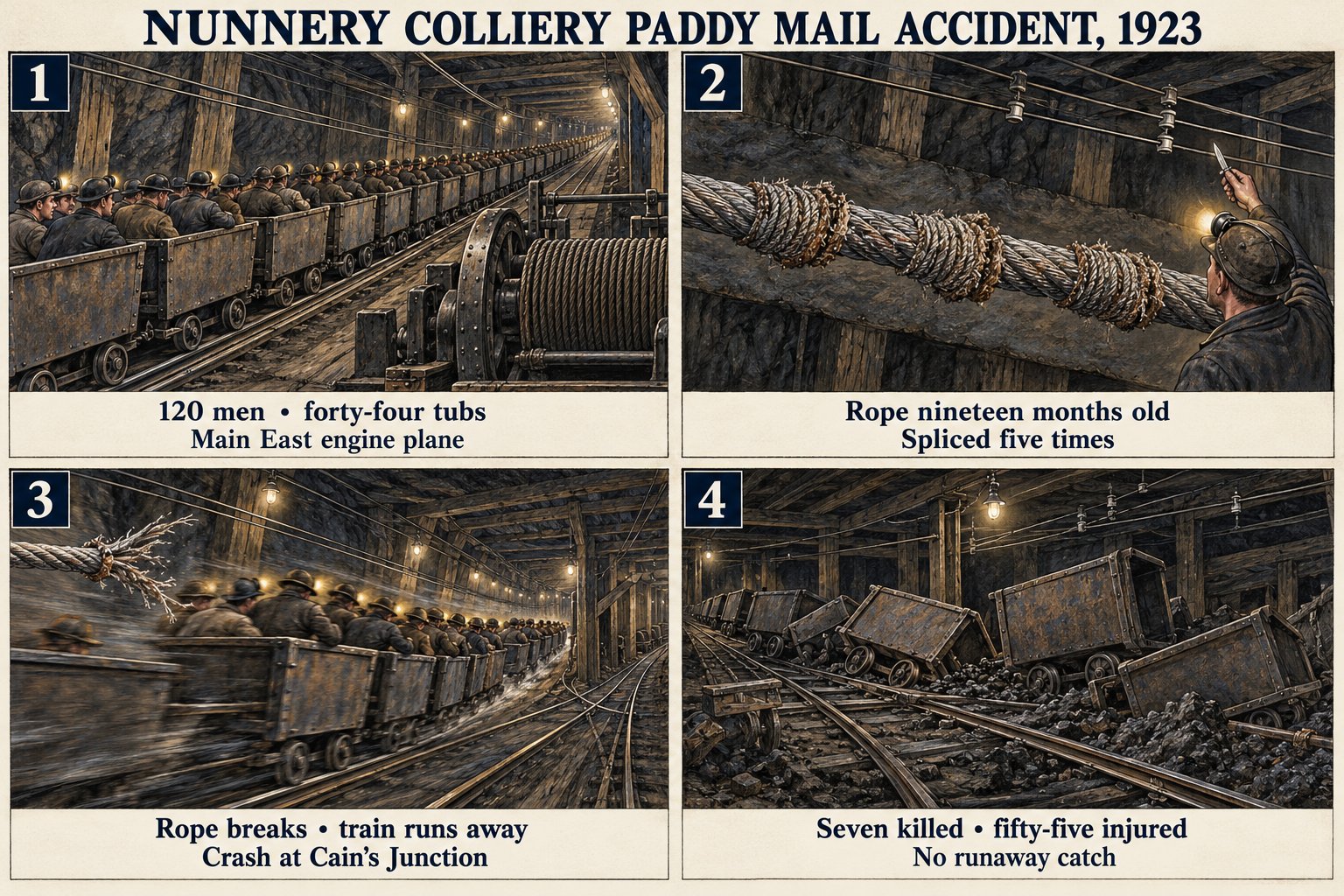
On the afternoon of 3 December 1923 a haulage rope broke on the Main East engine plane at Nunnery Colliery while 120 men and boys were riding down it in the Paddy Mail, a train of forty-four tubs. The set ran away, gathered speed and crashed at Cain's Junction 377 yards below the starting point, some of the tubs leaving the rails. Seven men died and fifty-five were injured. The inquiry led to recommendations that ropes used for riding be limited in life, never spliced, and fitted with runaway catches.
| Date | 3 December 1923 |
|---|---|
| Mine | Nunnery Colliery |
| Region | South Yorkshire |
| Primary type | Haulage / Transport |
| Associated types | Machinery |
| Fatalities | 7 (Seven were killed. The Northern Mine Research Society's account states seven deaths but prints six names, so one man's name is missing from that list rather than the count being in doubt.) |
| Injuries | Eight men were seriously injured and forty-seven received minor injuries. |
| Context | During active mining |
Cause
The failure of the main haulage rope, nineteen months old and spliced five times over its 2,330-yard length, at the moment the set began to run. With the rope gone the train was uncontrolled on a falling gradient.
Contributing factors
Men were ridden on the same single rope that hauled coal, with no separate manriding road and no appliance fitted to arrest a set if the rope failed. Signalling along the plane was done by shorting two overhead wires together, in practice with an open pocket knife, and the signal the run attendant meant to send was received at the engine house as a different one. The inquiry also found that statutory weekly rope examinations had not recorded defects: when broken wires were found or a splice made, the rope was repaired and then reported to be in good order.
What happened
Between two and half past two in the afternoon 120 men and boys were waiting to ride down the Main East engine plane in the Paddy Mail, a set of forty-four tubs of which forty-two carried men, as many as four to a tub. An injured man was being carried up the plane on a stretcher and there was not room to pass the standing train, so the run attendant, Colin Chappell, had the men step out and signalled the engineman to draw the set up about forty yards. The men then got back in and Chappell signalled that they were aboard and that the set should be lowered steadily. It ran normally at about three miles an hour, then began to gather speed. A haulage man, Harry Scott, saw it and shouted to Chappell to signal again; Chappell drew the overhead wires together with his knife, but at the engine house the signal was read as 'stop'. The engineman's assistant threw over the reversing lever and the engine stopped in eighteen feet, at which point they saw the rope hanging slack with no load on it. The train ran on down the incline and crashed at Cain's Junction, 377 yards from where it had started, tubs jumping the rails.
Rescue & recovery
The injured were brought out of the plane and taken to hospital; eight were seriously hurt and forty-seven had lesser injuries. Those who died were the colliers William Thomas Birch, 53, Charles Bowden, 62, John Henry Turner, 49, Charles Needham, 60, and Charles White, 37, and the eighteen-year-old haulage hand Bernard Newton, their injuries recorded as fractures of the skull, neck, spine and legs and injuries to the head and body.
Investigation & inquiry
A formal inquiry opened in the Council Chamber at Sheffield Town Hall on 7 May 1924, sat for two days and heard seventeen witnesses. It was conducted by Sir Thomas H. Mottram, C.B.E., formerly H.M. Chief Inspector of Mines, and reported to Emanuel Shinwell, Secretary for Mines, on 11 August 1924. The splicing history of the rope was set out in evidence, and the coroner's jury had already returned a verdict of accidental death. Mottram did not blame the management for the rope's failure, ropes of the same make having lasted longer elsewhere and the daily and weekly examinations having shown nothing beyond ordinary wear, but he was not satisfied that those examinations had been thorough, and found that the statutory reports required by section 66 of the Coal Mines Act 1911 had not been full and accurate.
Legal & regulatory aftermath
Mottram recommended that section 66 be extended to require daily examination of all gear used to haul people underground, with every defect and its remedy recorded in the mine's book; that splicing of ropes used to haul people on inclined planes be prohibited; that the life of such ropes be limited to eighteen months; and that every set used to ride men be fitted with an effective appliance to arrest it if the rope broke. Runaway catches were installed at Nunnery after the accident, and the desirability of a separate road for riding men was considered.
Changes to practice & legislation
The inquiry's recommendations on rope life, splicing, arresting appliances and recorded examinations belong to the run of interwar findings that pushed British manriding practice towards purpose-built manriding roads and gear.
Memorials & commemoration
None recorded.
Recorded claims
Individual factual claims, each attached to the source(s) that support it below. Where sources disagree, both are kept.
- The Paddy Mail was a train of forty-four tubs, forty-two of them carrying 120 men and boys, as many as four to a tub. 1
- The set ran away and crashed at Cain's Junction, 377 yards from where it had started down the plane. 1
- Seven men were killed, eight seriously injured and forty-seven injured less severely. 1,2
- The rope was nineteen months old and had been spliced five times between April 1922 and June 1923, its total length being 2,330 yards. 1
- The run attendant tried to signal 'lower steadily' by drawing the overhead wires together with his knife, but the signal received at the engine house was 'stop'. 1
- Samples of the broken rope were examined by the testing works superintendent James Hoyland and by Professor C. H. Desch of Sheffield University, neither of whom could explain the fracture beyond finding that it broke in tension. 2
- Sir Thomas Mottram's inquiry sat for two days from 7 May 1924, heard seventeen witnesses and reported to the Secretary for Mines on 11 August 1924, declining to blame the management for the rope's failure but finding the statutory examination reports incomplete. 1
- Mottram recommended daily examination of manriding gear with all defects recorded, a ban on splicing ropes used to haul people on inclined planes, a maximum rope life of eighteen months, and an arresting appliance on every set used to ride men. 1
- The coroner's jury returned a verdict of accidental death. 2
Related terminology
Mining terms this disaster is structurally linked to, with the nature of the relationship.
- Coal Mines Act 1911 (contextual relationship)
Named in this record’s investigation: “…and found that the statutory reports required by section 66 of the Coal Mines Act 1911 had not been full and accurate.” - Engine House (contextual relationship)
Named twice in this record, first in the contributing factors: “…and the signal the run attendant meant to send was received at the engine house as a different one. The inquiry also found that statutory weekly…” - Haulage (contextual relationship)
Named 4 times in this record, first in the summary: “On the afternoon of 3 December 1923 a haulage rope broke on the Main East engine plane at Nunnery Colliery while…” - Man-riding (contextual relationship)
Named twice in this record, first in the summary: “…Nunnery Colliery while 120 men and boys were riding down it in the Paddy Mail, a train of forty-four tubs. The set ran away, gathered speed and…” - Tub (contextual relationship)
Named 5 times in this record, first in the summary: “…boys were riding down it in the Paddy Mail, a train of forty-four tubs. The set ran away, gathered speed and crashed at Cain's Junction 377…”
Photographs & further reading
This page doesn't try to reproduce everything — these are the best original sources found for this disaster.
A digest of Sir Thomas Mottram's inquiry report, giving the layout of the Main East engine plane, the signal code in use, the splicing history of the broken rope, the names of the men who died and the recommendations that followed.
View sourceSources
- (secondary) Nunnery Colliery Manrider Accident, Sheffield, 1923 — Northern Mine Research Society
- (secondary) Nunnery Colliery — Wikipedia
Record created: 9 September 2026 · Last researched: 9 September 2026