 MineArchive
Loanhead (Ramsay) Colliery
| Also known as | Loanhead Colliery, Ramsay Colliery |
|---|---|
| Location | Loanhead, Midlothian — 55.8792, -3.1533 (approximate) |
| Commodities | Coal, Iron |
| Type | Coal |
| Worked | c.1850–1965 (abandoned 1966) |
| Maximum depth | 302 m (deeper of the two shafts) |
| Operators | Shotts Iron Company (1865–1947) |
Overview
A Midlothian pit worked by the Shotts Iron Company from the middle of the nineteenth century, first for blackband ironstone and then for house and steam coal. It closed in 1965, two years after the Bilston Glen 'super pit' opened a mile away and made it redundant.
History
Sinking and production at Ramsay began around 1850, and the Shotts Iron Company Limited held the colliery from 1865. It worked blackband ore at first — the ironstone that fed Scotland's iron industry — and later house and steam coal. A new washery by the Blantyre Engineering Company was installed in 1929, and one of the shafts was rebuilt at the same time, lined with concrete to 4.88 m diameter and deepened from 176 m to 285 m. Pithead baths followed in 1932, a first-aid room, and a snack canteen added in 1939. Most of the pit's electricity came from the power station at neighbouring Burghlee Colliery rather than the public supply.
The colliery's end was a matter of policy rather than exhaustion. In 1952 work began on Bilston Glen, a new 'super pit' just west of Loanhead designed to work seams 750 m down. It came into production in 1963, and two years later both Ramsay and Burghlee were closed.
Geology
The colliery worked house and steam coals in the Midlothian coalfield, and originally blackband ironstone — the ore-bearing bands that made the district valuable to the iron trade before coal became the main product.
Geological setting: Sedimentary Ironstones (historical documentary reference)
Workings
Two shafts, 302 m and 174 m deep. One was reconstructed in 1929 with a concrete lining at 4.88 m diameter and deepened from 176 m to 285 m. In 1948 the pit raised 122 tons a day and 30,500 tons in the year with 163 employees, using a Coppee Baum-type washer.
Closure
Ramsay closed in 1965 and was abandoned in 1966, two years after Bilston Glen came into production; its neighbour Burghlee closed at the same time. Bilston Glen itself, employing some 2,200 men, lasted until 1989.
What remains
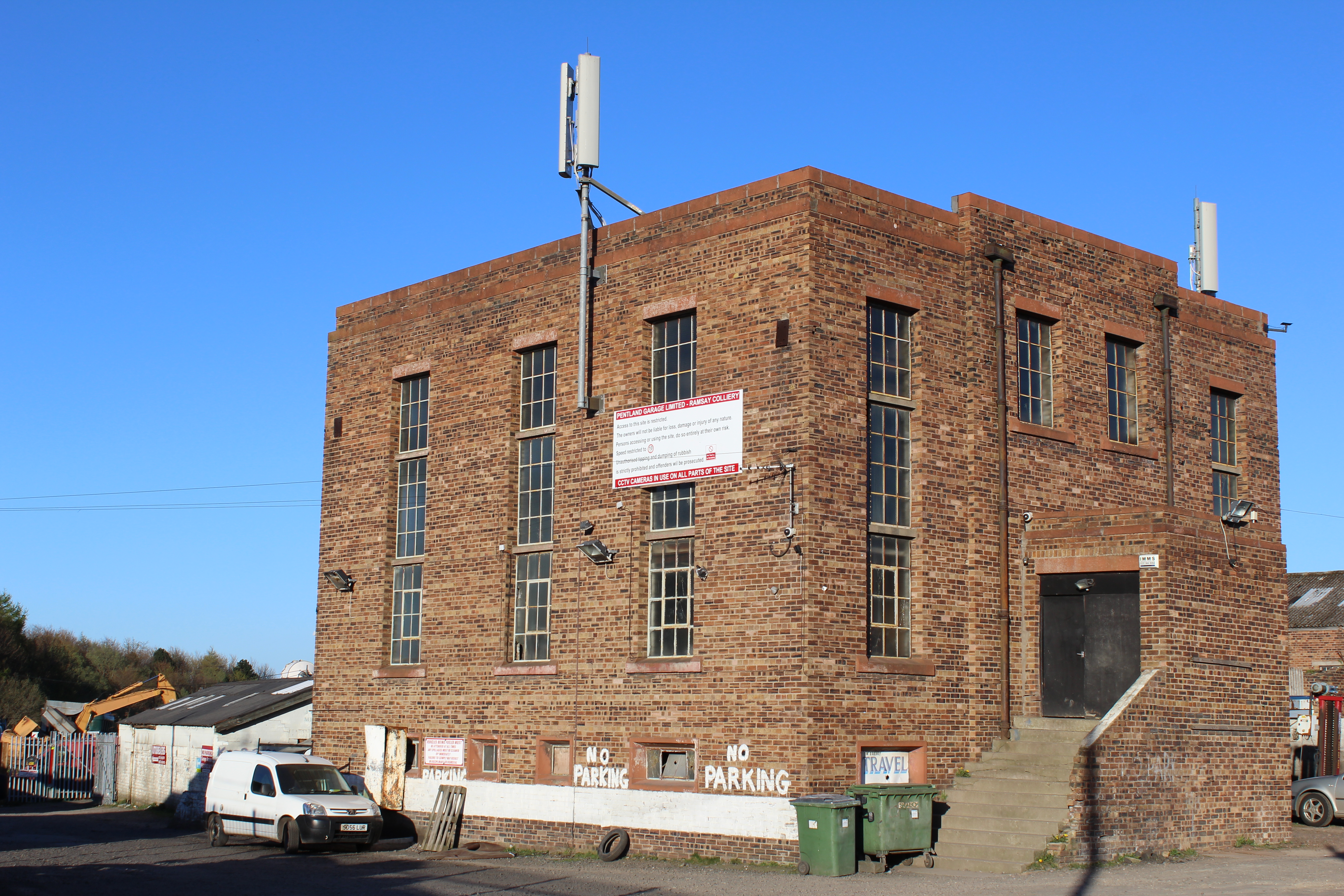
The colliery site has been redeveloped. A former Ramsay Colliery building survives on Engine Road in Loanhead, the clearest above-ground reminder of the pit left in the town.
A former colliery building on Engine Road survives in other use. The two headgears — one steel, one reinforced concrete — that stood over the shafts are recorded in the national collection but no longer stand.
Redevelopment
The colliery ground has been absorbed into Loanhead's built-up area; the town itself outlived the pit, and Bilston Glen's industrial estate now occupies part of the wider mining site.
Related mines
- Burghlee Colliery — The two Loanhead pits were closed together within two years of Bilston Glen starting production in 1963; Burghlee is named on the Ramsay record.
Nearby mines
- Bilston Glen Colliery — 0.6 miles (0.9 km) SW
- Burghlee Colliery — 0.5 miles (0.9 km) S
- Roslin Colliery — 1.8 miles (2.9 km) SW
- Gilmerton Colliery — 1.9 miles (3.0 km) NE
- Eldin Colliery — 2.0 miles (3.2 km) E
Straight-line distance, within 9 miles (15 km). Show on the map.
Disasters & major incidents
-
Loanhead Colliery roof fall, 1893
13 February 1893 · Collapse / Roof Fall · 2 fatalities
Two miners finishing a steep break incline in the Corbie coal at Loanhead were killed on 13 February 1893 when 20 tons of coal and blaes swept down it. -
Loanhead Colliery roof fall, 1895
11 October 1895 · Collapse / Roof Fall · 2 fatalities
Two miners, Abraham Pryde and Peter Frame, were killed by a fall of stone at the Shotts Iron Company's Loanhead Colliery on 11 October 1895.
Recorded claims
Individual factual claims, each attached to the source(s) that support it below. Where sources disagree, both are kept.
- Sinking and production at Ramsay began around 1850, and the Shotts Iron Company Limited held the colliery from 1865. It worked blackband ore originally, and later house and steam coal. 1
- The colliery had two shafts, 302 m and 174 m deep. One was reconstructed in 1929, concrete-lined at 4.88 m diameter and deepened from 176 m to 285 m, when a new Blantyre Engineering Company washery was installed. 1
- In 1948 the pit produced 122 tons a day and 30,500 tons in the year with 163 employees; it had baths from 1932, a first-aid room and a canteen added in 1939, and took most of its electricity from the power station at neighbouring Burghlee Colliery. 1
- The average workforce was 346, peaking at 385 in 1952. 1
- Work began in 1952 on Bilston Glen, a new 'super pit' west of Loanhead designed to reach seams 750 m down. It came into production in 1963, and two years later both Ramsay and Burghlee were closed. 2,1
Sources
- (primary) Loanhead, Ramsay Colliery — Canmore/Trove — Historic Environment Scotland
- (secondary) Loanhead — Undiscovered Scotland
Record created: 27 August 2026 · Last researched: 28 August 2026