 MineArchive
Bilston Glen Colliery
| Location | Loanhead, Midlothian — 55.8739, -3.1653 (exact) |
|---|---|
| Commodity | Coal |
| Type | Coal |
| Worked | From 1952 (sinking)–1989 |
| Maximum depth | Coal worked at around 750 m |
| Operators | National Coal Board (1952–1987), British Coal Corporation (1987–1989) |
Overview
A National Coal Board superpit sunk at Loanhead in 1952 to work the Midlothian coalfield far deeper than the old pits could reach. It employed well over two thousand men, replaced the collieries around it, became the focus of Scotland's bitterest picketing in 1984-85, and closed four years after the strike ended.
History
Coal had been worked around Loanhead since the 1680s, and by the end of the Second World War the town had two pits — the Ramsay, working since 1850 with about 350 men, and the Burghlee, from the 1860s, with about 770. In 1952 the National Coal Board began sinking Bilston Glen just west of the town, a modern superpit designed to reach seams some 750 m down in the Midlothian basin. Production began in 1963 and both older pits closed within two years. Bilston Glen employed around 2,200 men, averaging 2,154 over its life and peaking at 2,367 in 1970, and sent roughly 45 per cent of its coal to power stations.
In the strike of 1984-85 the pit became the focal point of picketing in Scotland, with men attempting to stop colleagues going in and flying pickets arriving from northern England. Midlothian's miners were dismissed at roughly twice the English rate — close to 25 per thousand — and over a hundred Lothians men never got their jobs back even after winning at tribunal. The colliery was closed as uneconomic in 1989.
At its peak the pit raised more than a million tons of coal a year and employed almost 2,500 people, many of them new to mining, which is part of why it mattered so much in 1984. Mass picketing began at Bilston Glen and at Monktonhall, across in East Lothian, on 12 March 1984, and Bilston Glen became the focal point of the strike in Scotland: the biggest and most modern pit in the coalfield, and the one where the National Coal Board was most determined to get men back through the gate. Local management painted white lines on the road outside and warned that any picket who crossed them would be dismissed; the union delegate at the pit, Jackie Aitchison, crossed and was sacked, and never got his job back despite winning his tribunal. Scottish miners were sacked at roughly twice the English rate, nearly 14 per thousand against seven, and in Midlothian at nearly 25 per thousand; about 1,400 were arrested in Scotland and more than 500 convicted, mostly of breach of the peace or obstruction. Thirty-six men from Bilston Glen and forty-six from Monktonhall, 106 across the Lothians, were never allowed back to work. The Scottish Government's independent review of the strike, reporting in 2020, recommended a pardon for those convicted of the lesser strike-related offences, and the pardon was granted in 2022; no compensation followed, and Alex Bennett, the branch chairman at Bilston Glen who was blacklisted for three years and had campaigned for both, died in 2023.
Geology
Bilston Glen worked the Limestone Coal Formation seams of the Midlothian coalfield, in the deep centre of the basin — ground the older, shallower pits around Loanhead could not reach. The Midlothian basin is a tight syncline, and it is the steep dip on its flanks that had kept the deeper coal out of reach of pits sunk in the 19th century: the new shafts were placed to meet the seams where they flatten out in the trough, which is why coal was being worked at around 750 m.
Geological setting: Anticlines and Synclines (well documented example), Sedimentary Beds and Seams (well documented example)
Workings
Two shafts, sunk from 1952 and equipped for a scale of output the older Midlothian pits could not match: one wound coal in skips, the other carried men in double-decked cages. Coal was worked at around 750 m, and a coal preparation plant on the surface handled the output before it went out by the colliery's own rail branch.
Closure
Closed as uneconomic in 1989, four years after the strike. The colliery buildings were demolished and the site cleared.
What remains
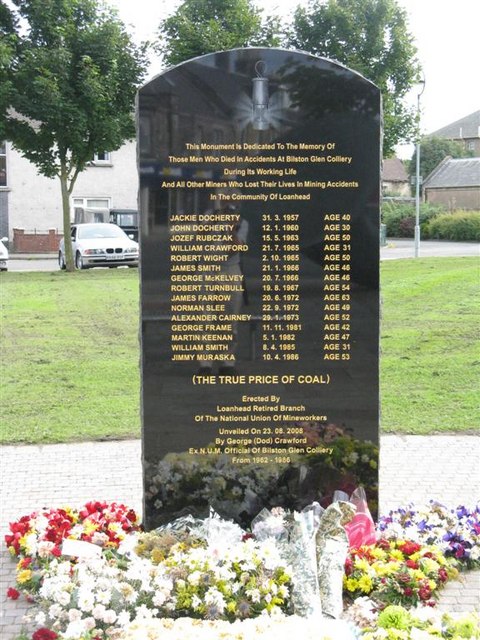
Nothing of the colliery stands. The site is an industrial estate, its rail branch partly converted to a walking and cycling route and its bing still visible as a mound in the landscape. A black marble monument, The True Price of Coal, stands in Loanhead town centre to the fifteen men killed in accidents at the pit between 1957 — while it was still being developed — and 1986.
An industrial estate on the colliery site, the spoil bing, the converted trackbed of the colliery branch, and the memorial in Loanhead.
Related mines
- Newcraighall Colliery — Newcraighall's workforce transferred to Bilston Glen on closure in 1968.
Nearby mines
- Burghlee Colliery — 0.3 miles (0.5 km) SE
- Loanhead (Ramsay) Colliery — 0.6 miles (0.9 km) NE
- Roslin Colliery — 1.2 miles (2.0 km) SW
- Whitehill Colliery — 1.9 miles (3.1 km) SE
- Eldin Colliery — 2.4 miles (3.9 km) E
Straight-line distance, within 9 miles (15 km). Show on the map.
Recorded claims
Individual factual claims, each attached to the source(s) that support it below. Where sources disagree, both are kept.
- Work began in 1952 on a superpit to exploit coal seams some 750 m underground; production started in 1963 and the Ramsay and Burghlee pits closed within two years. 1
- The new pit employed around 2,200 men, and about 45 per cent of its coal was burned in power stations. 1
- Bilston Glen was the focal point of picketing in Scotland during the 1984-85 strike; Midlothian miners were dismissed at nearly 25 per thousand, roughly double the English rate, and over 100 Lothians miners never returned to work despite winning tribunal cases. 2
- A black marble monument in Loanhead commemorates the fifteen men killed in accidents at the colliery between 1957 and 1986. 1
- BGS and the Coal Authority hold 26 catalogued plans under Bilston Glen, including plans of the No. 1 and No. 2 tips. 3
- At its peak Bilston Glen produced more than a million tons of coal a year and employed almost 2,500 people. 2
- Mass picketing began at Bilston Glen and Monktonhall on 12 March 1984, and Bilston Glen became the focal point of the strike in Scotland. Thirty-six Bilston Glen men were never allowed back to work, part of 106 across the Lothians. 2
- Scottish miners were dismissed at roughly twice the English rate and Midlothian miners at nearly 25 per thousand; about 1,400 were arrested in Scotland and over 500 convicted. A pardon for those convicted of lesser strike-related offences was granted in 2022 on the recommendation of the Scottish Government's independent review, without compensation. 2
Photographs & further reading
Account of Loanhead’s pits, the sinking of Bilston Glen and the memorial in the town.
View sourceSources
- (secondary) Loanhead — Undiscovered Scotland
- (secondary) 40 years on: how the miners' strike reshaped Midlothian — Edinburgh Inquirer, March 2024
- (primary) BGS mine plans catalogue: Bilston Glen (record 21856872) — British Geological Survey / The Coal Authority
Record created: 25 August 2026 · Last researched: 11 September 2026