 MineArchive
Hendre Mine
| Also known as | Hendre Lead Mines, Olwyn Goch, North Hendre Lead Mine |
|---|---|
| Location | Hendre, Halkyn, near Rhydymwyn, Flintshire — 53.2013, -3.1926 (approximate) |
| Commodities | Lead, Limestone, Zinc |
| Type | Metal |
| Worked | From 1931–1977 (lead) |
| Maximum depth | Olwyn Goch shaft 470 ft (143 m) |
| Operators | Halkyn District United Mines (1931–1987) |
Overview
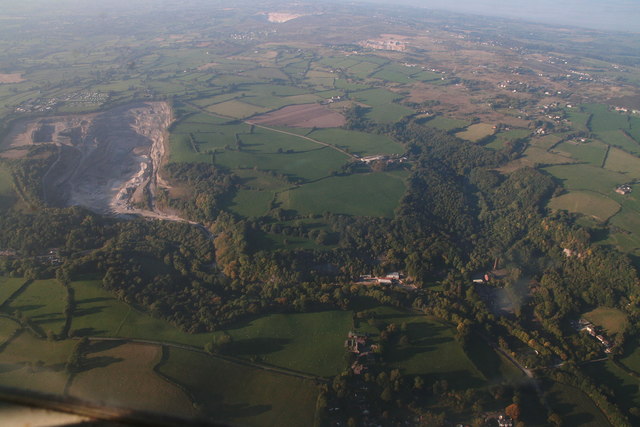
The lead workings at Hendre, on the southern end of the Halkyn orefield in Flintshire, became the last working centre of the whole district. The Milwr Tunnel reached the Olwyn Goch shaft here in 1931, surface operations moved down from Pen-y-Bryn three years later, and Hendre ran the district's offices, baths and lamp rooms for five hundred men. A separate mine at North Hendre worked its own shaft, Taylor's, until 1938. When lead gave out, both turned to high-grade limestone: North Hendre supplied Pilkington's glassworks at St Helens until 1969, and Hendre's own limestone kept the district alive into the 1980s.
History
Hendre sits at the far southern end of the ground drained by the Milwr Tunnel, the ten-mile drainage level driven inland from the sea at Bagillt from 1897. As the tunnel worked south towards Hendre, an old shaft there — since known as Olwyn Goch, at SJ 201 677 — was enlarged to 12 ft by 12 ft 6 in and deepened to 470 ft. The work found that the original shaft was not vertical: it was eight feet out of true at the bottom. The tunnel reached Olwyn Goch in 1931 and in 1934 Halkyn District United Mines moved its surface operations there from Pen-y-Bryn.
Olwyn Goch was fitted with a hoist like Pen-y-Bryn's but with larger cages, each taking sixteen men or two mine wagons, wound at 710 feet a minute. It was used chiefly for men and materials while Pen-y-Bryn wound ore. Around the shaft top stood offices, changing rooms, bath houses and lamp rooms for five hundred men; because the shaft head was up the hillside above them, a passage was driven into the shaft from behind the buildings so the men did not have to climb to it, and fixed ladders on platforms in the shaft side gave an emergency way out. In 1938 low ore prices halted the tunnel at the Pant-y-Mwyn vein and all but 40 of the 650 men were paid off.
The following year Pilkington's of St Helens took an interest in the high-grade limestone here, and large quantities were quarried underground west of Olwyn Goch, going to glassmaking, to agriculture and into toothpaste. From the 1940s Olwyn Goch raised that limestone as well as men. No lead was mined at all between 1958 and 1964, the work being all limestone at Hendre; a jump in the ore price in 1964 kept a workforce that never exceeded forty busy on the existing lodes until 1977, after which only maintenance continued, to final closure in 1987.
North Hendre Lead Mine, a separate working on the north side of what is now the A541, sank its own Taylor's Shaft and put up a brick engine house beside it. It worked lead until 1938 and was then mined for high-quality glass limestone for Pilkington's until 1969.
Geology
The Halkyn orefield works lead and zinc in Carboniferous Limestone, the ore carried in steeply dipping east-west veins the district numbered rather than named. Water in the limestone was the controlling problem everywhere, which is why the Milwr Tunnel was driven; at Hendre it also produced the high-purity limestone that outlasted the lead, clean enough for glassmaking.
Geological setting: Veins and Lodes (well documented example)
Workings
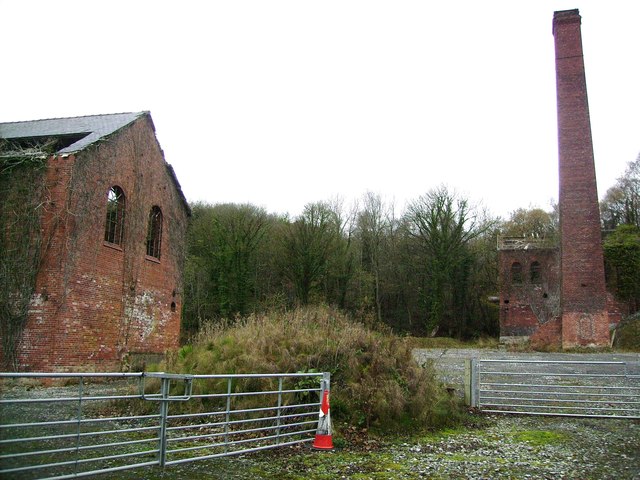
Access at Hendre was by the Olwyn Goch shaft and by the Milwr Tunnel itself, which reached it in 1931 and served as both drain and haulage road. Limestone was quarried underground west of the shaft from 1939 and raised up it from the 1940s. At North Hendre, Taylor's Shaft was wound by a horizontally mounted engine in a two-storey brick engine house built on a sloping site, with tall narrow openings in the rear wall for the winding cables and a boiler stack alongside.
Closure
Lead working at Hendre ended in 1977 when the last of the workable lodes was cleared by a workforce of under forty. Maintenance and tunnel repairs continued for another decade until everything stopped in 1987.
What remains
The engine house at Taylor's Shaft survives at the former North Hendre mine, in woodland on the north side of the A541 east of Hendre Villas: a derelict two-storey brick shell with its slate roof gone but its round-headed windows, king-post roof trusses and concrete engine bed with holding-down bolts still in place, and a very tall brick chimney beside it. Cadw listed it Grade II on 31 January 2002, together with its stack and dressing house, as a rare survival of a once important local industry.
The Grade II listed engine house at Taylor's Shaft, a derelict two-storey brick shell with its concrete engine bed, together with its tall brick chimney and the dressing house, in woodland at North Hendre.
Related mines
- Halkyn Mountain — Hendre is the southern end of the Halkyn orefield and the place its working finally ended.
- Milwr Tunnel — The Milwr Tunnel reached Hendre's Olwyn Goch shaft in 1931 and served it as both drain and haulage road until work stopped in 1987.
- Pen-y-Bryn Mine — Halkyn District United Mines moved its surface operations from Pen-y-Bryn to Hendre in 1934; the two shafts worked the same lodes, Pen-y-Bryn winding ore while Olwyn Goch wound men and materials.
Nearby mines
- Milwr Tunnel — 1.5 miles (2.4 km) NE
- Pen-y-Bryn Mine — 1.8 miles (2.9 km) N
- Bryngwiog Lead Mine — 2.2 miles (3.5 km) NW
- Halkyn Mountain — 2.5 miles (4.1 km) N
- Bailey Hill Colliery — 2.9 miles (4.6 km) SE
Straight-line distance, within 9 miles (15 km). Show on the map.
What's uncertain
Points where sources disagree or the record could not be settled; both accounts are kept. All open questions in the archive.
- Cadw's listing puts the Taylor's Shaft engine house at probably 1896, the date on the adjacent boiler stack. A 2006 field note instead describes it as built during the First World War to revive the lead mines. (disputed) 2,3
Recorded claims
Individual factual claims, each attached to the source(s) that support it below. Where sources disagree, both are kept.
- The old shaft at Hendre was enlarged to 12 ft by 12 ft 6 in and deepened to 470 ft as the Milwr Tunnel approached; the original shaft proved not to be vertical, being eight feet out of true at its bottom. 1
- The Milwr Tunnel reached Olwyn Goch in 1931 and in 1934 the district's surface operations were moved from Pen-y-Bryn to Hendre, where offices, changing rooms, baths and lamp rooms served five hundred men. 1
- Cadw's listing puts the Taylor's Shaft engine house at probably 1896, the date on the adjacent boiler stack. A 2006 field note instead describes it as built during the First World War to revive the lead mines. (disputed) 2,3
- North Hendre worked lead until 1938 and was then mined for high-quality limestone for Pilkington's of St Helens until 1969; at Hendre itself limestone was quarried underground from 1939, and between 1958 and 1964 no lead was mined at all. 1,2
Photographs & further reading
A detailed account of the Milwr Tunnel's progress and of the Olwyn Goch and Pen-y-Bryn shafts, with photographs of the underground locomotives and the winding houses.
View sourceSources
- (secondary) Halkyn Mines: History — Cambrian Mines Trust
- (primary) Taylor's Shaft Engine House, Halkyn — Cadw listed building 26202 — Cadw / British Listed Buildings
- (observational) Engine House at Taylor's Shaft, Hendre Lead Mines — Geograph Britain and Ireland
Record created: 9 September 2026 · Last researched: 9 September 2026