 MineArchive
Hazlerigg Colliery
| Also known as | Hazelrigg Colliery |
|---|---|
| Location | Hazlerigg, Newcastle upon Tyne, Tyne and Wear — 55.0400, -1.6464 (approximate) |
| Commodities | Coal, Fireclay |
| Type | Coal |
| Worked | 1892–1964 |
| Maximum depth | 466 feet (pumping shaft, 1892 sinking log) |
| Operators | Burradon and Coxlodge Coal Company (1892–1929), Hazlerigg and Burradon Coal Co. Ltd (1929–1947), National Coal Board (1947–1964) |
Overview
A Northumberland-coalfield colliery at Hazlerigg, five miles north of Newcastle upon Tyne, sunk from 1892 by the Burradon and Coxlodge Coal Company and worked until 1964. The village of Hazlerigg grew up around it in housing the company built for its miners, and employment peaked at 1,156 people in 1910, 960 of them below ground. Household and steam coal were the main products, with fireclay and shale raised alongside them for much of the colliery's first thirty years. The ground it stood on is now the Havannah and Three Hills Nature Reserve, whose hills are the colliery's spoil heaps and whose ponds are hollows left by subsidence over its own workings.
History
Hazlerigg was sunk from 1892 by the Burradon and Coxlodge Coal Company, which was already working Burradon Colliery two miles to the east. The 1894 List of Mines still records the pit as sinking, with 42 men below ground and 39 above; by 1896 it employed 208, by 1900 it employed 874, and by 1910 it had reached its peak of 1,156. The company built rows of miners' houses beside the pit, and the village of Hazlerigg grew from them — the settlement took the colliery's name rather than the other way about.
Ownership passed in 1929 to the Hazlerigg and Burradon Coal Co. Ltd, registered at Akenside House in Newcastle, which worked Hazlerigg, Burradon and Weetslade together for a combined output of about 600,000 tons a year and counted Sidney Bates and Clive Cookson among its directors. G. E. Young managed Hazlerigg through the 1930s. The colliery passed to the National Coal Board at nationalisation in 1947, when it employed 747 people and raised 205,000 tons.
Little of the colliery's own industrial record has survived into print, but the mines inspectors' accounts of the men killed there give a close view of how it was worked and what it cost. At least 66 men and boys are known by name to have been killed there between 1895 and 1964; falls of stone at the longwall face account for more of them than anything else, and the rest are largely haulage deaths — boys of thirteen and fourteen working the endless rope, run over by tubs at the shaft sidings. In January 1912 two stonemen returned to a rising drift twenty-five minutes after firing four shots of samsonite and were overcome by the fumes, one of them fatally. In the 1921 lockout the Hazlerigg men were out of work for more than nine weeks, drawing benefit of ten shillings from the Northumberland Miners' Association.
Geology
The colliery worked the Coal Measures of the Northumberland coalfield, the northern part of the Great Northern Coalfield. The 1892 sinking log for the pumping shaft records 36 feet of boulder clay, brown clay and sand at the surface, then brown freestone yielding 800 gallons of water an hour, and below that a Coal Measures sequence of sandstones, shales, seatearth clays and coals continuing to 466 feet, where the shaft bottomed shortly after passing the Beaumont Seam at 455 feet 7 inches. Over its working life the colliery took coal from seven named seams — High Main, Main, Yard, Bensham, Beaumont, Low Main (also called the Plessey) and Tilley — the annual returns naming different ones in different decades as the workings moved through the sequence. The seatearth clays between the coals were raised as fireclay in their own right from about 1900.
Geological setting: Sedimentary Beds and Seams (well documented example)
Workings
Coal was worked at the longwall face and run to the shaft on endless-rope haulage, the tubs detached by hand at the shaft sidings; the inspectors' accounts describe men kirving at the face, building pack walls behind them, and firing shots of gunpowder and samsonite to bring down coal and stone. Fireclay was raised alongside the coal from about 1900 and shale from about 1921, both dropping out of the returns by the later 1920s. By the 1930s the colliery ran on both electric and steam power. The only shaft with a sinking record is the pumping shaft at NZ 227 717, sunk in 1892 from a surface about 250 feet above Ordnance datum and logged to 466 feet; no reliable depth figure is recorded for the winding shafts.
Closure
The Low Main or Plessey seam was abandoned on 5 June 1934 and its plan lodged with the Catalogue of Plans of Abandoned Mines as no. 11,206, under the parishes of East Brunton and Dinnington; the Main seam was discontinued in 1950. The colliery itself closed in 1964, its workforce having fallen to 430. Sources disagree on the date: the Durham Mining Museum gives 25 April 1964 and the Tyne and Wear Historic Environment Record 25 November 1964, and the Guide to the Coalfields still carried Hazlerigg in its 1965 edition. The National Coal Board's compensation file for the colliery, dated 1964, is held at Durham Record Office.
What remains
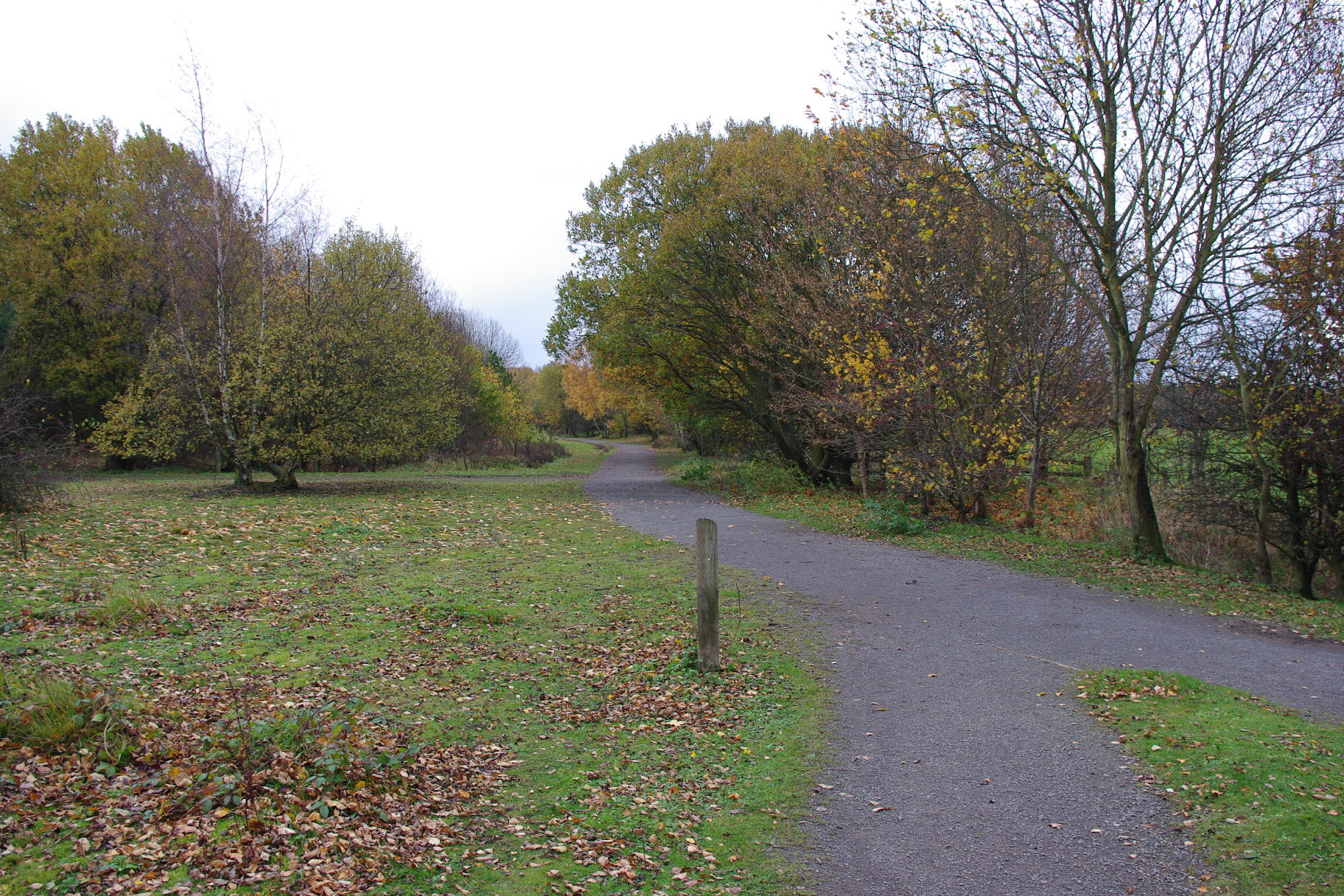
The colliery ground immediately west of the village is now the Havannah and Three Hills Nature Reserve, about 40 hectares of woodland, meadow, scrub, grazed field, marsh and ponds, declared a reserve in 1998, designated a Site of Local Conservation Interest and owned by Newcastle City Council. The council describes the reserve plainly as sited on the former Hazlerigg Colliery, and its name comes from the neighbouring Havannah drift mine and the three slag heaps that still dominate the ground. Much of the landform is the colliery's own, and the wet areas are subsidence hollows over the workings beneath. A Geograph photograph taken on 8 November 2010 shows surfaced paths running between birch and hawthorn scrub across the old site, with no industrial structure in view. The reserve now holds one of only two areas of lowland heath in Newcastle and supports red squirrels, great crested newts and dingy skipper butterflies.
Three spoil heaps, now grassed and wooded, which give the Three Hills reserve its name, and ponds formed by subsidence over the workings. No surviving colliery buildings are recorded.
Redevelopment
The colliery ground was made into a nature reserve in 1998. Housing has since been built directly north of it across Coach Lane, and the Newcastle Great Park development lies to the south and east; the Sage campus adjoins the reserve's southern tip.
Related mines
- Weetslade Colliery — Both were run by the Hazlerigg and Burradon Coal Co. Ltd before nationalisation, and before that by the Burradon and Coxlodge Coal Company.
Nearby mines
- Fawdon Colliery — 1.0 miles (1.6 km) S
- Wideopen Colliery — 1.2 miles (2.0 km) E
- Seaton Burn Colliery — 1.6 miles (2.5 km) NE
- East Walbottle Colliery — 1.8 miles (3.0 km) NW
- Weetslade Colliery — 2.0 miles (3.2 km) E
Straight-line distance, within 9 miles (15 km). Show on the map.
Culture
- Jackie Milburn (Sports)
Milburn worked as a fitter at Hazlerigg Colliery into his first seasons with Newcastle United, underground until ear disease stopped him in 1948.
What's uncertain
Points where sources disagree or the record could not be settled; both accounts are kept. All open questions in the archive.
- The Durham Mining Museum gives the closing date as 25 April 1964. (disputed) 1
- The Tyne and Wear Historic Environment Record gives the closing date as 25 November 1964. (disputed) 2
Recorded claims
Individual factual claims, each attached to the source(s) that support it below. Where sources disagree, both are kept.
- Sunk from 1892 by the Burradon and Coxlodge Coal Company; the 1894 List of Mines still records the colliery as sinking, with 42 men below ground and 39 above. 1,2
- The Durham Mining Museum gives the closing date as 25 April 1964. (disputed) 1
- The Tyne and Wear Historic Environment Record gives the closing date as 25 November 1964. (disputed) 2
- Employment peaked at 1,156 people in 1910, 960 of them below ground; 430 remained in 1964. 1
- Ownership passed to the Hazlerigg and Burradon Coal Co. Ltd in 1929 and to the National Coal Board at nationalisation in 1947. 1,2
- The pumping shaft at NZ 227 717, sunk in 1892 from a surface about 250 feet above Ordnance datum, was logged through 466 feet of strata, passing the Beaumont Seam at 455 feet 7 inches. 3,2
- The Low Main or Plessey seam was abandoned on 5 June 1934; its plan, no. 11,206, is catalogued under the parishes of East Brunton and Dinnington. 4
- The Durham Mining Museum's list of men killed at the colliery runs to 66 names and is explicitly incomplete; no single incident there is recorded as having killed two or more men. 1
- During the 1921 lockout the Hazlerigg men were out of work for more than nine weeks, drawing benefit of ten shillings from the Northumberland Miners' Association. 5
- Newcastle City Council describes Havannah and Three Hills Nature Reserve as sited on the former Hazlerigg Colliery, and names it after the Havannah drift mine and three slag heaps. 6,7
- The BGS mine-plans catalogue holds a Mining Remediation Authority abandonment plan titled 'Hazlerigg' (catalogue NC512, Beaumont, dated 1964). 8
Photographs & further reading
Owners, output, seams worked and year-by-year employment from 1894 to 1965, with the museum's list of 66 men killed at the colliery and the inspectors' accounts of how they died.
View sourceThe Historic Environment Record entry for the site, giving the grid reference of the pumping shaft and the ownership sequence from 1892 to closure.
View sourceNewcastle City Council's page for the nature reserve on the colliery site, describing the slag heaps, ponds and wildlife and how to reach it.
View sourceSources
- (primary) Hazlerigg Colliery — Durham Mining Museum
- (primary) Hazlerigg Colliery, HER 4240 — Tyne and Wear Historic Environment Record
- (primary) Account of Strata sunk and bored through in the Pumping Shaft at Hazlerigg Colliery (An Account of the strata of Northumberland & Durham as proved by Borings & Sinkings, Supplement, 1910, sinking no. 2752) — North of England Institute of Mining & Mechanical Engineers, via the Durham Mining Museum
- (primary) Catalogue of Plans of Abandoned Mines for Hazlerigg Colliery (1934 Supplement, plan 11,206) — Coal Authority catalogue, via the Durham Mining Museum
- (secondary) The 1921 Coal Miners Strike: Part One — Northumberland Archives
- (primary) Havannah and Three Hills Nature Reserve — Newcastle City Council
- (observational) Havannah Nature Reserve (photograph, 8 November 2010) — Geograph Britain and Ireland
- (primary) BGS / Mining Remediation Authority mine plans: HAZLERIGG — British Geological Survey / Mining Remediation Authority
Record created: 3 September 2026 · Last researched: 4 September 2026