 MineArchive
Fawdon Colliery
| Location | Fawdon, north-west Newcastle upon Tyne, Tyne and Wear — 55.0263, -1.6550 (approximate) |
|---|---|
| Commodity | Coal |
| Type | Coal |
| Worked | from 1810 |
| Maximum depth | About 48 fathoms (88 m), to the High Main |
| Operators | Newmarch, Sons and Co. (1840–?) |
Overview
A colliery at Fawdon, north-west of Newcastle, sunk from 1810 to the High Main at about 48 fathoms, whose partner Benjamin Thompson built the rope-hauled Fawdon Wagonway to Scotswood in 1818. Owned in the 1840s by Newmarch, Sons and Co., its A, B, E and F pits had gone out of use by the 1890s.
History
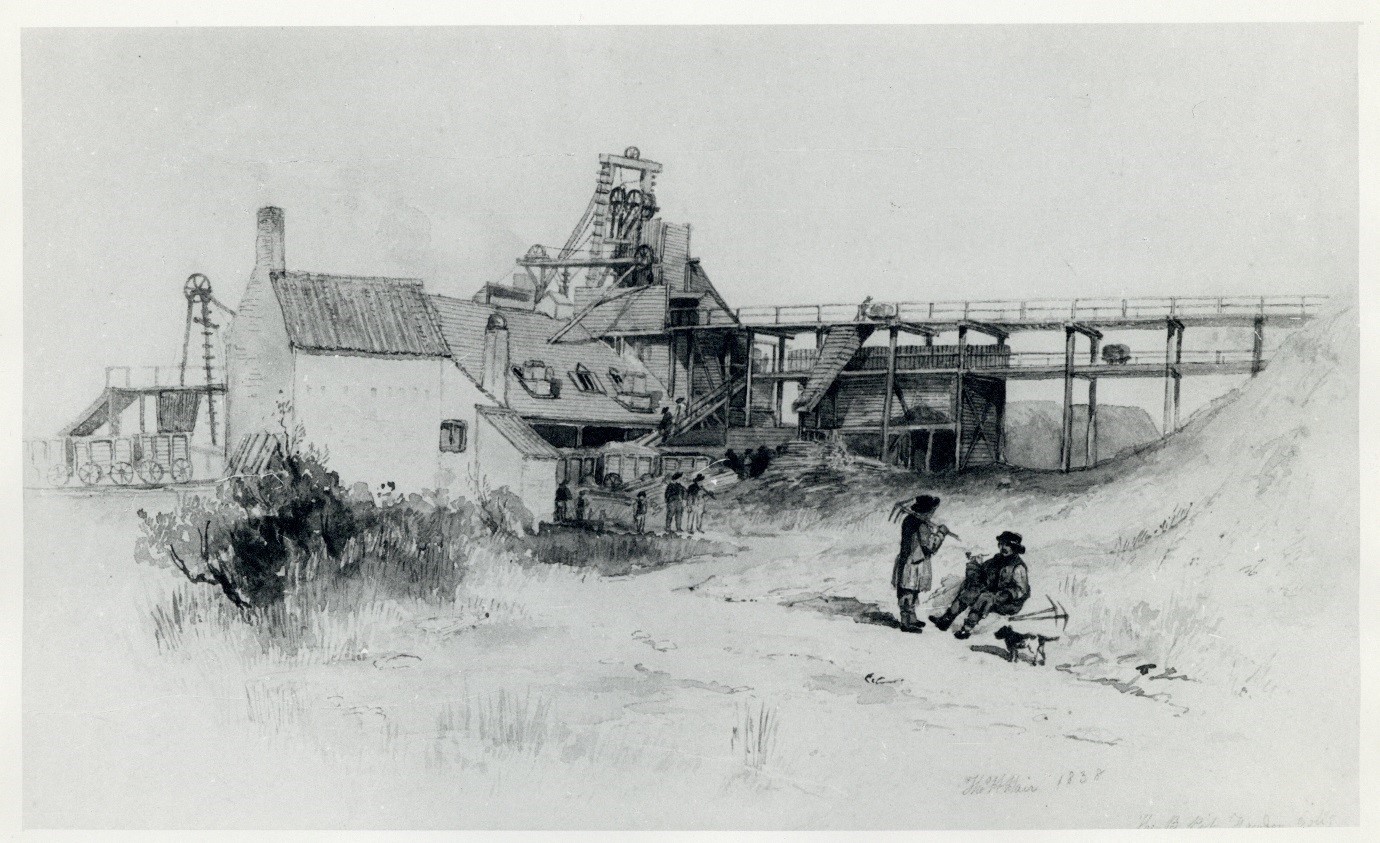
Fawdon Colliery lay in the parish of Gosforth, about three and a half miles north-by-west of Newcastle; High Fawdon, Fawdon Square and Low Fawdon grew up as its pit villages. The ground had been worked before: a plan of Fawdon Colliery in the national catalogue of mine plans is dated 1757. Sinking of the Engine Pit began on 9 March 1810 and the pits were taken to the High Main at about 48 fathoms. The B Pit followed in 1813, the E Pit in 1823 and the F Pit, for draining water, in 1836.
Its coal first went by the Kenton and Coxlodge Waggonway to Wallsend. In 1818 Benjamin Thompson, one of the partners who owned the colliery, built the Fawdon Wagonway on a new route south to Scotswood, worked by inclined planes and a series of stationary steam engines between the Kenton Bank and Hotchpudding planes, with a moving rope that the wagons could grip and release; it was used until 1826, when the Brunton and Shields Wagonway was built to the Tyne at Whitehill Point. An inclined plane worked by a fixed engine linked the colliery to Kenton Bankfoot.
On 5 September 1827 an explosion of gas burnt three young men, two of whom died. Mark Scott, an overman, fell down the shaft in 1836. In the 1840s the colliery belonged to Newmarch, Sons and Co. and worked the High Main, and Thomas Hair drew its B Pit. The B Pit was marked as old on the Ordnance Survey's second edition, out of use by 1895, and a combined plan of the Coxlodge and Fawdon B, Bower and Jubilee workings in the Low Main was abandoned in 1893.
Geology
Northumberland coalfield: the High Main, reached at about 48 fathoms, and the Low Main.
Workings
The Engine Pit (1810), A Pit, B Pit (1813), E Pit (1823) and F Pit (1836, for drainage); the Fawdon Wagonway to Scotswood (1818-1826) and an incline to Kenton Bankfoot.
Closure
The B Pit was out of use by 1895, and a combined Coxlodge and Fawdon plan of the Low Main was abandoned on 10 May 1893.
What remains
Unknown.
Redevelopment
Unknown.
Related mines
- Coxlodge Colliery — Their Coxlodge and Fawdon B, Bower and Jubilee workings in the Low Main share an abandonment plan of 1893.
Nearby mines
- Hazlerigg Colliery — 1.0 miles (1.6 km) N
- Coxlodge Colliery — 1.6 miles (2.6 km) SE
- Wideopen Colliery — 2.0 miles (3.2 km) NE
- East Walbottle Colliery — 2.3 miles (3.7 km) NW
- Gosforth Colliery — 2.4 miles (3.8 km) SE
Straight-line distance, within 9 miles (15 km). Show on the map.
Recorded claims
Individual factual claims, each attached to the source(s) that support it below. Where sources disagree, both are kept.
- Fawdon Colliery and its Engine Pit opened in 1810; the B Pit followed in 1813, the E Pit in 1823 and the F Pit, for draining water, in 1836. 1,2,3
- The Fawdon pits, sunk from 1810, were 48 fathoms deep to the High Main. 4
- In 1818 Benjamin Thompson, a partner in the colliery, built the Fawdon Wagonway to Scotswood, worked by stationary steam engines and a moving rope the wagons could grip and release; it was used until 1826. 5
- On 5 September 1827 an explosion of gas at Fawdon Colliery burnt three young men, two of whom died. 6,2,3
- In the 1840s Fawdon Colliery belonged to Newmarch, Sons and Co. and worked the High Main. 1,2
- The B Pit was marked as old on the second edition Ordnance Survey map and so was out of use by 1895. 2
- A combined Coxlodge and Fawdon B, Bower and Jubilee plan of the Low Main was abandoned on 10 May 1893. 7
Photographs & further reading
The Historic Environment Record entry for the B Pit, with the colliery's pits and owners.
View sourceThe rope-hauled wagonway built in 1818 to carry the colliery's coal to Scotswood.
View sourceSources
- (primary) Fawdon Colliery — Durham Mining Museum
- (secondary) Fawdon Colliery B Pit (HER 4002) — Tyne and Wear HER (Sitelines)
- (secondary) Fawdon Colliery, Engine Pit (HER 4011) — Tyne and Wear HER (Sitelines)
- (secondary) Fawdon, coal pits (HER 13773) — Tyne and Wear HER (Sitelines)
- (secondary) Fawdon Wagonway — Wikipedia
- (primary) Local Records; or, Historical Register of Remarkable Events, vol. 2 (J. Sykes, 1866 edition) — Internet Archive
- (primary) BGS mine plan: Coxlodge / Fawdon 'B' / Bower / Jubilee, Low Main, abandoned 1893 — BGS / Mining Remediation Authority mine plans
Record created: 5 October 2026 · Last researched: 5 October 2026