 MineArchive
Castlenook Mine
| Also known as | Castle Nook Mine |
|---|---|
| Location | Castlenook, head of the Newlands valley, near Little Town, Cumbria — 54.5408, -3.1957 (approximate) |
| Commodity | Lead |
| Type | Metal |
| Worked | 1860–1918 |
| Maximum depth | 10 fathoms (about 18 m) below adit in the shaft |
| Operators | Executors of Andrew Clarke (1860–1864), W. H. Heywood (1917–1918) |
Overview
A small lead mine at Castlenook, near the head of the Newlands valley below Dale Head, worked on the West Castlenook Lode from 1860 to 1864 by the executors of Andrew Clarke, who drove an adit above Newlands Beck, sank a shaft and raised 55 tons of ore with up to eighteen men. A last attempt on the high ground in 1917 was given up within a year, and the mine was last worked in 1918.
History
The mine worked the West Castlenook Lode, which runs for more than a mile along the valley bottom. In 1860 the executors of Andrew Clarke, who had held Yewthwaite and died at the end of 1859, drove an adit level above Newlands Beck, carried it 25 fathoms south on the course of the vein, and sank a shaft 10 fathoms below it, with a level from the shaft foot and the water pumped out by a 16-foot waterwheel. Dressing floors were built and up to eighteen men were employed. Over three years the mine produced 55 tons of ore, valued at about £620, and it closed in 1864. Short trial levels higher up the hill appear to have come to nothing. In 1917 W. H. Heywood showed an interest in the high ground and either extended or began one or more of the high trials, but he abandoned the project within a year, and the mine was last worked in 1918.
Geology
The West Castlenook Lode, carrying galena in a filling of smashed rock with a little quartz, and running for more than a mile along the valley bottom.
Geological setting: Veins and Lodes (well documented example)
Workings
An adit above Newlands Beck driven 25 fathoms south on the vein in 1860, a shaft sunk 10 fathoms below it with a level from its foot, pumped by a 16-foot waterwheel, and dressing floors; higher up the hill, short trial levels, one or more of them extended or begun in 1917.
Closure
The main working closed in 1864, after three years and 55 tons of ore. W. H. Heywood's trials on the high ground from 1917 were abandoned within a year, and the mine was last worked in 1918.
What remains
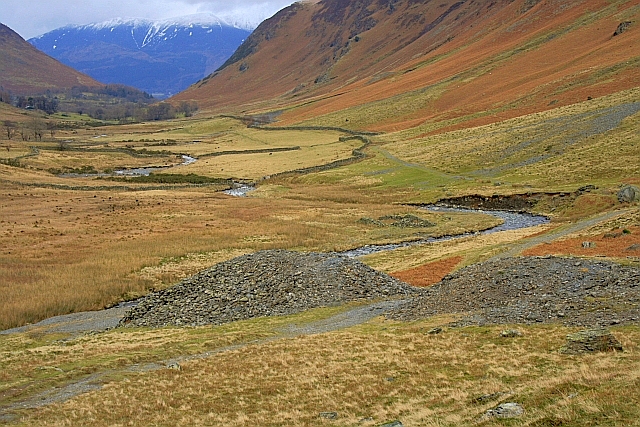
A 2020 survey for the National Trust recorded several spoil heaps, building platforms, two adits and a dressing floor beside Newlands Beck. Photographs from 2008 to 2014 show the grey spoil heaps on the valley floor below the fellside. In 2003 the National Trust steered a proposed water pipeline away from the mine remains and along existing gaps in the bridleway.
Spoil heaps, building platforms, two adits and a dressing floor beside Newlands Beck, with short trial levels higher up the hill.
Redevelopment
None: the remains lie on National Trust land in the Newlands valley.
Related mines
- Long Work Copper Mine — Both taken up by W. H. Heywood at the end of the First World War: Castlenook's high trials in 1917-18, the Long Work from 1919.
- Yewthwaite Mine — Both were worked by the executors of Andrew Clarke after his death in 1859: they opened Castlenook in 1860 and began the Trustees' Level at Yewthwaite.
Nearby mines
- Long Work Copper Mine — 0.6 km S
- Dale Head Copper Mine — 1.2 km SW
- Rigg Head Quarry — 1.9 km SE
- Quay Foot Quarry — 2.4 km E
- Yewthwaite Mine — 2.6 km NE
Straight-line distance, within 15 km. Show on the map.
People
- Andrew Clarke (d. 1859) · proprietor, 1860–1864 — via the operator record Executors of Andrew Clarke
- W. H. Heywood · lessee, 1917–1918 — Took an interest in the high ground in 1917, extending or starting one or more of the high trials, and abandoned the project within a year.
- W. H. Heywood · proprietor, 1917–1918 — via the operator record
Recorded claims
Individual factual claims, each attached to the source(s) that support it below. Where sources disagree, both are kept.
- In 1860 Andrew Clarke's executors drove an adit level above Newlands Beck 25 fathoms south on the vein and sank a shaft 10 fathoms below it, pumped by a 16-foot waterwheel. 1
- Up to 18 men were employed, and 55 tons of ore worth about £620 were produced before the mine closed in 1864. 1,2
- W. H. Heywood took an interest in the high ground in 1917 but abandoned the project within a year; the mine was last worked in 1918. 1,3,2
- The mine worked the West Castlenook Lode, galena in smashed rock and a little quartz. 1,3
- A 2020 survey recorded several spoil heaps, building platforms, two adits and a dressing floor beside Newlands Beck. 1
Photographs & further reading
The working history from 1860 to 1918 and the 2020 survey of the surviving remains.
View sourceSources
- (primary) Castlenook Mine, Newlands Valley, Borrowdale (MNA123722) — National Trust Heritage Records Online
- (observational) Castlenook Lead Mine (photograph, 2010) — Geograph Britain and Ireland
- (secondary) Castlenook Mine, Above Derwent — Old Cumbria Gazetteer
- (observational) Castlenook lead mine (photograph, 2008) — Geograph Britain and Ireland
Record created: 18 September 2026 · Last researched: 18 September 2026