 MineArchive
Yewthwaite Mine
| Also known as | Yewthwaite Lead Mine |
|---|---|
| Location | Newlands valley, below Cat Bells, near Keswick, Cumbria — 54.5614, -3.1768 (approximate) |
| Commodities | Lead, Zinc |
| Type | Metal |
| Worked | 1849–1893 |
| Maximum depth | Thirty fathoms (about 55 m) below adit by 1870 |
| Operators | Clarke, Chapman, Horn and Hart (1849–1859), Yewthwaite and Newlands United Mines Ltd (1883–1893) |
Overview
Yewthwaite worked a lead vein on the western flank of Cat Bells, in the Newlands valley south-west of Keswick. Shallow workings on the back of the vein came first; the deeper ground was reached by two adits, the Low Adit and, from 1863, the Trustees' Level, and by 1870 the mine was thirty fathoms below adit with a steam engine on the shaft. It was overshadowed throughout by Goldscope next door, and after a bankruptcy, three failed flotations and one short attempt on a copper vein it was abandoned in 1893.
History
Unlike most of the Newlands mines, Yewthwaite is not mentioned in the early documents, which suggests it is relatively young. The record begins in 1849, when Messrs Clarke, Chapman, Horn and Hart took the lease of this mine and Goldscope together. They reopened the Low Adit, found nothing of value driving south, drove north instead and struck a good quantity of grey ore, which was dressed on floors near the adit mouth using a sixteen-foot waterwheel. The mine was worked hard until early 1853, when an important lead discovery at Goldscope drew the hands away; by 1854 there were six men underground and the year's production was 35 tons of ore. A legal dispute between two of the partners put the management in the hands of John Taylor junior in 1855, but the court would allow no speculative work and all work ceased in the autumn of 1856. Andrew Clarke, the last partner left, died in 1859, and his executors began a new deep adit which reached the vein in 1863 as the Trustees' Level; driven south, it exposed large quantities of ore, output ran at about 300 tons a year and by 1870 the mine was thirty fathoms below adit. The executors then ran short of money and sold to H. K. Spark and B. Plummer, who put in little effort and were bankrupt by 1876 to the tune of fourteen thousand pounds. Trustees for the creditors worked a little, then the mine closed. In 1883 it was taken up by Yewthwaite and Newlands United Mines Ltd, formed by Henry Vercoe, a mining engineer of Portinscale with interests in the Barrow and Brandlehow mines, and in 1887 the lease was assigned to Joseph Cunliffe, a calico printer. Little was done beyond an 1891 level of eleven fathoms driven to explore the copper vein. Three attempts to float a new company -- the Mid Cumberland Silver-Lead and Blende Mines Company in 1888, the Derwentwater Copper, Lead and Zinc Ore Company in 1891 and the Lakes Mine Company in 1893 -- all failed, and the mine was abandoned in 1893.
Geology
Two veins run through the site. The Yewthwaite lead vein carried nearly all the work: it courses twenty degrees west of north, hades east at about one fathom in 2.3, and is thought to be part of one large vein of which the Thornthwaite and Barrow lodes are others. Its filling was argentiferous galena, cerussite -- grey lead ore -- and blende in a matrix of quartz, sometimes compact but generally friable. Width was usually about eighteen inches and sometimes as much as ten feet, but in many places it nipped out completely, which made the ore distribution sporadic. The second vein is a copper vein, believed to be a continuation of the Goldscope Lode, which was tried but never properly developed; copper pyrite was tested at Little Mine Crag between Knott End and High Crag.
Geological setting: Hydrothermal Deposits (well documented example), Veins and Lodes (well documented example)
Workings
There are numerous shallow workings along the back of the vein where it was first attacked from the surface. The deeper workings were reached by two levels: the Low Adit at about 850 feet above Ordnance datum and the Trustees' Level, the deep adit begun in 1859 and into the vein by 1863, at about 700 feet. By 1870 the mine stood thirty fathoms below adit, with water and ore raised by a steam engine at the top of the engine shaft; its smoke found its way up through the old stopes and out of the Low Adit. The highest working on the site is the Yewthwaite High Adit on Trap Knotts, 350 feet long, with small stopes and a shaft in the floor about eighty feet in from the entrance. The 1891 trial on the copper vein was a level eleven fathoms long with cross-cuts north and south. Two of the mine's own plans survive in the Cumbrian Amenity Trust Historical Mining Society collection held by the BGS: a section of the cross cut to the low adit levels dated 13 June 1870, and a section showing the workings from the adit down to the thirty-fathom level.
Closure
The mine was abandoned in 1893, after the last of three failed attempts to float a new company. An abandonment plan for Yewthwaite is catalogued by the Mining Remediation Authority with an abandonment date of 1877, which matches the earlier stop after H. K. Spark and B. Plummer's bankruptcy rather than the final end of working; the two dates record two different closures of the same mine.
What remains
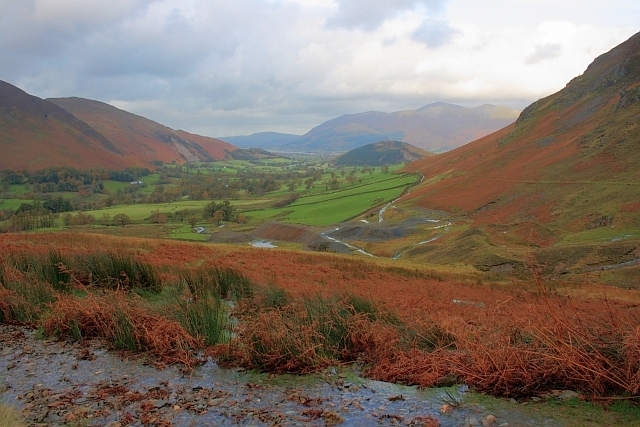
The workings are derelict and the site is on National Trust land inside the English Lake District World Heritage Site, within the National Park and an Environmentally Sensitive Area. Spoil heaps remain the most obvious trace, in Yewthwaite Comb between Cat Bells and Maiden Moor and along Yewthwaite Gill. A National Trust monitoring visit in June 2003, with the National Park Authority and the Environment Agency, found the lower spoil heaps being badly eroded by Yewthwaite Beck after an intervention about a decade earlier, with more material being deposited downstream as a result. Northern Archaeological Associates recorded the component parts of the complex separately in a 2020 historic landscape survey of Derwentwater, and photographs from 2008 and 2017 show the spoil and the line of workings still plain on the fellside.
Spoil heaps, the line of shallow workings along the vein back, and the adit and level mouths of the complex, which the National Trust's records list as separate monuments. The line of workings in Yewthwaite Comb culminates in the spoil heap below the level on Trap Knotts, and the dressing ground near the Low Adit mouth, where the sixteen-foot waterwheel stood, lies at the foot of it.
Redevelopment
No redevelopment: the site is National Trust land in the Lake District World Heritage Site, managed and monitored as an archaeological and erosion concern.
Related mines
- Goldscope Mine — Leased together from 1849 by Clarke, Chapman, Horn and Hart, and Yewthwaite's copper vein is believed to be a continuation of the Goldscope Lode; when Goldscope struck lead in 1853 most of Yewthwaite's men transferred to it.
- Thornthwaite Mine — The National Trust's record reads the Yewthwaite Vein as part of one large vein of which the Thornthwaite and Barrow lodes are others -- a shared structure, on that source's own hedge of 'thought to be'.
Nearby mines
- Quay Foot Quarry — 1.9 km SE
- Brandelhow Mine — 2.7 km N
- Goldscope Mine — 2.7 km N
- Rigg Head Quarry — 3.8 km S
- Force Crag Mine — 4.6 km NW
Straight-line distance, within 15 km. Show on the map.
People
- Andrew Clarke (d. 1859) · partner, 1849–1859 — The last of the 1849 partners left in the company; on his death at the end of 1859 the mine's affairs passed to his executors, who began the Trustees' Level.
- Joseph Cunliffe · lessee, from 1887 — A calico printer, assigned the lease in January 1887; an old report described him as very much in the hands of Vercoe and his connections.
- B. Plummer · owner, from 1870 — Bought the mine with H. K. Spark; the pair put in little effort and were bankrupt by 1876 to the tune of fourteen thousand pounds.
- H. K. Spark · owner, from 1870 — Bought the mine from Andrew Clarke's executors with B. Plummer when their money ran out, and was bankrupt by 1876.
- John Taylor junior · manager, 1855–1856 — Put in charge of the mine by the court in 1855 after a dispute between two of the partners; he wanted to work it deeper, but the court would allow no speculative work.
- Henry Vercoe · engineer, from 1883 — Mining engineer of Portinscale who formed Yewthwaite and Newlands United Mines Ltd in 1883; he also had interests in the Barrow and Brandlehow mines.
Recorded claims
Individual factual claims, each attached to the source(s) that support it below. Where sources disagree, both are kept.
- In 1849 Messrs Clarke, Chapman, Horn and Hart acquired the lease of Yewthwaite and Goldscope together, reopened the Low Adit and, after failing in the level south, drove north and found a good quantity of grey ore. 1
- After the Goldscope lead discovery of 1853 drew the workforce away, Yewthwaite was down to six men underground in 1854 and raised just 35 tons of ore that year. 1
- The Trustees' Level reached the vein in 1863 and was driven south into large quantities of ore; output ran at about 300 tons a year and by 1870 the mine was thirty fathoms below adit, water and ore being raised by a steam engine on the engine shaft. 1,2
- The vein filling was argentiferous galena, cerussite and blende in a quartz matrix, usually about eighteen inches wide and sometimes as much as ten feet, but nipping out completely in many places, so the ore was distributed sporadically. 1
- A second, copper vein on the site is believed to be a continuation of the Goldscope Lode; it was tried -- including an eleven-fathom level in 1891 -- but never properly developed. 1
- The mine was abandoned in 1893, after the Mid Cumberland Silver-Lead and Blende Mines Company of 1888, the Derwentwater Copper, Lead and Zinc Ore Company of 1891 and the Lakes Mine Company of 1893 all failed to get it working again. 1,3
- An abandonment plan for Yewthwaite held by the Mining Remediation Authority carries an abandonment date of 1877, recording the stop that followed the owners' bankruptcy rather than the mine's final closure in 1893. 1,4
- A National Trust monitoring visit in June 2003 found the lower spoil heaps being badly eroded by Yewthwaite Beck following an intervention about a decade earlier, increasing the deposition of material downstream. 1
Photographs & further reading
The fullest account of the mine: the two veins, the adits and their levels, the working history from 1849 to 1893 and the National Trust's own monitoring of spoil erosion.
View sourceOne of two mine plans from the Cumbrian Amenity Trust Historical Mining Society collection, showing the workings from the adit down to the thirty-fathom level.
View sourceA recent photograph of the workings and spoil on the fellside below Cat Bells.
View sourceSources
- (primary) Yewthwaite Lead Mine, Derwentwater, Borrowdale (MNA115529) — National Trust Heritage Records Online
- (primary) Mine plan CT362, section of Yewthwaite Mine below the adit level — BGS / Cumbrian Amenity Trust Historical Mining Society mine plans
- (observational) Spoil Heaps, Yewthwaite Lead Mine (photograph, 2008) — Geograph Britain and Ireland
- (primary) Abandonment plan OM15091, YEWTHWAITE (lead ore), abandoned 1877 — BGS / Mining Remediation Authority mine plans catalogue
- (observational) Former mine workings at Yewthwaite Gill (photograph, 2017) — Geograph Britain and Ireland
- (observational) Line of workings in Yewthwaite Combe (photograph, 2008) — Geograph Britain and Ireland
- (primary) Mine plan CT267, YEWTHWAITE MINE: section of cross cut to low adit levels, 13 June 1870 — BGS / Cumbrian Amenity Trust Historical Mining Society mine plans
Record created: 18 September 2026 · Last researched: 18 September 2026