 MineArchive
Long Work Copper Mine
| Also known as | Long Work |
|---|---|
| Location | Upper Newlands valley, below Dale Head, near Little Town, Cumbria — 54.5351, -3.1961 (approximate) |
| Commodity | Copper |
| Type | Metal |
| Worked | c. 1565–1922 |
| Maximum depth | About 70 feet (21 m) below the top of the openworks, at the 1919 level |
| Operators | W. H. Heywood (1919–1922) |
Overview
A small and very old copper mine in the upper Newlands valley below Dale Head: a line of Elizabethan openworks begun about 1565 on the east-west Long Work Vein, extended around 1690, and tried one last time from 1919 by W. H. Heywood, whose new levels found the vein disappointing. He gave up mining in 1922 and the Long Work was abandoned.
History
The earliest working at the Long Work began in about 1565, in the Elizabethan copper boom around Keswick, and later extensions were made around 1690 by Davies and Robinson. The workings are a line of openworks, trenches on the vein, running from near the west bank of Newlands Beck to a little beyond the sheepfold, and the vein yielded malachite and copper pyrite. Little more was done until the 20th century. In 1919 a Mr B. John of Keswick, working for W. H. Heywood, drove a level from close to the west side of Newlands Beck to explore the vein 70 feet below the top of the old trench workings, with an inclined rise of 31 feet connecting it to the trenches through a small drainage hole. The vein there proved disappointing, and an 80-foot cross-cut was driven to test a vein to the south. Heywood's high level also disappointed, and when he withdrew from mining in 1922 the Long Work was abandoned.
Geology
The Long Work Vein runs east-west and carried malachite and copper pyrite.
Geological setting: Veins and Lodes (well documented example)
Workings
A line of openworks along the vein from near Newlands Beck to beyond the sheepfold, now partly flooded; the 1919 level beside the beck, 70 feet below the top of the trenches, with a 31-foot inclined rise into them and an 80-foot cross-cut to the south vein; and a second 20th-century level on higher ground west of the sheepfold. A 2022 visitor recorded a short tunnel of about a hundred yards near Newlands Beck, driven to drain the old openworks behind it.
Closure
Abandoned in 1922, when W. H. Heywood withdrew from mining after his 1919 levels found the vein disappointing.
What remains
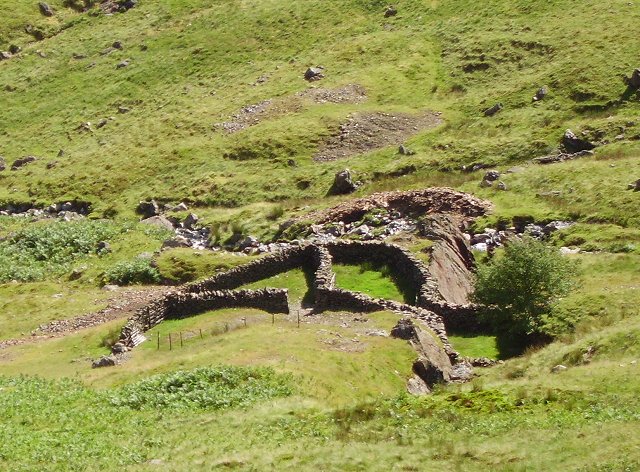
The openworks survive as a line of trenches across the valley floor, partly flooded when photographed in 2022, with spoil beside Newlands Beck and a sheepfold built among the copper mining debris. A 2020 survey for the National Trust recorded the site.
The line of openwork trenches, spoil heaps, the mouths of the 20th-century levels and a sheepfold among the debris.
Redevelopment
None: the site is open fell in the upper Newlands valley.
Related mines
- Castlenook Mine — Both taken up by W. H. Heywood at the end of the First World War: Castlenook's high trials in 1917-18, the Long Work from 1919.
Nearby mines
- Castlenook Mine — 0.6 km N
- Dale Head Copper Mine — 0.7 km SW
- Rigg Head Quarry — 1.4 km SE
- Yew Craggs Quarry — 2.3 km S
- Honister Slate Mine — 2.7 km S
Straight-line distance, within 15 km. Show on the map.
People
- W. H. Heywood · lessee, 1919–1922 — B. John drove the 1919 level for him; he withdrew from mining in 1922 and the Long Work was abandoned.
- W. H. Heywood · proprietor, 1919–1922 — via the operator record
- B. John · contractor, from 1919 — Of Keswick; drove the 1919 level from beside Newlands Beck for W. H. Heywood.
Recorded claims
Individual factual claims, each attached to the source(s) that support it below. Where sources disagree, both are kept.
- The earliest working at the Long Work began about 1565, with later extensions around 1690 by Davies and Robinson. 1
- The Long Work was worked for malachite and pyrite from Elizabethan times. 2,3
- In 1919 B. John of Keswick, working for W. H. Heywood, drove a level near Newlands Beck to explore the vein 70 feet below the old trenches; the vein proved disappointing and an 80-foot cross-cut tested the south vein. 1
- Heywood's high level also disappointed; he withdrew from mining in 1922 and the Long Work was abandoned. 1
- In 2022 part of the Long Work openworks was flooded, and a short tunnel of about 100 yards near Newlands Beck drained them. 2
Photographs & further reading
The vein, the Elizabethan openworks and the 1919-22 levels driven for W. H. Heywood.
View sourceSources
- (primary) Long Work Copper Mine, Derwentwater, Borrowdale (MNA118714) — National Trust Heritage Records Online
- (observational) Mines 14 - Dale Head Copper (Cumbria, Mar, 2022) — 28DaysLater (urbanchemist)
- (secondary) Dale Head — Wikipedia
- (observational) A Newlands fold (photograph) — Geograph Britain and Ireland, via Wikimedia Commons

Record created: 18 September 2026 · Last researched: 18 September 2026