 MineArchive
Camerton Colliery
| Also known as | Camerton Old Pit, Camerton New Pit, Old and New Camerton |
|---|---|
| Location | Camerton, near Radstock, Somerset — 51.3198, -2.4484 (approximate) |
| Commodity | Coal |
| Type | Coal |
| Worked | 1781–1950 |
| Maximum depth | 1,818 ft (554 m) in the New Pit; 921 ft (281 m) in the Old Pit |
| Operators | The Jarrett family of Camerton Court (?–1947), National Coal Board (1947–1950) |
Overview
Two pits a few hundred yards apart in the Cam valley south-west of Bath, worked as one concern and connected underground and by a surface tramway. The Old Pit was leased in November 1781 and reached 921 feet; the New Pit followed by 1800 and went down to 1,818 feet. Camerton belonged to the Jarrett family of Camerton Court, and its coal went out first by road, then by the Somerset Coal Canal, then by the Great Western branch from Hallatrow. Its peak output was 77,000 tons in 1903. On 14 November 1893 an underground explosion killed two men; the cause was a mystery at first and was eventually proved to be shot-firing igniting coal dust in the pit’s atmosphere. The Old Pit stopped winding coal about 1898 and the New Pit survived to be nationalised, closing in 1950.
History
The lease for the first of the two Camerton pits was granted on 13 November 1781, and by 1800 the second or New Pit had been sunk a few hundred yards away. The two shafts were connected underground and by a surface tramway. Coal was delivered by road at first, then by the Somerset Coal Canal, and finally by rail when the Great Western branch from Hallatrow opened. Two tramways carried coal from the pithead: one to the Old Pit, taken up around 1910 and converted into a road, and a second running down to the Meadgate coal depot on an incline worked by an endless-rope haulage engine.
The colliery belonged to the Jarrett family, who built Camerton Court to a design by George Repton in 1838–40 and are recorded as its owners in the mine inspectors’ lists of 1896 and 1908 in the person of Miss E. E. Jarrett. The Misses Jarrett employed a good many men from Peasedown St John, two miles south, and provided the land and much of the capital for that village’s parish church in 1874. Output peaked at 77,000 tons in 1903.
The Old Pit was closed for coal winding about 1898 but kept open as an airway and escape road for the New Pit, until an underground roadway was driven through from Braysdown Colliery in 1928–30 and the old shaft was capped. Underground the New Pit changed remarkably little: to the end of private ownership all the coal was got by hand, and about sixty per cent of it travelled to the shaft bottom in tubs. Conveyors were extended after nationalisation and a new canteen was opened in 1949, but the pit closed in 1950 and the men transferred to other collieries.
Geology
The Somerset coalfield is a difficult one: Variscan earth movements tightly folded, fractured and faulted the sandstone and mudstone strata and the Coal Measures with them, and along the Radstock Slide Fault the broken ends of a single seam can be as much as 1,500 feet apart. The seams are thin and the coal of good grade but expensive to win — Camerton New went down 1,818 feet for it. The field’s other notoriety is coal dust: three underground explosions here, in 1893, 1895 and 1908, were among the first anywhere to be attributed solely to airborne coal dust rather than to firedamp, and the first of them was at Camerton.
Geological setting: Anticlines and Synclines (historical documentary reference), Faults and Fractures (well documented example), Sedimentary Beds and Seams (well documented example)
Workings
Two shafts — the Old Pit seven feet in diameter and 921 feet deep, the New Pit eight feet and 1,818 feet — linked underground and by a surface tramway, so that after 1898 the disused Old Pit served as the New Pit’s second means of escape and its upcast. That arrangement lasted until 1928–30, when a roadway driven through from Braysdown provided the connection instead. Working methods stayed old-fashioned to the end of private ownership: hand-got coal, and tubs to the shaft bottom for most of it, with conveyors coming in only after 1947.
Closure
Camerton New Pit was one of the twelve Somerset collieries taken into the National Coal Board in 1947 and one of the many that did not last long under it: the cost of bringing thin, faulted seams up to modern standards was not recoverable. It closed in 1950 and the men were transferred to other pits. Only five Somerset collieries were left by 1959 and the last closed in 1973.
What remains
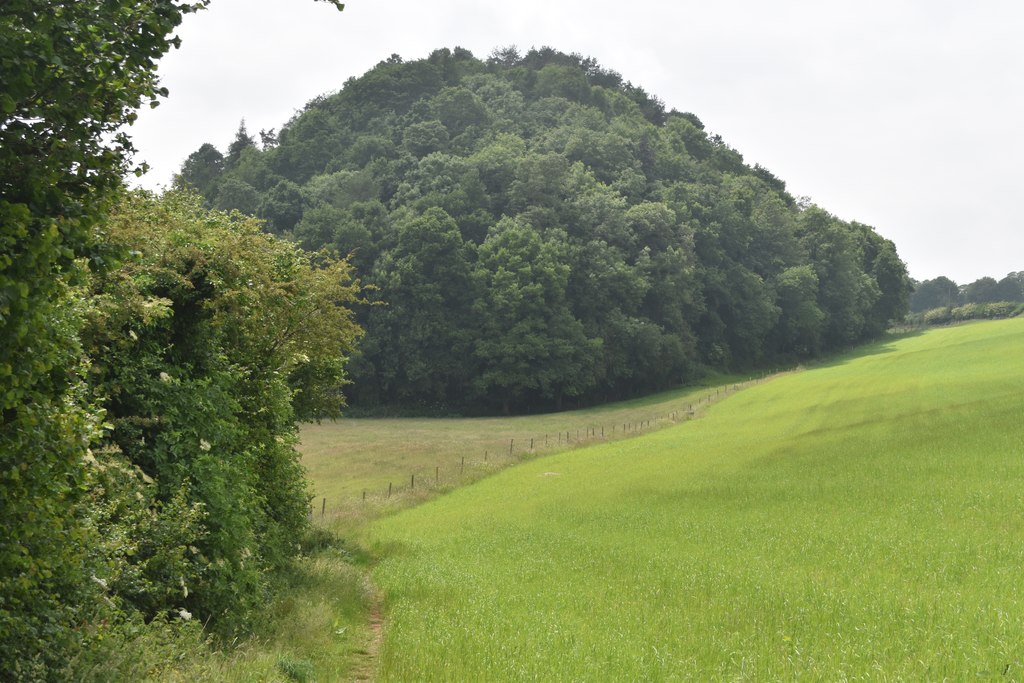
Both shafts are gone and the ground is largely returned to fields and village. What survives is the spoil. Camerton Batch, the older tip, stands almost in the middle of the village and was designated a Local Nature Reserve in 1997; it was bare, like the Paulton batches, until — according to local account — the wife of the owner of Camerton Court paid to have it planted with trees to improve the view from the house. Camerton New Batch, the taller of the two, lies just to the east and was photographed in 2025 still standing well above the surrounding ground.
Camerton Batch and Camerton New Batch, the two colliery spoil tips, the older of them now a Local Nature Reserve; the infilled trackbed of the Great Western Camerton branch, which can be followed through the valley; and Camerton Court, the colliery owners’ house.
Related mines
- Braysdown Colliery — Joined underground in 1928: a roadway driven through from Braysdown replaced the disused Camerton Old Pit shaft as the New Pit’s second means of escape and airway.
Nearby mines
- Conygre Colliery — 1.0 miles (1.6 km) W
- Clandown Colliery — 1.0 miles (1.7 km) SW
- Braysdown Colliery — 1.2 miles (1.9 km) SE
- Old Pit Radstock — 1.9 miles (3.1 km) S
- Dunkerton Colliery — 2.0 miles (3.2 km) NE
Straight-line distance, within 9 miles (15 km). Show on the map.
Disasters & major incidents
-
Camerton Colliery explosion
14 November 1893 · Explosion · 2 fatalities
Two men were killed by an underground explosion at Camerton New Pit. The cause was a mystery at first; it was eventually proved that shot-firing had ignited coal dust suspended in the pit’s atmosphere — one of the first three explosions in Britain attributed to coal dust alone, all of them in the Somerset field.
Recorded claims
Individual factual claims, each attached to the source(s) that support it below. Where sources disagree, both are kept.
- The lease for the first of the two Camerton pits was granted on 13 November 1781 and the second, or New Pit, had been sunk a few hundred yards away by 1800; the two shafts were connected underground and by a surface tramway. 1
- Camerton Old Pit’s shaft was 7 ft in diameter and 921 ft deep; the New Pit’s was 8 ft and 1,818 ft. 2
- The mine inspectors’ lists of 1896 and 1908 record Camerton Old Pit as owned by Miss E. E. Jarrett of Camerton Court, whose family employed many men from Peasedown St John and paid for that village’s church. 2,3
- The maximum amount mined at Camerton was 77,000 tons, in 1903. 3
- The Old Pit was closed for coal winding about 1898 but remained open as an airway and escape route for the New Pit until 1928–30, when an underground roadway was driven through from Braysdown Colliery and the shaft was capped. 2,1
- Underground the pit was almost unchanged since opening: all the coal was got by hand and about 60 per cent of it travelled to the shaft bottom in tubs, with conveyors extended only after nationalisation. 1
- Three underground explosions in the Somerset coalfield — in 1893, 1895 and 1908 — were among the first anywhere to be attributed solely to airborne coal dust; the 1893 one was at Camerton New. 2
- The official list of collieries at work in 1880 returns both pits separately in the Paulton district — "Camerton, Old, Paulton (Bristol), Miss Jarrett" and "Camerton, New, Paulton (Bristol), Miss Jarrett" — confirming the Jarrett ownership of both. The same return separately lists "Camerton, Workington, R. S. Mutch" in Cumberland, an unrelated colliery of the same name. 4
- The BGS mine-plans catalogue holds a Mining Remediation Authority abandonment plan titled 'Camerton' (catalogue SW74, Top/ Little, dated 1950). 5
Photographs & further reading
A short local account of the colliery with an audio track, covering the 1781 lease, the two tramways down to the Old Pit and the Meadgate depot, the 1893 explosion and how its cause was eventually established, and the hand-got working that lasted to nationalisation.
View sourceSources
- (secondary) Camerton — Somer Valley Audio Trails — Somer Valley Audio Trails
- (secondary) Somerset Coalfield — Wikipedia
- (secondary) Camerton, Somerset — Wikishire
- (secondary) List of coal mines UK 1880 — Coalmining History Resource Centre
- (primary) BGS / Mining Remediation Authority mine plans: CAMERTON — British Geological Survey / Mining Remediation Authority
- (observational) Camerton New Batch (photographed 9 June 2025) — David Martin, Geograph Britain and Ireland
- (primary) 1922 Colliery Undertakings — Grace’s Guide to British Industrial History
Record created: 6 September 2026 · Last researched: 6 September 2026