 MineArchive
Barnsley Main Colliery
| Also known as | Barnsley Main Colliery No. 2 Shaft, New Oaks Colliery |
|---|---|
| Location | Hoyle Mill, Stairfoot, Barnsley, South Yorkshire — 53.5528, -1.4511 (exact) |
| Commodity | Coal |
| Type | Coal |
| Worked | 1892–1991 |
| Maximum depth | Unknown. No. 2 Shaft was deepened beyond the Barnsley Main Seam to the Fenton Seam in 1916. |
| Operators | National Coal Board (1947–1987) |
Overview
The last pithead left standing in the Dearne. Barnsley Main grew out of the workings shown on the 1892 map as Rylands Main, took over the neighbouring Oaks Colliery by 1931, and closed and reopened repeatedly until production ended in 1991. Its winding engine house and headstocks, of about 1900 and rebuilt in 1956, were listed in 2013.
History
Barnsley Main No. 2 Shaft appears on the Ordnance Survey map of 1892 with no buildings around it, labelled then as part of Rylands Main Colliery, whose pit head stood immediately to the south. Those workings were developed and renamed Barnsley Main, and the earliest parts of the winding house and shaft-top building are probably among the new buildings shown on the map published in 1906. In 1916 No. 2 Shaft was deepened past the Barnsley Main Seam to reach the Fenton Seam, and machine cutting was introduced at the colliery for the first time.
By 1931 Barnsley Main had expanded again and taken over the Oaks Colliery, whose pit head lay just to the south east and which this archive holds as a record of its own. The Oaks is the site of the explosions of December 1866, the worst mining accident in England, and Barnsley Main's association with it is the reason its last structures now stand protected.
After the Second World War the colliery passed to the National Coal Board, which modernised No. 2 Shaft with new headstocks and an electric winder; a plain datestone on the engine house reads 1956 and is thought to date that work, including the upper floor of the engine house and the top of the shaft-head building. The colliery closed and reopened many times from 1929 until it closed in 1966. In the 1970s No. 2 Shaft was put back to work carrying men, with the coal itself brought to the surface at Barrow Colliery. Barnsley Main ceased production for good in 1991, after which the buildings were cleared and the ground landscaped.
What was kept was No. 2 Shaft with its headstocks and winding engine house, which passed to the local authority and had its openings bricked up against intruders. The Dearne was once covered in structures like this and these are the only ones left, which is why they were listed at Grade II on 4 June 2013.
Geology
The colliery worked the Coal Measures of the South Yorkshire coalfield on the eastern edge of Barnsley. No. 2 Shaft was sunk to the Barnsley Main Seam and deepened in 1916 to reach the Fenton Seam below it.
Geological setting: Sedimentary Beds and Seams (well documented example)
Workings
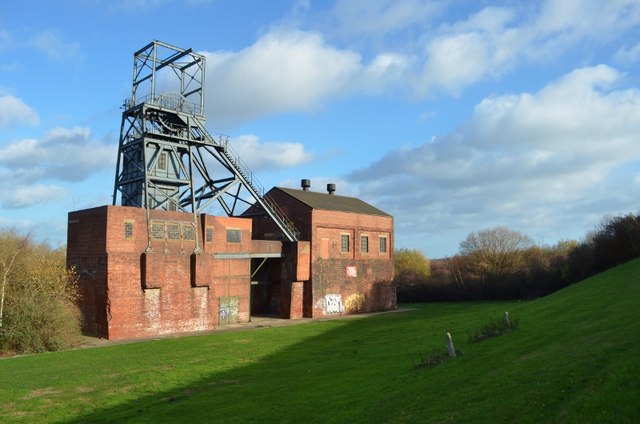
No. 2 Shaft, deepened to the Fenton Seam in 1916 and modernised by the National Coal Board in 1956 with steel headstocks and an electric drum winder. The winding engine house stands three bays by four to the south east of the shaft, detached from the smaller shaft-head building at ground level and linked to it by a bridge at first floor; the headstocks rise from the shaft-head building with their backstays springing from a buttress on the engine house gable. At the head of the shaft, inside the base of the headstocks, is a steel enclosure for a pair of double-deck cages, with two winding wheels above and a third, smaller, emergency wheel.
Closure
The colliery closed and reopened many times from 1929 before closing in 1966. In the 1970s the shaft was reused for man-riding while the coal was wound at Barrow Colliery. Production ceased finally in 1991 and the buildings were cleared.
What remains
Disused and secured, the openings bricked up. The engine house is of brick with a corrugated steel roof, concrete lintels and sills and steel windows close to Crittall's W20 pattern, most keeping their frames and glazing bars, with two steel ventilators on the roof. The interior is not accessible but is reported to keep the electric drum winder, the hydraulics for the braking system, the control cabin and an overhead travelling gantry crane, with at least one control box marked Metropolitan Vickers; the shaft keeps its cages and gates. Rail tracks are still visible in the concrete of the yard.
The winding engine house, the shaft-head building and the steel headstocks of No. 2 Shaft, with their equipment in place, and rail track set in the yard.
Redevelopment
None here: the structures passed to the local authority and are conserved. The Oaks pit head to the south east has been redeveloped as an industrial estate.
Related mines
- Barrow Colliery, Worsbrough — Merged in 1932 into Barrow Barnsley Main Collieries Limited (Wikipedia, Barrow Colliery).
- Monk Bretton Colliery — Both brought together in 1932 as Barrow Barnsley Main Collieries Limited.
- Oaks Colliery — Barnsley Main expanded to take over the neighbouring Oaks Colliery by 1931 — the Oaks record's own closure note has the workings absorbed from 1929 — and the surviving structures here were listed partly for that association with the 1866 disaster.
Nearby mines
- Oaks Colliery — 0.6 miles (0.9 km) S
- Mount Osborne Colliery — 0.6 miles (1.0 km) W
- Mottram Wood Colliery — 0.7 miles (1.2 km) NW
- Darley Main Colliery — 1.5 miles (2.4 km) S
- Wharncliffe Carlton Colliery — 1.6 miles (2.5 km) NW
Straight-line distance, within 9 miles (15 km). Show on the map.
Disasters & major incidents
-
Barnsley Main Colliery explosions, 1942
1942 · Explosion · 13 fatalities
On 16 February 1942 a new trailing cable flashed on B face of Barnsley Main's Fenton seam and fired gas, fatally burning Frederick Wood and starting a fire. The next day, as the district was being sealed off, a far larger explosion killed twelve of the men building the stoppings and injured twenty-eight. -
Barnsley Main Colliery explosion, 1947
1947 · Explosion · 9 fatalities
At 12.15 p.m. on 7 May 1947, four months after nationalisation, firedamp exploded at the top of No. 3 right face in Barnsley Main's Kent's Thick seam and ran the length of the face. Nine men died, most of them from afterdamp; nearly every other man on that side was burned but survived.
What's uncertain
Points where sources disagree or the record could not be settled; both accounts are kept. All open questions in the archive.
- The Dearne heritage account instead says Barnsley Main originated as the Oaks Colliery, sunk west of Oaks Lane at Stairfoot in 1824, whose shafts were infilled after the 1866 explosions and replaced by new shafts at Ardsley opening as the New Oaks Colliery in 1870. (disputed) 2,1
- The Dearne heritage account says a 25 million pound refurbishment reopened the colliery in the 1970s and that the surviving headgear and two-storey brick engine house date from that work; the list entry dates them to about 1900 and 1956 and describes the 1970s use as man-riding, with the coal wound at Barrow Colliery. (disputed) 2,1
- The list entry says 361 miners and 27 rescuers died in the 1866 explosions at the Oaks; the Dearne heritage account gives 383 killed; this archive's own disaster record gives 361 as the official total and states that figure already includes 27 colliery employees and 23 volunteer rescuers. (disputed) 2,1
Recorded claims
Individual factual claims, each attached to the source(s) that support it below. Where sources disagree, both are kept.
- Barnsley Main No. 2 Shaft is shown on the 1892 Ordnance Survey map without buildings, labelled then as part of Rylands Main Colliery whose pit head stood immediately to the south; those workings were developed and renamed Barnsley Main, and the earliest parts of the winding house and shaft-top building are probably among the new buildings shown on the map published in 1906. 1
- The Dearne heritage account instead says Barnsley Main originated as the Oaks Colliery, sunk west of Oaks Lane at Stairfoot in 1824, whose shafts were infilled after the 1866 explosions and replaced by new shafts at Ardsley opening as the New Oaks Colliery in 1870. (disputed) 2,1
- No. 2 Shaft was deepened beyond the Barnsley Main Seam to reach the Fenton Seam in 1916, which saw machine cutting introduced at the colliery for the first time. 1
- By 1931 Barnsley Main Colliery had expanded to take over the Oaks Colliery, whose pit head stood just to the south east and has since been redeveloped as an industrial estate. 1
- The winding engine house, headstocks and shaft-head building are of about 1900, modernised and reconstructed in 1956 for the National Coal Board, with new headstocks and an electric winder and a 1956 datestone on the engine house. 1
- The Dearne heritage account says a 25 million pound refurbishment reopened the colliery in the 1970s and that the surviving headgear and two-storey brick engine house date from that work; the list entry dates them to about 1900 and 1956 and describes the 1970s use as man-riding, with the coal wound at Barrow Colliery. (disputed) 2,1
- The colliery closed and reopened many times from 1929 until closure in 1966; in the 1970s No. 2 Shaft was reused for man-riding with the coal brought to the surface at Barrow Colliery, and Barnsley Main finally ceased production in 1991, after which the buildings were cleared and the ground landscaped. 1
- The engine house and pithead structures were listed at Grade II on 4 June 2013, as list entry 1413541, for the nationally rare survival of an essentially nineteenth-century arrangement of winding shaft structures modernised in the 1950s, for the extensive in situ equipment, and as the last significant standing remains of a colliery associated with the Oaks disaster. 1
- The interior is not accessible but is reported to retain the electrically powered drum winder, the hydraulics for the braking system, the control cabin and an overhead travelling gantry crane, with at least one electrical control box marked Metropolitan Vickers; the shaft retains its cages and gates. 1
- The list entry says 361 miners and 27 rescuers died in the 1866 explosions at the Oaks; the Dearne heritage account gives 383 killed; this archive's own disaster record gives 361 as the official total and states that figure already includes 27 colliery employees and 23 volunteer rescuers. (disputed) 2,1
- Both the Atlas Obscura entry and the 2017 Derelict Places report give the same history as the list entry rather than the Dearne heritage account: structures of about 1900 modernised in 1956, No. 2 Shaft appearing on the 1892 map under Rylands Main, the Oaks taken over by 1931, closure in 1966, man-riding in the 1970s with the coal wound at Barrow Colliery, and final closure in 1991. 3,4
- The Derelict Places report says deep mining has taken place on the colliery site since late Georgian times. 4
- The site is secured to the point of being described as a fortress by an explorer in March 2017, who could not get inside; entry had been possible in 2014 through a squeeze. The brickwork is covered in graffiti and the winding gear stands motionless above its wooded hill. Since then the site has had minor works — debris and overgrowth cleared and several information boards installed. 3,4
- The BGS mine-plans catalogue holds a Mining Remediation Authority abandonment plan titled 'Barnsley Main' (catalogue NE1075, Parkgate, dated 1992). 5
Photographs & further reading
The Grade II listing of 4 June 2013: a full description of the engine house, shaft-head building and headstocks, the history from the 1892 map through the 1916 deepening and the 1956 rebuild to closure in 1991, and the reasons for listing.
View sourceThe heritage project's account, which traces the colliery from the Oaks sinking of 1824 and gives the 1970s refurbishment as the origin of the standing structures.
View sourceA short visitor's entry on the site and the 1866 disaster, with the recent clearance work and information boards.
View sourceAn urban exploration report that could not get inside, with a full history of the shaft and a set of photographs of the standing structures.
View sourceSources
- (primary) Barnsley Main Colliery engine house and pithead structures, list entry 1413541 — Historic England
- (secondary) Barnsley Main: Marking Mining — Discover Dearne
- (observational) Barnsley Main Colliery — Atlas Obscura
- (observational) Barnsley Main colliery, S. Yorks, March 2017 — Derelict Places
- (primary) BGS / Mining Remediation Authority mine plans: BARNSLEY MAIN — British Geological Survey / Mining Remediation Authority
Record created: 9 September 2026 · Last researched: 9 September 2026