 MineArchive
Sanquhar Coalfield
| Location | Sanquhar and Kirkconnel, Nithsdale, Dumfries and Galloway — 55.3681, -3.9251 (approximate) |
|---|---|
| Commodity | Coal |
| Type | Coal |
| Worked | From late 18th century–1968 (closure) |
| Operators | Sanquhar and Kirkconnel Collieries Limited (1903–1947), National Coal Board (1947–1980) |
Overview
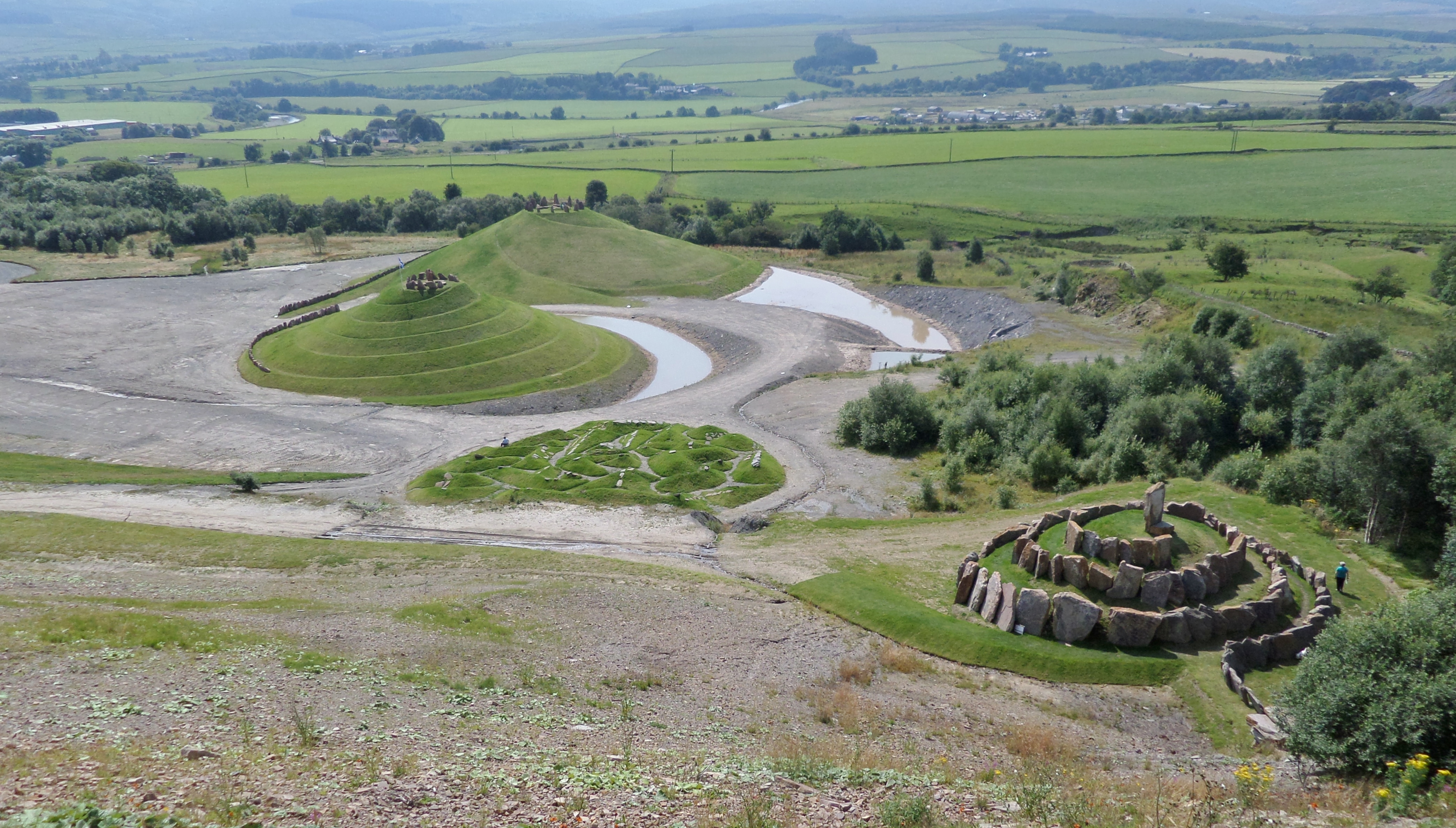
One of Scotland's oldest recorded coalfields, developed by the Duke of Queensberry from the late 18th century and grown by 1903 into the largest privately owned colliery concern in the country, employing over 2,000 miners by 1925. Its last opencast working, at Crawick, closed in 1980 and was later transformed into Charles Jencks's land-art park, Crawick Multiverse.
History
Coal has been worked in the Sanquhar and Kirkconnel area, in upper Nithsdale, since early times, but organised development began in the late 18th century when the Duke of Queensberry began developing the coalfield on his estate; in 1792 Sanquhar Town Council separately set up its own mine to supply the townspeople directly. At this stage the industry was still small — the First Statistical Account of Scotland recorded only 40 miners at Sanquhar and 16 at Kirkconnel. Deep mining began in earnest with the sinking of the first deep pit at Gateside in 1848, followed by Bankend in 1857, New Gateside in 1891 and Fauldhead — eventually the largest pit in the coalfield — in 1896. In 1903 the combined operation was incorporated as the Sanquhar and Kirkconnel Collieries Limited, by then the largest privately owned colliery concern in Scotland; Tower Pit followed in 1916 despite wartime shortages, and by 1925 the coalfield employed over 2,000 miners.
The industry was nationalised after the Second World War, and the National Coal Board developed two new drift mines, Rigg and Roger, in the years that followed. Decline set in through the 1960s: Fauldhead closed in 1968 despite reserves that had been expected to last well into the 21st century. Underground mining gave way to opencast working in the coalfield's final years, and when the last opencast site, at Crawick, closed in 1980, it left the landowner, the Duke of Buccleuch, with a 55-acre scarred void and little obvious use for it. Three decades later the Duke commissioned the landscape artist and cultural theorist Charles Jencks to transform the former opencast void; built between 2011 and 2017, the resulting Crawick Multiverse — standing-stone avenues, a Sun Amphitheatre, sculpted mounds representing the Andromeda galaxy and the Milky Way, and a visitor centre named the Coalface, added in 2022 — became Jencks's largest completed work in Britain and his final land-art project before his death.
Geology
The Sanquhar coalfield forms a discrete basin of Upper Carboniferous Coal Measures within the wider Southern Uplands, structurally isolated from Scotland's larger Central Belt coalfields — a relatively small but workable basin roughly 7 miles long by 2½ miles wide straddling the Sanquhar and Kirkconnel parishes.
Workings
The coalfield was worked by a succession of individual deep pits — Gateside, Bankend, New Gateside, Fauldhead and Tower among them — sunk between 1848 and 1916, followed after nationalisation by the drift mines Rigg and Roger; its final years of production were opencast, culminating in the Crawick site that closed in 1980.
Closure
Fauldhead, the coalfield's largest deep pit, closed in 1968 despite reserves thought capable of lasting into the 21st century; the coalfield's last working, the opencast site at Crawick, closed in 1980.
What remains
The former Crawick opencast site was transformed between 2011 and 2017 into Crawick Multiverse, a 22.5ha land-art park designed by Charles Jencks for the site's owner, the Duke of Buccleuch, and listed on Scotland's Inventory of Gardens and Designed Landscapes; elsewhere across the old coalfield, spoil and pit remains survive in varying states amid farmland and forestry.
Crawick Multiverse — standing-stone avenues, the Sun Amphitheatre, sculpted galaxy mounds and the Coalface visitor centre — occupies the coalfield's most visible former mining ground; scattered pit remains and spoil survive elsewhere across the old coalfield.
Nearby mines
- Fauldhead Colliery — 3.4 miles (5.5 km) NW
- New Glencrieff Mine — 6.1 miles (9.8 km) E
- Wanlockhead — 6.1 miles (9.9 km) E
- Cove Vein Mine — 6.2 miles (10.0 km) E
- Glengonnar — 6.9 miles (11.1 km) NE, South Lanarkshire
Straight-line distance, within 9 miles (15 km). Show on the map.
Culture
- Crawick Multiverse (Art)
The Multiverse occupies the coalfield's Crawick open-cast working, closed in 1980, and is built from material left on that site; Historic Environment Scotland records the involvement of the neighbouring mining communities as central to it.
Recorded claims
Individual factual claims, each attached to the source(s) that support it below. Where sources disagree, both are kept.
- The Duke of Queensberry began developing the coalfield in the late 18th century; Sanquhar Town Council separately established its own mine in 1792, with only around 56 miners recorded across Sanquhar and Kirkconnel at that time. 1
- Deep pits were sunk at Gateside (1848), Bankend (1857), New Gateside (1891), Fauldhead (1896, the coalfield's largest) and Tower (1916); the combined operation, incorporated in 1903 as the Sanquhar and Kirkconnel Collieries Limited, was by then the largest privately owned colliery concern in Scotland, employing over 2,000 miners by 1925. 1,2
- The industry was nationalised after the Second World War, with the National Coal Board developing the Rigg and Roger drift mines; Fauldhead closed in 1968, and the coalfield's last opencast working, at Crawick, closed in 1980. 3,1
- The Duke of Buccleuch commissioned Charles Jencks to transform the former 55-acre Crawick opencast void into Crawick Multiverse, built 2011-2017 and covering 22.5ha — Jencks's largest completed UK land-art work and his final such project. 3
Sources
- (secondary) Opencast Coal Mining, Kirkconnel — Future Museum (Dumfries and Galloway museums service)
- (primary) BGS/Mining Remediation Authority mine plans — Fauldhead/Roger — British Geological Survey / Mining Remediation Authority
- (secondary) When the Coal Mine Ran Out of Coal: Creating Crawick Multiverse — Historic Environment Scotland (blog)
Record created: 26 August 2026 · Last researched: 26 August 2026