 MineArchive
Crawick Multiverse
| Category | Art |
|---|---|
| Dates | Open-cast working closed 1980; Jencks accepted the commission May 2012; constructed 2011-2017; opened 21 June 2015; Jencks died 13 October 2019; The Coalface visitor centre added 2022; inventoried 28 March 2024 |
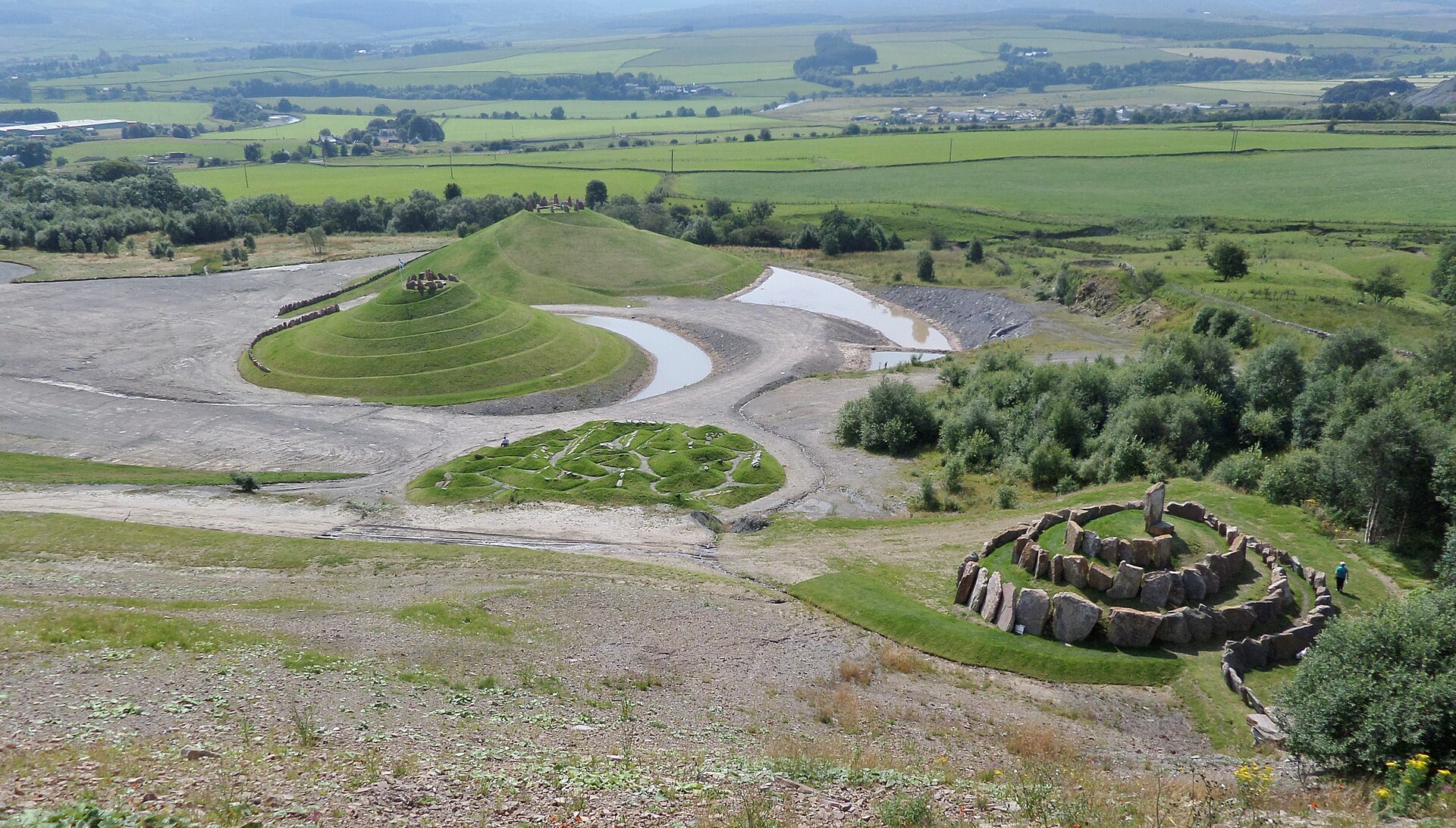
When the open-cast coal working at Crawick near Sanquhar ran out and was left as a fifty-five-acre scar, the Duke of Buccleuch asked his friend the land artist Charles Jencks what could be done with it. The answer was a cosmological landscape of mounds, stone avenues and amphitheatres built out of what the mine had left behind — Jencks's largest completed work in Britain, and his last.
The mining history in this record
The open-cast mine closed in 1980, leaving fifty-five acres of hazardous, unsightly ground on the Queensberry Estate. There was early pressure to put the land back to agriculture, and then a shift of emphasis towards conservation, landscape renewal and recreation. The landowner, the Duke of Buccleuch, turned to Charles Jencks, whose Garden of Cosmic Speculation stood twenty miles away at Portrack.
Historic Environment Scotland records that Jencks accepted the commission in May 2012, with a brief requiring that what was already on the site be reused and allowed to inform the design. Construction ran from 2011 to 2017; initial work was finished in early 2015 and the site opened to the public on 21 June that year. Jencks called the project the greatest pleasure of his life, and said it came of an old friend having a coal site that had run out of coal.
Nine landforms make up the Multiverse, and they are built of stone rather than the turf of Portrack, in the manner of megalithic monuments. The North-South Line is a four-hundred-metre stone avenue flanked by more than three hundred boulders; two mounds carrying stone circles stand for the Milky Way and the Andromeda galaxy; the Sun Amphitheatre sits at the centre and the Belvedere, the highest point, looks out over the Nith valley; the Omphalos signifies the geological and mythical interior of the earth. More than two thousand boulders went into the work in all.
People
Charles Jencks (1939-2019), landscape designer, land artist, architectural historian and theorist of Postmodernism, and a co-founder of the Maggie's Centres, designed it; the Duke of Buccleuch, the landowner, commissioned it and committed a million pounds to the Crawick Artland Trust. The account Historic Environment Scotland published in 2024 summarises work by Patrick Lorimer, a trustee of the Crawick Multiverse Trust, and Rob Close.
Legacy today
Historic Environment Scotland is explicit that the involvement and enjoyment of the mining communities of Kelloholm, Kirkconnel and Sanquhar was critical to the project's success, and describes the Multiverse as ahead of its time as an example of a just transition — a response to the habit of digging holes in the ground for resources and then failing to make good afterwards.
Charles Jencks died on 13 October 2019. Crawick was both his largest completed work in the United Kingdom and his final land art project, covering 22.5 hectares. The Crawick Multiverse Trust runs the site, and added a small visitor centre in 2022; it is called The Coalface. On 28 March 2024 the Multiverse was added to the Inventory of Gardens and Designed Landscapes in Scotland, reference GDL00413, under Historic Environment Scotland's initiative to record designed landscapes of the recent past — recognised, its designation report says, for its ambitious scale and its integrity of visual and conceptual design, and of outstanding artistic and historical interest as early twenty-first-century land art.
Recorded claims
Individual factual claims, each tagged with how solidly it's grounded and attached to the source(s) that support it. Where sources disagree, both are kept.
- The Multiverse was built on the site of an open-cast coal mine near Sanquhar which closed in 1980, leaving fifty-five acres of derelict ground on the Queensberry Estate. It covers 22.5 hectares and is the largest of Jencks's works in Britain. (documented fact)
- Historic Environment Scotland records that Jencks accepted the commission in May 2012 and that construction ran from 2011 to 2017, with initial work complete in early 2015. The Wikipedia article instead dates the project's beginning to 2005, when Jencks was invited to re-imagine the mine. Both accounts agree that it opened to the public in June 2015. (documented fact, disputed)
- The commission required that objects and resources already on the site be reused and help to inform the design. More than two thousand boulders were used, including the more than three hundred flanking the four-hundred-metre North-South Line. (documented fact)
- Historic Environment Scotland records that the involvement and enjoyment of the local mining communities of Kelloholm, Kirkconnel and Sanquhar was critical to the project's success. (documented fact)
- Crawick Multiverse was Charles Jencks's final land art project and his largest completed work in the United Kingdom. He died on 13 October 2019. (documented fact)
- The Multiverse was added to the Inventory of Gardens and Designed Landscapes in Scotland on 28 March 2024 as GDL00413, assessed as of outstanding artistic and historical interest as an example of early twenty-first-century land art. (documented fact)
Mines
- Sanquhar Coalfield — Dumfries and Galloway
The Multiverse occupies the coalfield's Crawick open-cast working, closed in 1980, and is built from material left on that site; Historic Environment Scotland records the involvement of the neighbouring mining communities as central to it.
Sources
- (secondary) Crawick Multiverse — Wikipedia
- (secondary) When the Coal Mine Ran Out of Coal: Creating Crawick Multiverse — Historic Environment Scotland (blog)
Record created: 23 September 2026 · Last researched: 23 September 2026