 MineArchive
Robin Hood Colliery
| Location | Robin Hood, near Rothwell, West Yorkshire — 53.7388, -1.5110 (exact) |
|---|---|
| Commodity | Coal |
| Type | Coal |
| Worked | 1854–1960s |
| Maximum depth | Unknown. |
| Operators | J. & J. Charlesworth (1854–1946), National Coal Board (1946–?) |
Overview
Robin Hood Colliery stood opposite the Halfway House on the Leeds to Wakefield road, in the village that took its name from a spring by the old quarries. It opened in 1854 under J. and J. Charlesworth, who named their pits after the family's daughters and knew this one as Jane Pit. It worked the Beeston, Silkstone and Little seams, and grew from about 400 people in the 1890s to more than 1,100 by 1910. Nationalised in 1946 and closed in the 1960s, its shaft went on ventilating other collieries in the district and the buildings stood derelict until the 1980s. A housing estate covers the site; a brick ventilation shaft beside the recreation ground is the only thing left above ground.
History
Mining had gone on around Robin Hood since the late 1600s, but the pit that mattered opened in 1854 under J. and J. Charlesworth, who worked many of the large collieries between Leeds and Wakefield. Charlesworth named his pits after his daughters, and Robin Hood Colliery was known as Jane Pit. A second shaft, the Bye Pit, was returned alongside it: in 1894 the Bye employed 216 people and the Jane 412, both raising household coal. The Bye ran down through the 1890s to 64 people in 1900 while the Jane grew to 691, and after 1900 the colliery was returned as one, employing 914 in 1905 and 1,141 in 1910 and raising coking, gas and household coal from the Beeston and Silkstone seams, with the Little seam added by 1915. The colliery sat at the centre of a dense network of mineral railways. The East and West Yorkshire Union Railways were built mainly for colliery traffic and linked all the large pits in the district, running from Lofthouse to join the Midland main line beyond Stourton; branches ran off it to Castle Pit, to the Armitage brickworks and to the Robin Hood quarries behind the colliery. Robin Hood's own passenger station opened in 1904 and lasted six months, after which it served excursions and coal traffic only. An explosion at a Charlesworth colliery at Robin Hood on 16 February in either 1836 or 1838 suffocated a boy instantly; the two dates come from different reports of the same incident and it has not been possible to settle which is right.
Geology
Robin Hood worked the Beeston and Silkstone seams of the Yorkshire Coal Measures, adding the Little seam by 1915. The same ground carried building stone: the Robin Hood quarries behind the colliery worked from the late 1800s until the 1950s, with the Armitage brickworks alongside them.
Geological setting: Sedimentary Beds and Seams (well documented example)
Workings
Two shafts, the Jane Pit and the Bye Pit, returned separately until about 1900 and as one colliery afterwards. Output ran to coking, gas and household coal. The site was linked into the East and West Yorkshire Union Railways, a network laid mainly for colliery traffic, with branches to the neighbouring quarries and brickworks.
Closure
The colliery was nationalised in 1946 and closed during the 1960s. Its shaft was kept on as a ventilation shaft for other collieries in the district, and the buildings stood derelict on the site into the 1980s. A large housing estate built in the 1990s now covers the ground.
What remains
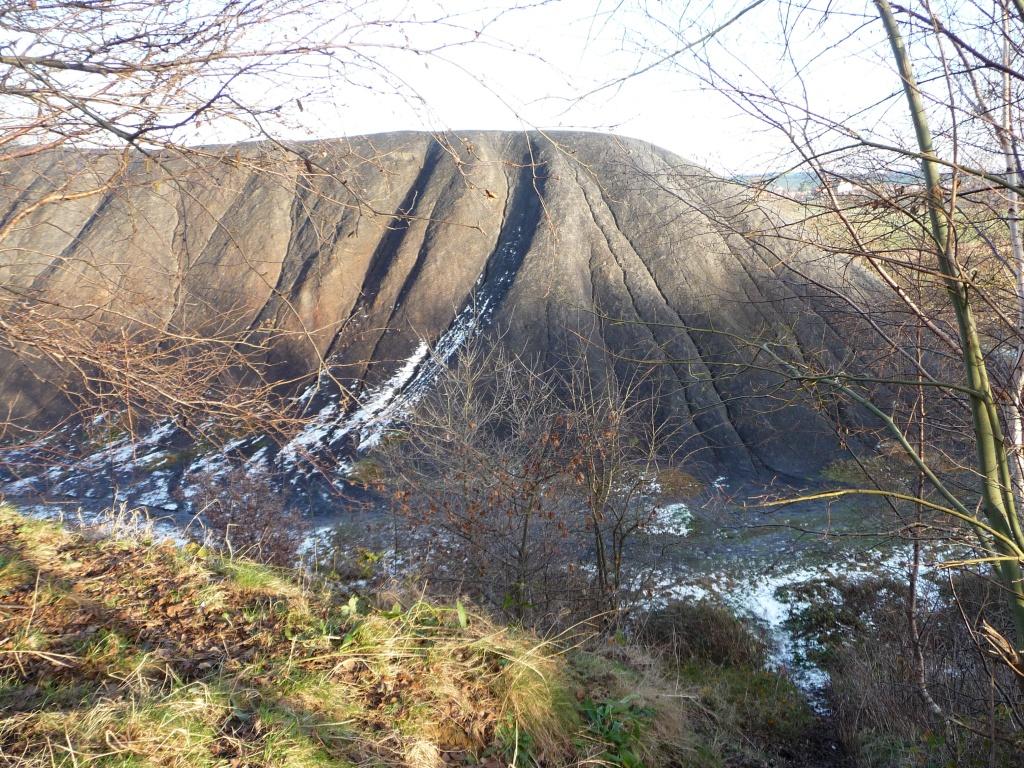
A housing estate of the 1990s covers the colliery. The only relic still above ground is the brick ventilation shaft beside the present Robin Hood recreation ground; the spoil heap survives as a grassed mound nearby, and the railway embankment that carried the colliery line is now part of the Rothwell Greenway.
The brick ventilation shaft beside Robin Hood recreation ground; the spoil heap survives as a grassed mound and the railway embankment is part of the Rothwell Greenway.
Related mines
- Kilnhurst Colliery — Both were worked by J. & J. Charlesworth, the Rothwell firm whose collieries were named after the family's daughters.
- Rothwell Haigh Colliery — Both were J. and J. Charlesworth collieries in the Rothwell district.
Nearby mines
- East Ardsley Colliery — 1.3 miles (2.2 km) SW
- Lofthouse Colliery — 1.6 miles (2.6 km) SE
- Rothwell Haigh Colliery — 2.3 miles (3.6 km) NE
- Water Haigh Colliery — 3.2 miles (5.1 km) E
- Wrenthorpe Colliery — 3.2 miles (5.1 km) S
Straight-line distance, within 9 miles (15 km). Show on the map.
What's uncertain
Points where sources disagree or the record could not be settled; both accounts are kept. All open questions in the archive.
- An explosion at Messrs Charlesworth's Robin Hood colliery in which a boy was instantly suffocated is reported as 16 February 1836 by one account and 16 February 1838 by another. (disputed) 3
- The BGS mine-plans catalogue holds a Mining Remediation Authority abandonment plan titled 'Robin Hood' (catalogue 5283, Yard, dated 1908); the catalogue gives no location and the plan's details do not clearly tie it to this working, so it may belong to another of the same name. (uncertain) 4
Recorded claims
Individual factual claims, each attached to the source(s) that support it below. Where sources disagree, both are kept.
- The mine opened in 1854 and was operated by J. and J. Charlesworth, who named their collieries after the family's daughters; Robin Hood Colliery was known as Jane Pit. 1
- The Jane and Bye pits were returned separately into the 1890s — 412 and 216 people respectively in 1894 — and as a single colliery after 1900, employing 1,141 in 1910. 2
- The colliery worked the Beeston and Silkstone seams, with the Little seam added by 1915. 2
- An explosion at Messrs Charlesworth's Robin Hood colliery in which a boy was instantly suffocated is reported as 16 February 1836 by one account and 16 February 1838 by another. (disputed) 3
- The pit closed in the 1960s after nationalisation in 1946, was used as a ventilation shaft for other collieries in the area, stood derelict until the 1980s, and is now occupied by a large housing estate built in the 1990s. 1
- The BGS mine-plans catalogue holds a Mining Remediation Authority abandonment plan titled 'Robin Hood' (catalogue 5283, Yard, dated 1908); the catalogue gives no location and the plan's details do not clearly tie it to this working, so it may belong to another of the same name. (uncertain) 4
Photographs & further reading
Owners, output, employment and seams for each Lists of Mines year, with the names and circumstances of the people killed at the Jane and Bye pits.
View sourceThe village article, with sections on the colliery, the quarries and brickworks behind it, and the colliery railways of the East and West Yorkshire Union.
View sourceSources
- (secondary) Robin Hood, West Yorkshire — Wikipedia
- (primary) Durham Mining Museum: Robin Hood Colliery — Durham Mining Museum, from the Mines Inspectors Reports and the Lists of Mines
- (secondary) Robin Hood Colliery Explosion, Wakefield, 1836 or 1838 — Northern Mine Research Society (read via a 2021 Wayback Machine capture)
- (primary) BGS / Mining Remediation Authority mine plans: ROBIN HOOD — British Geological Survey / Mining Remediation Authority
- (observational) Spoil heap, Robin Hood (photographed 2014) — Geograph Britain and Ireland, Christine Johnstone
Record created: 10 September 2026 · Last researched: 10 September 2026