 MineArchive
Newstead Colliery
| Location | Newstead, close to Newstead Abbey, Nottinghamshire — 53.0667, -1.2000 (approximate) |
|---|---|
| Commodity | Coal |
| Type | Coal |
| Worked | 1874–19 March 1987 |
| Maximum depth | Unknown. The two shafts were 13 feet in diameter. |
| Operators | Newstead Colliery Co., Ltd. (1874–1947), National Coal Board (1947–1987) |
Overview
A Nottinghamshire colliery begun in 1874, when the Newstead Colliery Company sank two thirteen-foot shafts close to Newstead Abbey, Lord Byron’s old home. A village went up for the miners in 1875 and the first coal came the year after. The pit was a late bloomer: in 1957, at eighty-four years old, it topped the national productivity averages for the first time, and in 1959 its 1,280 men raised more than a million tons in a year — a feat repeated fifteen more times up to 1976. It closed on 19 March 1987 after 113 years.
History
Two shafts of 13 feet diameter were sunk from 1874 by the Newstead Colliery Company close to Newstead Abbey. The old village was built in 1875 to house the miners and their families, and the first coal was produced a year later. Workshops and stores followed in 1880, and in the 1890s electricity was generated to light the pit bottom, the pithead and the screens.
Success brought demand for more men, and the owners built new housing between 1923 and 1925 — better designed, with gardens and a more generous layout. Pithead baths for 1,680 men were added in 1935, and a canteen and medical centre seven years later.
The colliery’s best years came late. In 1957, at eighty-four, it was first recorded topping the national productivity averages; two years later its 1,280 men produced more than a million tons in a year for the first time, and did so on fifteen further occasions up to 1976. Geological conditions then worsened: the Tupton seam was abandoned in 1986 after severe problems on faces and roadways, and when the pit closed all its coal was coming from two faces in the High Hazels.
Geology
The Nottinghamshire coalfield. The Tupton seam was abandoned in 1986 after severe problems on the faces and roadways, leaving production from two faces in the High Hazels seam alone.
Workings
Two shafts of 13 feet diameter sunk from 1874, with workshops and stores from 1880 and electric lighting at the pit bottom, pithead and screens from the 1890s. Pithead baths designed for 1,680 men opened in 1935, with a canteen and medical centre from about 1942.
Closure
Closed on 19 March 1987 after 113 years, following the abandonment of the Tupton seam in 1986 and with production reduced to two faces in the High Hazels.
What remains
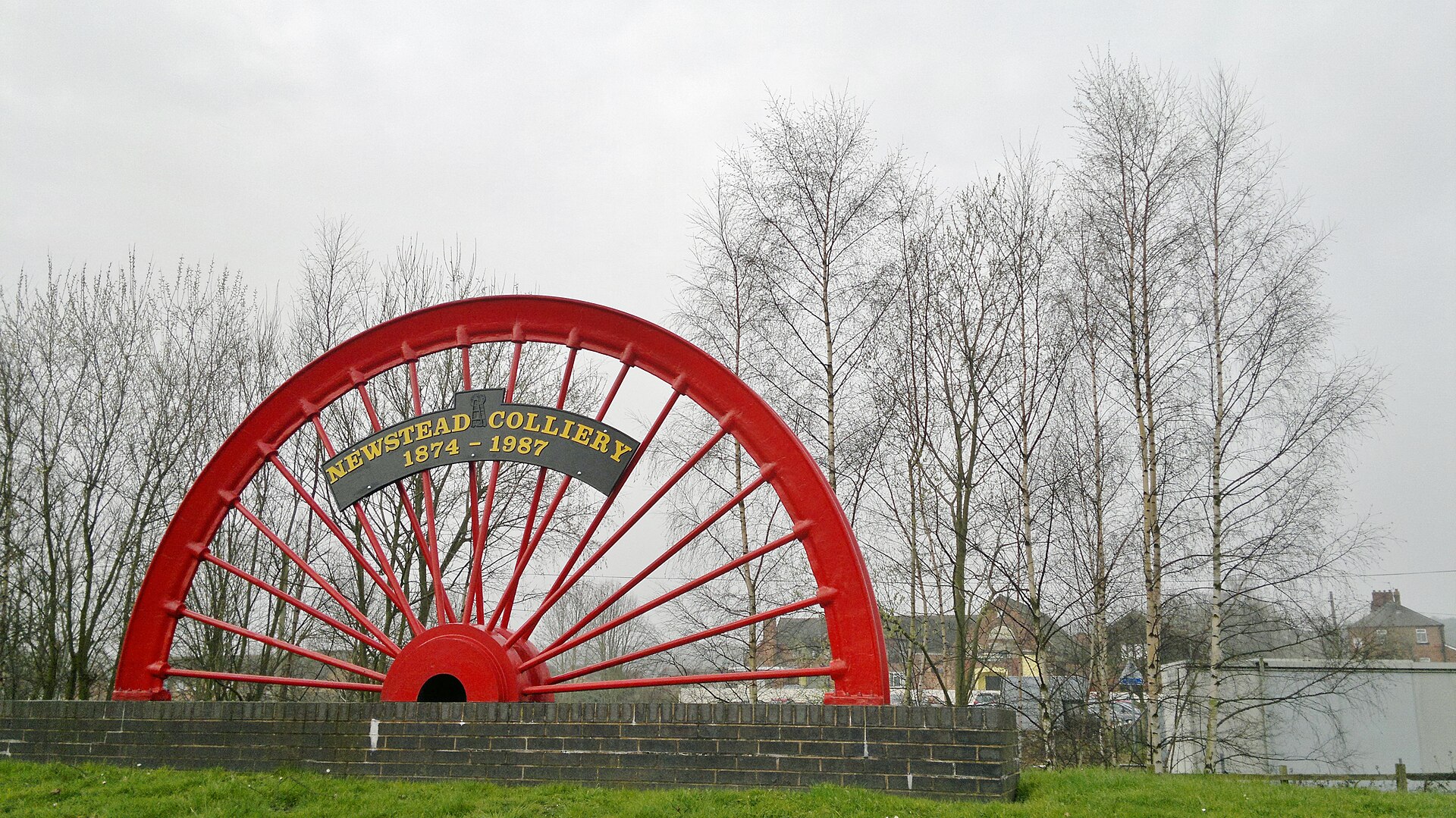
Newstead is now a village without a colliery; the miners’ housing of 1875 and of 1923-25 survives as part of it.
No colliery structure is known to survive.
Nearby mines
- Linby Colliery — 1.2 miles (2.0 km) S
- Annesley Colliery — 1.8 miles (3.0 km) NW
- Hucknall Colliery — 2.0 miles (3.3 km) S
- Bestwood Colliery — 3.3 miles (5.3 km) S
- Watnall Colliery — 3.3 miles (5.4 km) SW
Straight-line distance, within 9 miles (15 km). Show on the map.
Recorded claims
Individual factual claims, each attached to the source(s) that support it below. Where sources disagree, both are kept.
- Two shafts of 13 feet diameter were sunk in 1874 by the Newstead Colliery Company, close to Newstead Abbey. The old village was built in 1875 and the first coal produced a year later. 1
- Workshops and stores were built in 1880, new and better-designed housing with gardens between 1923 and 1925, pithead baths for 1,680 men in 1935, and a canteen and medical centre seven years later. 1
- In 1957, at the age of eighty-four, the pit was first recorded topping national productivity averages. Two years later its 1,280 men produced more than a million tons of coal in a year for the first time — an achievement repeated a further fifteen times up to 1976. 1
- The Tupton seam was abandoned in 1986 after severe problems on faces and roadways, and when the colliery closed on 19 March 1987, after 113 years, all coal production was coming from two faces in the High Hazels seam. 1
Photographs & further reading
The colliery’s own story as recorded by the Nottinghamshire miners’ union memories project, from the 1874 sinking through the productivity records of the 1950s to the 1987 closure.
View sourceSources
- (secondary) A short history of Newstead Colliery — NUM Coal Mining Memories in Nottinghamshire
- (secondary) Newstead — Gedling Heritage
Record created: 8 September 2026 · Last researched: 8 September 2026