 MineArchive
Nant-y-Garw Lead Mine
| Also known as | Nantgarw Mine, Nant y Garw Mine |
|---|---|
| Location | Rhayader, Powys — 52.2321, -3.6502 (exact) |
| Commodity | Lead |
| Type | Metal |
| Worked | 1877 (vein discovered)–1899 |
| Operators | George Green (1877–1886), Builth Lead Mining Co Ltd (1886–1893), Nantgarw Mining Co Ltd (1893–1899) |
Overview
Nant-y-Garw, above Rhayader, was a short-lived but exceptionally well-preserved late-Victorian lead mine — worked for barely sixteen years, but leaving behind one of the most complete single-period lead-mining sites anywhere in Wales.
History
A lead vein was discovered at Nant-y-Garw around 1877, and work began in 1882, with the first ore sold the following year. George Green, a chemist and iron-founder from Aberystwyth who owned the Cambrian Foundry, held the property for a period early on and equipped the mine's dressing mill with his own patent ore-crushing machinery. The Builth Lead Mining Co Ltd bought the mine in 1886 and worked it until 1893, after which the Nantgarw Mining Co Ltd continued operations until 1899, when the mine was finally abandoned. Over its working life the mine produced a recorded 2,177 tons of lead ore concentrate.
Geology
The mine worked a lead-bearing vein within the Cambrian Mountains orefield of mid-Wales, part of the same broad mineralised belt worked at other Ceredigion and Powys lead mines.
Geological setting: Hydrothermal Deposits (well documented example), Veins and Lodes (well documented example)
Workings
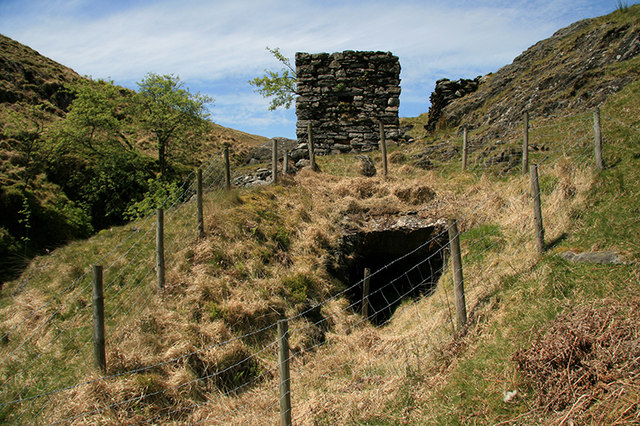
Because the mine was sunk, worked and abandoned within a single sixteen-year period, its surface plant survives largely as a single coherent layout rather than a patchwork of successive rebuilds: a processing mill fitted with George Green's patent crusher, jigger and stone-breaker; a shaft with its original wooden headframe; a water wheel pit and leats bringing in the power supply; an explosives magazine; and an office and smithy. Unusually, the dressing mill was built uphill of the shaft rather than beside or below it, connected by a purpose-built up-haulage incline to bring ore up to be processed.
Closure
The mine was abandoned in 1899 after the Nantgarw Mining Co Ltd gave up working it, its ore body evidently no longer justifying the cost of extraction.
What remains
Nant-y-Garw survives as a Scheduled Monument, described as the well-preserved remains of a single-period mine — among the most complete surviving examples of a late-19th-century Welsh lead mine's above-ground layout.
The mine's water-management, transport and dressing systems, along with its spoil tips, survive together across the site much as they were left in 1899.
Nearby mines
- Cwm Elan Mine — 3.3 miles (5.3 km) NE
- Esgair Mwyn Mine — 9.1 miles (14.7 km) NW, Ceredigion
Straight-line distance, within 9 miles (15 km). Show on the map.
Recorded claims
Individual factual claims, each attached to the source(s) that support it below. Where sources disagree, both are kept.
- Over its working life the mine produced a recorded 2,177 tons of lead ore concentrate. 1
- The Royal Commission's record, at SN 8740 0606, dates the mine 1883-1899 and lists a single shaft with a well-preserved wooden frame at its rim, an adit near the pumping wheelpit, stone-breaker, crusher and jigger platforms, a round buddle west of the shaft, a miners' track blasted out of Craig Rhiwnant, barracks, office and smithy foundations, and a magazine intact but for a failing roof. 2
- George Green (1824-95) of the Cambrian Foundry, Aberystwyth, patented self-acting dressing machinery of crusher rolls, jiggers, buddles and classifiers for water-powered mills, and a Green's mill worked at Nant-y-Garw; three leats supplied the mine, the longest built in 1893 to bring water from Llyn Carw, two kilometres to the west. 1,2
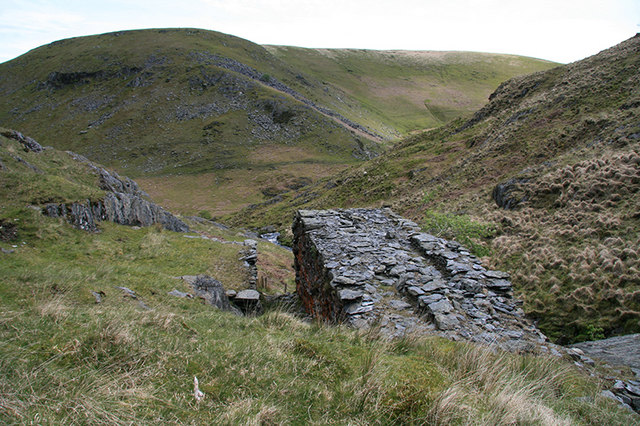
- The massive stone walls of the wheelpit housed the waterwheel that drove the pumps, and possibly the winder, at the engine shaft about 100 metres away, the power passing along flat rods carried on dolly posts whose fixings survive on the rocks beside the stream; the powder house stands well away from the mine, heavy-walled and light-roofed, with traces of its wooden lining. 3
Photographs & further reading
The Royal Commission's record of the mine and its remains.
View sourceSources
- (secondary) Nant Y Garw Mine — Elan Valley Past and Present
- (primary) Nant y Garw Mine, NPRN 277033 (Coflein) — Royal Commission on the Ancient and Historical Monuments of Wales
- (observational) Waterwheel pit, Nant y Garw mine, and companion photographs (Geograph, John Gibson, 2009) — Geograph Britain and Ireland
- (secondary) Nant-y-Garw Lead Mine, Rhayader (Rhaeadr Gwy), Powys — Ancient Monuments
Record created: 22 August 2026 · Last researched: 24 September 2026