 MineArchive
Longhoughton Quarry
| Also known as | Longhoughton Whinstone and Limestone Quarry |
|---|---|
| Location | Longhoughton, near Alnwick, Northumberland — 55.4307, -1.6366 (exact) |
| Commodities | Limestone, Whinstone |
| Type | Quarry |
| Worked | Early 19th century–1974 |
| Maximum depth | An open whinstone quarry; no depth is recorded. |
| Operators | Northumberland Whinstone Company Ltd (1876–1932) |
Overview
Longhoughton Quarry worked whinstone — the hard quartz-dolerite of the Great Whin Sill — about a mile west of the coastal village of Longhoughton and some three miles east-north-east of Alnwick. A small quarry existed early in the nineteenth century, but the first registered company was the Northumberland Whinstone Company Ltd, formed in 1876 and quarrying here by 1887. By 1902 it employed a hundred men, and it supplied setts and crushed whinstone for roads, including six-inch by three-inch setts to Ashington Urban District Council in 1914. The quarry closed in 1974 and has since filled with water. It is a Site of Special Scientific Interest, notified in 1968 over 6.7 hectares, for the way its faces show the Whin Sill baking the sedimentary rocks above it.
History
The Longhoughton ground is geologically unusual in having limestone of the Great Limestone series lying very close to whinstone, and both were worked. A small quarry existed early in the nineteenth century, but the first registered company was the Northumberland Whinstone Company Ltd, formed in 1876, which was quarrying at Longhoughton by 1887 and probably earlier; the second edition Ordnance Survey of the 1890s shows how greatly the quarry had grown. At that stage the product left by road cart under the manager John Lamb. Kelly's Directory of 1902 records the company with a hundred men working under manager Andrew Anderson, and in 1914 it supplied six-inch by three-inch setts, and some crushed whinstone, to Ashington Urban District Council; by 1925 Kelly's gives the manager as David Turnbull and the company was still operating from the quarry in 1932. The tenure is not entirely clear, however: a lease of 1896 between the landowners, the Duke of Northumberland's Alnwick Castle Estate, and H. G. Prowde Ltd covered the 'Longhoughton Whinstone and Limestone Quarry', and a further lease was granted to the same company in 1919 — which may refer to a new quarry opened east of the original. Later whinstone quarrying centred on Ratcheugh Quarry, effectively a westward extension of Longhoughton. The quarry closed in 1974.
Geology
The quarry works the Great Whin Sill, the sheet of quartz-dolerite intruded across Northumberland and Durham and known locally as whinstone. What makes the site nationally notable is the contact: the faces display intrusions of dolerite beneath a stratum of the Great Limestone and show the chilled upper surface of the sill, blocks and rafts of sedimentary rock caught up and baked within the quartz-dolerite, and the delineation of ancient watercourses. It is an excellent exposure of thermal metamorphism — country rock cooked by the molten sheet forced into it — and a vein of calcite formed where the molten whinstone met the limestone.
Geological setting: Faults and Fractures (well documented example)
Workings
An open quarry served by tramways introduced by the Northumberland Whinstone Company, worked at first with horses drawing the wagons. Some crushed stone went away by horse-drawn cart to local road works and some was carted the short distance to Longhoughton station yard: in 1913 that yard loaded 26,249 tons of roadstone and 3,875 tons of building stone onto main line wagons. By the 1940s the tramway wagons were being moved by small four-wheeled petrol locomotives built for the War Department in the First World War, delivering empties to the faces and loaded wagons to a winch that hauled them up to the elevated stone crushers; four-wheeled diesel mechanical locomotives replaced them in the 1940s and early 1950s and worked until about 1963 or 1964, when the whole tramway system was lifted. Two of the locomotives stood derelict at Longhoughton in 1968 and were scrapped in September 1969.
Closure
The quarry closed in 1974. Whinstone quarrying in the area had by then moved west to Ratcheugh Quarry, which is still used intermittently for rail ballast, rock, gravel, sand and construction aggregate.
What remains
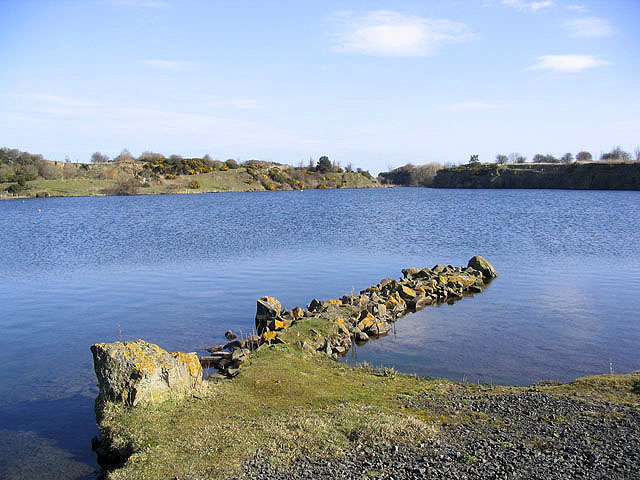
Disused and flooded. The quarry has become a water-filled lake which is a haven for birdlife and is used for angling, and its condition as a Site of Special Scientific Interest was judged favourable in 2009.
The quarry faces around the lake are the surviving feature and are what the SSSI protects: the dolerite beneath the Great Limestone, the chilled upper surface of the sill, the baked rafts of sedimentary rock within the quartz-dolerite, and the calcite vein at the contact. Nothing remains of the tramway, lifted about 1963-64, or of its locomotives, scrapped in 1969.
Nearby mines
- Ratcheugh Quarry — 0.0 miles (0.0 km) S
- Shilbottle Colliery — 4.6 miles (7.4 km) S
- Whittle Colliery — 6.4 miles (10.3 km) SW
- Alnwick Moor Bell Pits — 6.9 miles (11.1 km) SW
- Newton Colliery, Newton-on-the-Moor — 7.0 miles (11.3 km) SW
Straight-line distance, within 9 miles (15 km). Show on the map.
What's uncertain
Points where sources disagree or the record could not be settled; both accounts are kept. All open questions in the archive.
- A lease of 1896 between the Duke of Northumberland's Alnwick Castle Estate and H. G. Prowde Ltd covered the 'Longhoughton Whinstone and Limestone Quarry', with a further lease to the same company in 1919, while the Northumberland Whinstone Company is recorded working here from 1887. The source states that matters are not completely clear and suggests the Prowde leases may refer to a new quarry opened east of the original. (disputed) 1
Recorded claims
Individual factual claims, each attached to the source(s) that support it below. Where sources disagree, both are kept.
- A small quarry existed early in the nineteenth century, but the first registered company was the Northumberland Whinstone Company Ltd, formed in 1876 and quarrying at Longhoughton by 1887. Kelly's Directory of 1902 records a hundred men working under manager Andrew Anderson. 1
- The company is known to have supplied 6 inch by 3 inch setts, plus some crushed whinstone, to Ashington Urban District Council in 1914. 1
- In 1913, 26,249 tons of roadstone and 3,875 tons of building stone were loaded onto main line rail wagons at Longhoughton station yard. 1
- By the 1940s the quarry tramway was worked by small four-wheeled petrol locomotives built for the War Department in the First World War, replaced by four-wheeled diesel mechanical locomotives in the 1940s and early 1950s; these worked until about 1963 or 1964 when the tramway was lifted, and two stood derelict at Longhoughton in 1968 before being scrapped in September 1969. 1
- A lease of 1896 between the Duke of Northumberland's Alnwick Castle Estate and H. G. Prowde Ltd covered the 'Longhoughton Whinstone and Limestone Quarry', with a further lease to the same company in 1919, while the Northumberland Whinstone Company is recorded working here from 1887. The source states that matters are not completely clear and suggests the Prowde leases may refer to a new quarry opened east of the original. (disputed) 1
- The site is a Site of Special Scientific Interest of 6.7 hectares notified in 1968, displaying intrusions of dolerite beneath a Great Limestone stratum, the incorporation of blocks of sedimentary rock, baking of sedimentary rock and the delineation of ancient watercourses; its condition was judged favourable in 2009. 2
Photographs & further reading
The fullest account of the quarry — the companies and managers from 1876, the tonnages loaded at Longhoughton station, and the war-surplus petrol locomotives that worked the tramway until it was lifted in the 1960s.
View sourceSources
- (secondary) Longhoughton's Limestone and Whinstone Tramways — Alnwick & District Local History Society
- (secondary) Longhoughton Quarry — Wikipedia
Record created: 4 September 2026 · Last researched: 4 September 2026